Tag: Film Scores

  • Kurosawa Film Scores on Picture Perfect

    Kurosawa Film Scores on Picture Perfect

    This week on “Picture Perfect,” we’ll have music from three classic historical films by the influential Japanese director Akira Kurosawa.

    “Seven Samurai” (1954) concerns a band of ronin who come together to defend a farmers’ village against invading brigands. The simplicity of that synopsis doesn’t begin to hint at what a marvelous achievement it really is. In fact, “Seven Samurai” is regularly included on lists of the greatest films of all time. It was remade in the United States as “The Magnificent Seven.” And though “The Magnificent Seven” enjoys great popularity, a terrific cast, and an unforgettable film score, it stands only knee-high to the original. The music is by Fumio Hayazaka.

    “Seven Samurai” was Kurosawa’s first, full-out samurai film, but a samurai does feature as one of the characters in his earlier, break-out international hit, “Rashomon” (1950). In this instance, the discovery of a murdered samurai leads to a series of courtroom-style examinations, during which everyone present at the killing gives his or her own account of what transpired – including (through a medium) the murdered man himself! The conflicting testimonies reveal the slippery subjectivity of what we understand as “truth.” The film, the first from Japan to receive wide exposure abroad, had such an impact that the term “Rashomon effect” entered the English language.

    Kurosawa had great respect not only for American movies, but also Western classical music. This led him, on occasion, to request of his composers that they emulate certain well-known pieces. In the case of “Rashomon,” Hayazaka was encouraged, during one of the segments, to channel Ravel’s “Bolero.” “Rashomon” was remade as, among other things, “The Outrage,” a middling western starring Paul Newman.

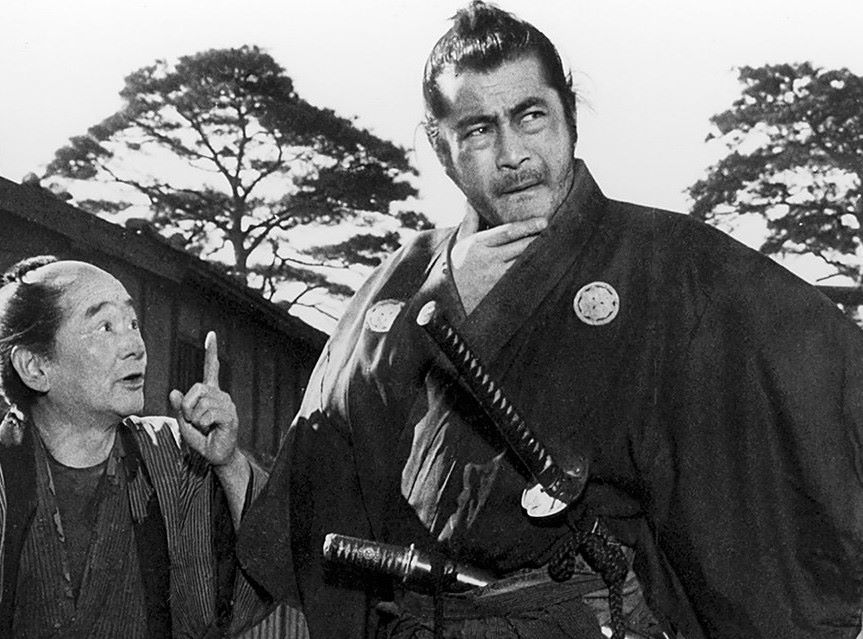
    Masura Sato sought out Hayazaka as a teacher on the merits of his music for “Rashomon.” Following his master’s early death from tuberculosis at the age of 41, Sato stepped in to fill the void as Kurosawa’s composer of choice. Sato would score eight of Kurosawa’s films (his first, a completion of Hayazaka’s score for “Record of a Living Being”). He too could be called upon to conjure the spirit of Western composers, with the ghost of Verdi hovering over “Throne of Blood,” Haydn and Brahms coloring “Red Beard,” and in the case of “Yojimbo” (1961), Franz Liszt lending attitude to masterless samurai Toshiro Mifune, who wanders into a remote town and sets about playing two rival families off one another to his own profit.

    “Yojimbo” provided the basis for the first of Sergio Leone’s spaghetti westerns, “A Fistful of Dollars.” What’s interesting about that is not only Leone’s reliance on the scene-by-scene structure of the plot, but also that its composer, Ennio Morricone, emulated the kind of goofy juxtapositions and unexpected orchestrations used by Sato in the original film. Kurosawa himself was inspired by the western tropes of John Ford movies and the pulp fiction of Dashiell Hammett.

    As a bonus, I will include just a little music from one of my least favorite Kurosawa films (beside “Rhapsody in August”), “Dodes’kaden” (1970). “Dodes’kaden” marked a break with Kurosawa’s classic style. It was his first film shot in color, for one thing – truly lurid Technicolor – and the first made after his break with Mifune (who was brilliant in “Rashomon,” “Seven Samurai” and “Yojimbo,” among others). The title can be translated, roughly, as “clickety-clack,” the sound of an imaginary trolley car in the fantasy world of a mentally-challenged boy who literally lives in a dump. Though it earned an Academy Award nomination for Best Foreign Film, its commercial failure drove Kurosawa into a deep depression and even to attempted suicide.

    For as much as I personally dislike the film, the composer of its soundtrack, Toru Takemitsu is regarded as one of Japan’s most important classical concert composers. Interestingly, like Sato, Takemitsu was a protégé of Kurosawa’s friend and frequent colleague, Fumio Hayazaka.

    I hope you’ll join me for music from Kurosawa classics (and “Dodes’kaden”), this Friday evening at 6:00 EST, on WWFM – The Classical Network and at wwfm.org.

    Tune in early, between 4 and 6:00, for a birthday tribute to Spanish composer Federico Moreno Torroba and Elie Siegmeister’s “Theater Set,” assembled from his film score to “They Came to Cordura” – from which “Picture Perfect” takes its signature music!

  • Oscar Music Special on WWFM

    Oscar Music Special on WWFM

    This week on “Picture Perfect,” join me for a special, two-hour edition, as we anticipate the 89th Academy Awards. We’ll hear selections from the five nominees for Best Original Score (“Jackie,” “La La Land,” “Lion,” “Moonlight,” and “Passengers”), alongside music from established, Oscar-winning classics, like “Lawrence of Arabia,” “The Godfather,” and “Gone with the Wind,” and more recent favorites, like “Titanic,” “The Lord of the Rings,” and “The Hateful Eight.”

    You supply the popcorn. I’ll cue the music, this Friday evening from 6 to 8 p.m. EST, on WWFM – The Classical Network and at wwfm.org.

  • Silk Road Soundtrack Adventure

    Silk Road Soundtrack Adventure

    Put on a comfortable pair of walking shoes. This week on “Picture Perfect,” we travel the Silk Road.

    We’ll have music from “The Adventures of Marco Polo” (1938), with Gary Cooper, of all people, as the medieval merchant-explorer. The score was the first by Hugo Friedhofer (born in San Francisco, despite his über-German name). Freidhofer had labored as an orchestrator for bigger-named composers, such as Erich Wolfgang Korngold and Max Steiner. He would go on to win an Academy Award for his music for “The Best Years of Our Lives.”

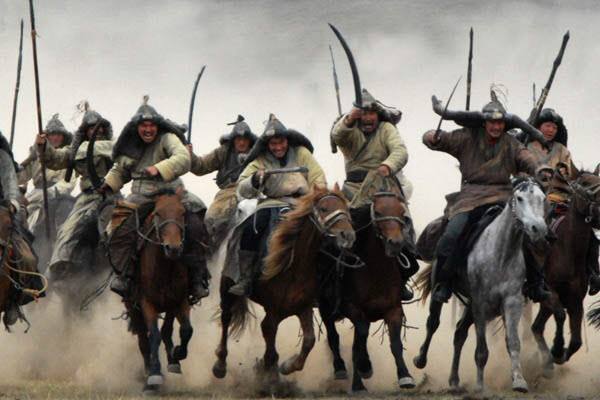
    Then we’ll hear selections from two big screen tellings of the exploits of Genghis Khan. “Genghis Khan” (1965) had quite a multi-national cast, in the best Old Hollywood tradition: Omar Sharif, Stephen Boyd, James Mason, Robert Morley, Francoise Morleac, Telly Savalas, Eli Wallach, Woody Strode, and hordes of extras. The music was by Yugoslavian composer Dusan Radic.

    “Mongol” (2007) was a joint production of Russia, Germany and Kazakhstan, which was actually shot in China. The music was by Finnish composer Tuomas Kantelinen, in the film supplemented with contributions by the Mongolian rock band Altan Urag. (We’ll stick with the orchestral stuff.)

    The score is striking for its use of khöömii throat-singers, female soloists lamenting and ululating over the orchestra, as well as the unique art of “urtiin duu” – traditional Mongolian long-singing. “Mongol” received an Academy Award nomination for Best Foreign Language Film.

    Finally, we’ll have selections from “Crouching Tiger, Hidden Dragon” (2000), with music by Tan Dun. The film was the winner of four Academy Awards, including Best Foreign Language Film and Best Original Score. It was also nominated for Best Picture.

    Yo-Yo Ma performs the cello solos on the soundtrack. One of the tracks is titled “Silk Road.” A couple of years earlier Ma had founded his Silk Road Ensemble.

    I hope you’ll join me for 7000 miles in sensible shoes this week, as we travel the Silk Road, on “Picture Perfect,” this Friday evening at 6:00 EST, on WWFM – The Classical Network and at wwfm.org.

  • Hitchcock Williams & Murderous Movie Music

    Hitchcock Williams & Murderous Movie Music

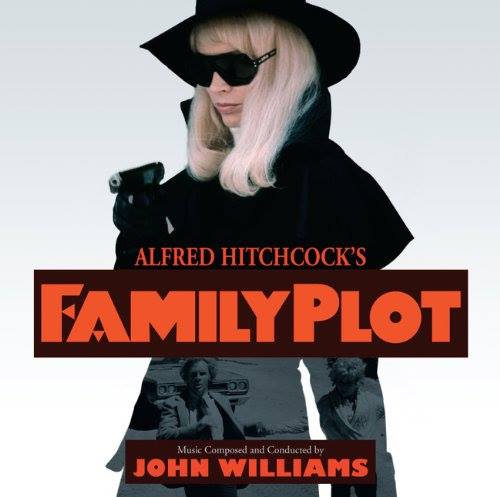
    When trying to convey the tone he was looking for with his latest motion picture, director Alfred Hitchcock stated drolly to the film’s composer, “Mr. Williams, murder can be fun.”

    John Williams was hired to score Hitchcock’s final film, “Family Plot,” in 1976. At the time, he was poised between his breakout success with “Jaws” and “Star Wars,” which would make him a household name. He would be honored for both with Academy Awards for Best Original Score.

    To satisfy Hitch’s hunger for ham on wry, Williams turned to the harpsichord, an instrument that had taken on a certain mischievous quality when applied to mysteries and thrillers.

    This week on “Picture Perfect,” we’ll hear selections from this neglected score from the dawn of Williams’ widespread popularity, alongside Ron Goodwin’s music for “Murder She Said” (the first of Margaret Rutherford’s Miss Marple films), John Addison’s for “Sleuth” (Sir Laurence Olivier and Michael Caine engage in a battle of wits with potentially deadly consequences), and André Previn’s for “Dead Ringer” (a post-“Whatever Happened to Baby Jane” Bette Davis plays contentious twins whose relationship, naturally, leads to murder).

    Join me for an hour of wicked fun with arch harpsichords this week, on “Picture Perfect,” music for the movies, this Friday evening at 6:00 EST, on WWFM – The Classical Network and at wwfm.org.

  • Fantastic 18th Century Adventures

    Fantastic 18th Century Adventures

    The Enlightenment isn’t exactly remembered for its flights of fancy. If the odd novel embraced a fantastic tone, it was frequently in the service of satire, an entertaining means to send-up contemporary mores and pursuits or to poke fun at authority figures and good old reliable human frailty. This week on “Picture Perfect,” we’ll explore a few of these fantastic adventures of the 18th century.

    “The Surprising Adventures of Baron Munchausen” (1785) pokes fun at a real-life German nobleman and veteran of the Russo-Turkish War, one Hieronymus Karl Friedrich, Freiherr von Münchhausen, whose reputation for telling outrageous tall tales was lampooned by Rudolf Erich Raspe. Raspe, fearing a libel suit, published the work anonymously, with the result that it was commonly believed that the Baron had actually dictated the tales himself. Naturally, Munchausen was upset by the unwanted attention. The name “Munchausen” has come down through the centuries to describe feigned illness and pathological lying.

    The book has been adapted to film several times, beginning with a silent version by Georges Méliès, all the way back in 1911. We’ll be hearing music from two subsequent adaptations. The first, titled simply “Münchhausen” (1943), is undeniably entertaining and exceptionally well-made. However, underlying a sense of enjoyment is a kind of unease in the knowledge that the film was a pet project of Joseph Goebbels, who wanted to celebrate the 25th anniversary of the UFA film studio by producing a lavish spectacle worthy to stand toe-to-toe with foreign efforts like “The Wizard of Oz” and “The Thief of Bagdad.”

    Considering the source, one would have to look awfully hard to come up with anything resembling Nazi propaganda. The entire exercise comes across as a pastoral escape from the horrors of totalitarianism, total war and the Final Solution. The elegant music, by Georg Haentzschel, would not be out of place in the concert hall. Haentzschel is regarded as perhaps the last representative of a generation of Middle European light music composers.

    More than 40 years later, director Terry Gilliam undertook another production design-driven adaptation that resembled a series of Doré illustrations brought to life. Contrary to received wisdom, “The Adventures of Baron Munchausen” (1988) managed to pull in a respectable amount of per-screen capital. Ultimately, the film was a casualty of a management turnover at Columbia Pictures, with the new regime eager to bury the projects of the old. Therefore, it was never seen theatrically beyond a very limited release. The score, by Michael Kamen, while in a romantic heroic style, wittily contains abundant allusions to music of the 18th century.

    “The Manuscript Found in Saragossa” (1805) is a transitional work, with its ecstatically lurid opening chapter – replete with gypsy storytellers, highwaymen, dueling skeletons, lesbian vampires and a couple of corpses dangling in a gibbet – dragging the Enlightenment kicking and screaming into the Romantic age. It starts out as a masterpiece of surrealism by way of Gothic convention, with the spell eventually broken, sadly, by a large cold bucket of Enlightenment water in the form of a perfectly rational explanation at the end. But until then, the author, Jan Potocki, gets an A for effort. The interlocking structure, with stories inside stories inside stories looks ahead to postmodern experiments by writers like Italo Calvino and John Barth, to say nothing of Jorge Luis Borges.

    The book was made into an acclaimed Polish film, “The Saragossa Manuscript,” in 1965. Its cult status led to a restoration financed by Jerry Garcia, Martin Scorsese and Francis Ford Coppola that was released on VHS and DVD in 2001.

    Who else could provide the perfect soundtrack to such a hallucinogenic experience but Krzysztof Penderecki? Penderecki intersperses spooky passages with neo-classical and baroque interludes.

    Finally, we’ll have music from one of the many adaptations of Jonathan Swift’s “Gulliver’s Travels” (1726). “The Three Worlds of Gulliver” (1960) simplifies the book’s narrative and dispenses with a great deal of the misanthropic humor in favor of children’s fantasy. You won’t catch Gulliver extinguishing a fire in the Lilliputian Emperor’s palace with his urine in this version. What you will find is a good deal of technical wizardry and a delightful score by Bernard Herrmann.

    I hope you’ll join me for music from fantastic 18th century adventures this week, on “Picture Perfect” – music from the movies – this Friday evening at 6 EST, on WWFM – The Classical Network and at wwfm.org.


    PHOTO: Munchausen hitches a ride on a cannonball

Tag Cloud

Aaron Copland (92) Beethoven (95) Composer (114) Film Music (123) Film Score (143) Film Scores (255) Halloween (94) John Williams (187) KWAX (229) Leonard Bernstein (101) Marlboro Music Festival (125) Movie Music (138) Opera (202) Philadelphia Orchestra (89) Picture Perfect (174) Princeton Symphony Orchestra (106) Radio (87) Ralph Vaughan Williams (85) Ross Amico (244) Roy's Tie-Dye Sci-Fi Corner (290) The Classical Network (101) The Lost Chord (268) Vaughan Williams (103) WPRB (396) WWFM (881)

DON’T MISS A BEAT

Receive a weekly digest every Sunday at noon by signing up here


RECENT POSTS