Tag: Film Scores

  • Jaws Turns 40 Underwater Thriller Film Scores

    Jaws Turns 40 Underwater Thriller Film Scores

    Just when you thought it was safe to go back in the water…

    The film “Jaws” opened on June 20, 1975 – which means we are barreling down on its 40th anniversary. (Personally, I find that concept much more terrifying than anything portrayed onscreen.)

    The blockbuster success of “Jaws” is widely credited with having laid the foundation for the phenomenon which was to become known as the summer movie. This week, we celebrate Steven Spielberg’s game-changer with music from films about underwater threats.

    “Beneath the 12-Mile Reef” (1953) stars Robert Wagner and Peter Graves in a Romeo and Juliet story about two families of competing fishermen along the Gulf coast of Florida, one working class and of Greek origin, and the other a family of privileged WASPs. Gilbert Roland is the Greek patriarch who runs afoul of an improbably large octopus. Bernard Herrmann wrote the music. The complete score, characterized by ample harp glissandi for the underwater sequences, has been reissued on Kritzerland Records in a limited edition of 1000 copies.

    In “The Sharkfighters” (1956), Victor Mature joins Navy scientists in trying to develop a shark repellent (from octopus ink, actually) in order protect downed pilots at sea. The score, by Jerome Moross, employs an expanded percussion section reflective of the film’s Cuban environs.

    A young Henry Mancini was one of three composers to work on “The Creature from the Black Lagoon” (1954). Mancini was teamed with veteran film composer Hans J. Salter and Herman Stein. None of the three are credited on screen – typical of what was considered at the time a low-budget B-movie.

    It all culminates in “Jaws” (1975). What can be said about John Williams’ masterful music? It’s right up there with “Psycho” and “The Good, the Bad and the Ugly” in terms of most recognized and most-frequently parodied. Everyone remembers the primal shark theme, but what is sometimes overlooked is that “Jaws” is also one of the great adventure scores, the music effortlessly navigating the choppy waters of suspense, horror, and seafaring swashbuckler. The composer was recognized with a richly-deserved Academy Award.

    I hope you’ll join me (on the beach) for “Picture Perfect,” music for the movies, this evening at 6 ET, with a repeat tomorrow morning at 6; or that you’ll listen to it later as a webcast at http://www.wwfm.org.

  • Need for Speed Movie Soundtracks Mad Max & More

    Need for Speed Movie Soundtracks Mad Max & More

    This week on “Picture Perfect,” we’ve got the need for speed.

    With Mad Max back in theaters, we’ll have music from the second installment in the series, “The Road Warrior” (1981). Australian composer Brian May wrote the music, as he did for the original. The director, George Miller, specified that he was looking for a gothic, Bernard Herrmann-type mood to underscore his dystopian vision of a post-apocalyptic Australian Outback.

    Maurice Jarre took over to write the music for the third installment, “Mad Max Beyond Thunderdome,” but it’s purely by coincidence that we’ll hear selections from another Jarre score built for speed, “Grand Prix” (1966). The film’s international cast featured James Garner, Eva Marie Saint, Yves Montand, and Toshiro Mifune, but the plot’s assorted relationship and business conflicts take a back seat to driver’s-eye views of lapping the track.

    When we remember Steve McQueen, chances are one of the first images that springs to mind is that of McQueen behind the wheel of his Ford Mustang GT 390 Fastback, tearing up and down the streets of San Francisco in “Bullitt” (1968). The high-octane action sequence became the yardstick against which all big screen car chases were measured (at least until “The French Connection”). Lalo Schifrin provided the jazzy score.

    Finally, Marty McFly and Doc Brown’s time-travelling DeLoreon needs to hit 88 miles per hour in order to get “Back to the Future” (1985). Director Bob Zemeckis had already worked with composer Alan Silvestri on “Romancing the Stone,” but the producer of “Back to the Future,” Steven Spielberg, didn’t care for the music in that film. Zemeckis’ advice to his colleague: go grand and epic, since Spielberg had a marked preference for the music of John Williams. It was a very good choice.

    I hope you’ll join me for an hour of chases and races, this evening at 6 ET, with a repeat tomorrow morning at 6; or that you’ll listen to it later as a webcast, at http://www.wwfm.org.

    Just be sure you’re not driving when you do!

  • Saints on the Silver Screen

    Saints on the Silver Screen

    With Easter and Passover right around the corner, the most obvious course of action would be to program music from Biblical epics, but I’ve already done that in the past. In fact, last year I spread it out over two weeks, with one devoted to the Old Testament and the other to the New. It’s been done. This year, I figured I’d give it a rest (kind of) and instead present music from cinematic treatments of the lives of the saints.

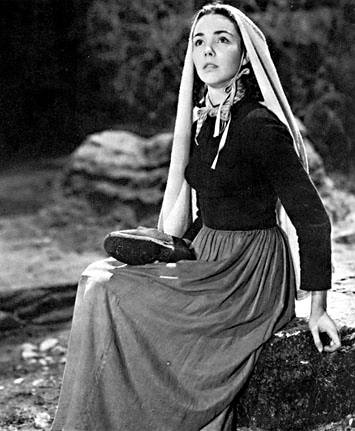
    We’ll hear a suite from “The Song of Bernadette” (1943), one of Jennifer Jones’ finest hours. Jones was honored with an Academy Award for her performance (the film was nominated in 12 categories). Franz Werfel’s novel tells the story of Bernadette Soubirous, a Lourdes peasant prone to visions of the Blessed Virgin Mary.

    Igor Stravinsky made several attempts to break into Hollywood, but he could never keep up with the grinding schedule. He took a crack at scoring the “Apparition of the Virgin” scene, but then thought better of it. The project went to Alfred Newman, who won his third (of nine) Oscars. Stravinsky’s music was recycled in the second movement of his “Symphony in Three Movements.”

    The story of Joan of Arc has been translated to film many times. In the case of “Saint Joan” (1957), Otto Preminger adapted the play by George Bernard Shaw. Newcomer Jean Seberg was cast in the title role. Her inexperience brought her in for a sound critical drubbing. Even an old hand like screenwriter Graham Greene was not immune to critical barbs for the liberties he took in reworking Shaw’s play. Despite all that, the score, by Russian-born English composer Mischa Spoliansky, is lovely.

    By contrast, the film of “A Man for All Seasons” (1966), after the play of Robert Bolt, was lavishly praised, especially Paul Scofield’s performance as Sir Thomas More (for which he received an Academy Award for Best Actor). The film won six Academy Awards in all, including that for Best Picture. The period-inflected score is by Georges Delerue.

    It’s sobering to look back and realize that such an intelligent, dramatic film could become such a popular success. “A Man for All Seasons” was the fifth highest-grossing film of 1966. The fifth highest-grossing film of 2014 was “The Hunger Games: Mockingjay – Part 1.”

    I guess it’s impossible to get through Easter without some Biblical bombast, so why not go all out with “Quo Vadis” (1951)? Henryk Sienkiewicz’s international bestseller incorporates into its narrative Saints Peter and Paul, but the really interesting characters are the cynical Petronius, who knows how to throw a party, and the quite mad Nero, who plays the lyre even as Rome burns.

    Miklós Rózsa’s score has been much-lauded for its attempt at historical authenticity (the incorporation of contemporaneous Greek, Hebrew and Sicilian melodies), though its popularity has been eclipsed, somewhat, by that of his work on “Ben-Hur” and “King of Kings.” “Quo Vadis” is really the film in which Rózsa lays out the blueprint for a decade or more of big screen piety. Bernard Herrmann called it “the score of a lifetime.”

    I hope you’ll join me for music from movies depicting the saints this week, on “Picture Perfect,” this Friday evening at 6, with a repeat Saturday morning at 6; or that you’ll listen to it later as a webcast at http://www.wwfm.org.

    PHOTO: Jennifer Jones and the Lourdes’ prayer

  • Silk Road Soundtrack Adventure

    Silk Road Soundtrack Adventure

    Put on a comfortable pair of walking shoes. This week on “Picture Perfect,” we travel the Silk Road.

    We’ll have music from “The Adventures of Marco Polo” (1938), with Gary Cooper of all people as the medieval mechant-explorer. The score was the first by Hugo Friedhofer (born in San Francisco, despite his über-German name). Freidhofer had labored as an orchestrator for bigger-named composers, such as Erich Wolfgang Korngold and Max Steiner. He would go on to win an Academy Award for his music for “The Best Years of Our Lives.”

    Then we’ll hear selections from two big screen tellings of the exploits of Genghis Khan. “Genghis Khan” (1965) had quite a multi-national cast, in the best Old Hollywood tradition: Omar Sharif, Stephen Boyd, James Mason, Robert Morley, Francoise Morleac, Telly Savalas, Eli Wallach, Woody Strode, and hordes of extras. The music was by Yugoslavian composer Dusan Radic.

    “Mongol” (2007) was a joint production of Russia, Germany and Kazakhstan, which was actually shot in China. The music was by Finnish composer Tuomas Kantelinen, in the film supplemented with contributions by the Mongolian rock band Altan Urag. (We’ll stick with the orchestral stuff.)

    The score is striking for its use of khöömii throat-singers, female soloists lamenting and ululating over the orchestra, as well as the unique art of “urtiin duu” – traditional Mongolian long-singing. “Mongol” received an Academy Award nomination for Best Foreign Language Film.

    Finally, we’ll have selections from “Crouching Tiger, Hidden Dragon” (2000), with music by Tan Dun. The film was the winner of four Academy Awards, including Best Foreign Language Film and Best Original Score. It was also nominated for Best Picture.

    Yo-Yo Ma performs the cello solos on the soundtrack. One of the tracks is titled “Silk Road.” A couple of years earlier Ma had founded his Silk Road Ensemble.

    I hope you’ll join me for 7000 miles in sensible shoes this week, as we travel the Silk Road, on “Picture Perfect,” this Friday evening at 6 ET, with a repeat Saturday morning at 6, or that you’ll listen to it later as a webcast at http://www.wwfm.org.
  • Alexandre Desplat Finally Wins Oscar

    Alexandre Desplat Finally Wins Oscar

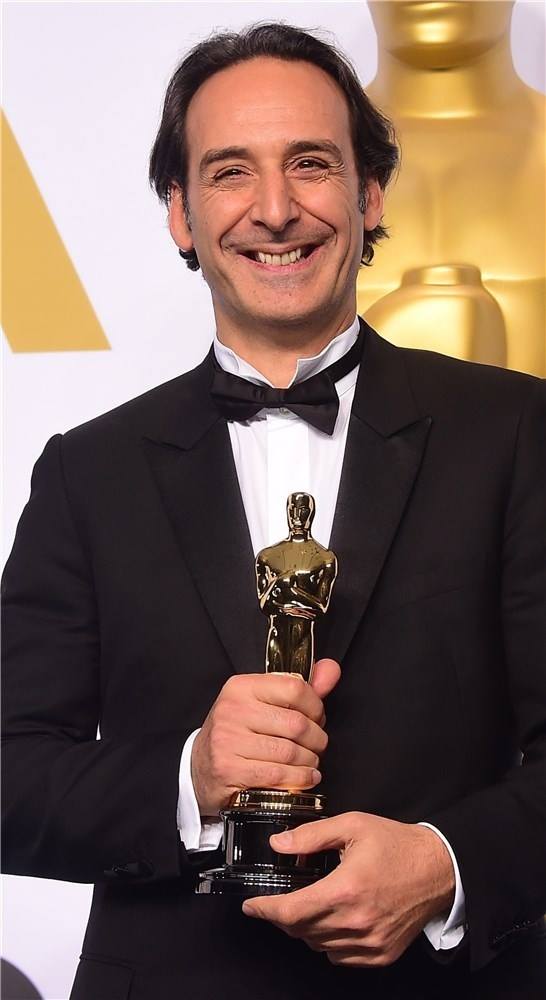
    Film composer Alexandre Desplat finally picked up an Oscar last night, after his seventh and eighth nominations, for “The Imitation Game” and “The Grand Budapest Hotel.” He was recognized for his quirky, disjointed and fun score for the latter, which is distinguished by its use of folk instruments such as the balalaika, mandolin and alphorn.

    Of course, I can’t help but feel he coasted to victory on the coattails of the classic Mercury Living Presence recording of “Kamarinskaya,” made by the Osipov State Russian Folk Orchestra, which is used during film’s end credits. It was quoted on at least one occasion last night when an award recipient approached the stage.

    Still, there’s no denying Desplat worked very hard this past year, having written the scores for six films, including “The Monuments Men,” “Godzilla,” “Unbroken” and “Suffragette.” I had an inkling that he was going to win, but wondered if the double nomination would split the vote.

    I can’t say I was all that impressed with most of the nominees, though Gary Yershon’s score for “Mr. Turner” does kind of stick with me, in a desolate, artsy kind of way. At any rate, any year that Hans Zimmer loses is a good year.

    Congratulations, Alexandre Desplat.

    Desplat’s score for “The Grand Budapest Hotel”:

    https://www.youtube.com/watch?v=6ZM7Iz3eDNU&list=PLlq1il6oOJt0EBgxghlYV-Hk1d5YcUegJ

    Gary Yershon’s music for “Mr. Turner”:

    https://www.youtube.com/watch?v=WZlrVf3q3Mc&list=PLZeZu8hkpymOOpWl_smRZEZXoi6NrtxEo

    “Interstellar,” by The Great Satan, Hans Zimmer:

    https://www.youtube.com/watch?v=nXtOsmwfQXg&list=PLQmB7XebboHxEQ56JWiYGGsTPDyboZsAK

Tag Cloud

Aaron Copland (92) Beethoven (95) Composer (114) Film Music (123) Film Score (143) Film Scores (255) Halloween (94) John Williams (187) KWAX (229) Leonard Bernstein (101) Marlboro Music Festival (125) Movie Music (138) Opera (202) Philadelphia Orchestra (89) Picture Perfect (174) Princeton Symphony Orchestra (106) Radio (87) Ralph Vaughan Williams (85) Ross Amico (244) Roy's Tie-Dye Sci-Fi Corner (290) The Classical Network (101) The Lost Chord (268) Vaughan Williams (103) WPRB (396) WWFM (881)

DON’T MISS A BEAT

Receive a weekly digest every Sunday at noon by signing up here


RECENT POSTS