Tag: Franz Schubert

  • Schubert’s Unfinished Symphonies Revealed

    Schubert’s Unfinished Symphonies Revealed

    Franz Schubert’s “Unfinished” Symphony is not his only unfinished symphony.

    Schubert began thirteen symphonies, of which nine are generally numbered; but of these, he only completed seven. And regarding the canonical nine, there has been some discrepancy over the centuries as to the actual sequence of their composition.

    Schubert began his famous “Unfinished” Symphony (now widely accepted as No. 8 ) in 1822. It consists of two complete movements. Despite the fact that Schubert would live another six years, for whatever reason, he never finished the other two. There’s a nearly-completed scherzo that exists in short score, with only two pages in the composer’s orchestration. (Another fragment was discovered in an attic in Vienna only in 2017.) It’s been speculated that material originally intended for the last movement may have wound up in another piece, or that Schubert was distracted by work on the “Wanderer Fantasy,” or that the symphony ultimately held bad associations for him, since it coincided with his having contracted syphilis.

    But Schubert wasn’t exactly the kind of guy to fall into crippling despondency.

    The symphony was given its first performance on December 17, 1865 – 37 years after the composer’s death. A characteristic Schubertian blend of geniality and passion, the piece was immediately recognized as one of his most beautiful orchestral works. It is sometimes referred to as the first Romantic symphony. It certainly is a moody one.

    There have been a number of attempts to complete the symphony over the years. Like Michelangelo’s abandoned “Pietà,” it continues to fascinate, despite – or perhaps because of – its orphan status. The music is some of Schubert’s most famous. It has been used in numerous movies and cartoons and as the basis for other composers’ compositions.

    Just don’t get the idea that Schubert never finished anything. He may have died at 31, but in a career that spanned less than 20 years, he managed to complete about 1500 works, including symphonies, overtures, incidental music, quartets, quintets, an octet, twenty piano sonatas, operas, masses, some fifty additional choral works, and about 600 songs.

    Then, this was before Facebook.

    Happy birthday, Franz Schubert.
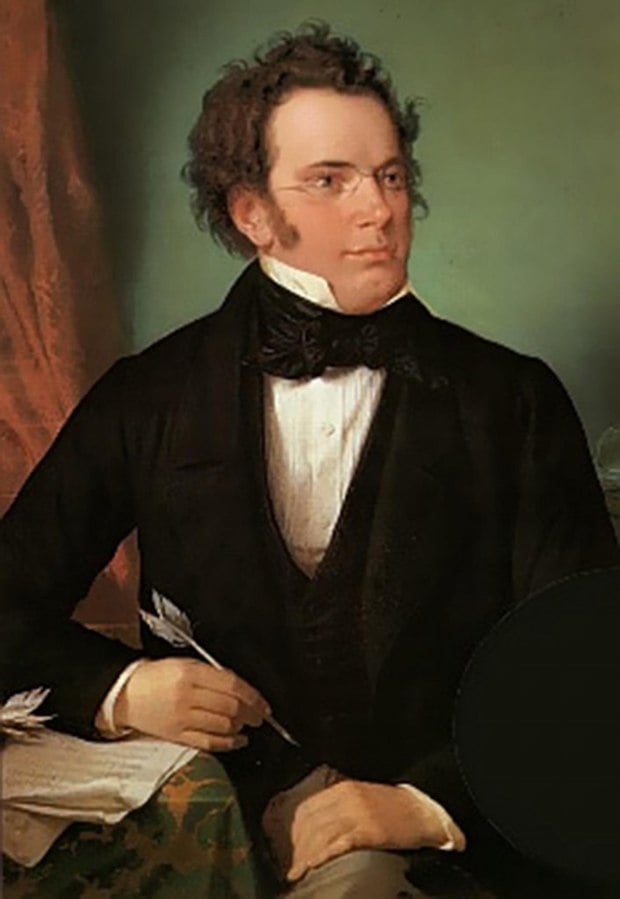
  • Schubert’s Arpeggione Sonata Rediscovered

    Schubert’s Arpeggione Sonata Rediscovered

    In honor of Franz Schubert’s birthday, I reserve the right to harp on the arpeggione.

    If you’re not familiar with the arpeggione (and who is these days?), it was an instrument invented around 1823. It possessed six strings and was fretted and tuned like a guitar, but was played with a bow, like a cello.

    Schubert’s “Arpeggione Sonata,” composed in 1824, didn’t see publication until 1871 – 43 years after the composer’s death in 1828. (Schubert died at the age of 31.) The only substantial work written for the instrument, Schubert’s sonata wasn’t recognized until long after the arpeggione had already slipped into obscurity. These days, Schubert’s sonata is almost always performed on the cello.

    Here’s a recording that presents the piece as Schubert originally intended, with Klaus Storck playing a rare surviving specimen, an arpeggione attributed to Anton Mitteis, pupil of the instrument’s inventor, Johann Georg Stauffer. Anton Kontarsky plays a Brodmann fortepiano built in Vienna around 1810.

    And here it is in concert, in the form it’s usually heard today, with cellist Mischa Maisky and pianist Martha Argerich.

    However it is you prefer your “Arpeggione Sonata,” Schubert’s message transcends the medium.

    Happy birthday, Franz Schubert!

  • Erlkönig Sand Art A Spooky Halloween Treat

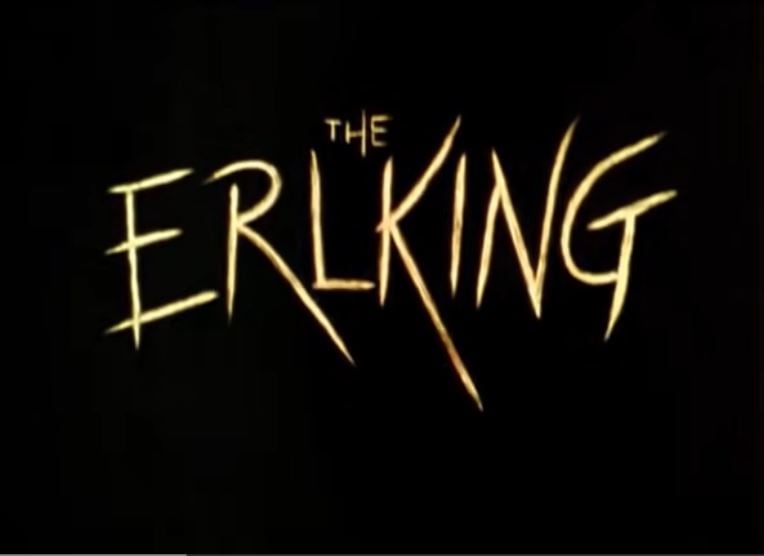
    Erlkönig Sand Art A Spooky Halloween Treat

    In case you didn’t happen to see it in the comments under last night’s post, a shared video of a shadow-puppet interpretation of Franz Schubert’s “Erlkönig,” John M Polhamus has one-upped me with his discovery of this one, rendered in sand-art! It’s spooky, more imaginative in concept and execution, and truer to Goethe’s text (well, maybe except for the wolves, which were a nice touch). Thanks, John, for the Halloween chill!

  • Mendelssohn, Schubert, and Composer Birthdays

    Mendelssohn, Schubert, and Composer Birthdays

    Mozart’s birthday is always a signal to me that we are entering a season of great composer birthdays.

    Perhaps it is all coincidence, but for whatever reason, music history has arrayed itself in such a way that larger patterns can be discerned. Autumn is heavy with birthdays of significant American composers (Gershwin, Ives, Hanson, Copland, and Virgil Thomson, to name a few). Revered violinists Fritz Kreisler and Jascha Heifetz were born on the same day (February 2), as were venerated pianists Sergei Rachmaninoff and Ferruccio Busoni (April 1). Brahms and Tchaikovsky share a birthdate (May 7). So do two of the most prominent film composers, Max Steiner and Dimitri Tiomkin (May 10). After 34 years in radio, these natal serendipities are etched in my memory like tablets carved on Mount Sinai.

    Nonetheless, even as I anticipated the birthday of Franz Schubert (January 31), in my eagerness to pay tribute to Mario Lanza on the occasion of his centenary, I inadvertently let it slip by. Please forgive me, Schwammerl. Today, on the anniversary of the birth of Felix Mendelssohn (1809-1847), I hope to make amends.

    Mendelssohn, of course, was one of the most astonishing of musical prodigies. He composed his earliest masterpieces, the overture to “A Midsummer Night’s Dream” and the Octet for Strings in E-flat major, at the ages of 16 and 17 respectively. This is some of the “youngest” music in the entire repertoire. In their precocity and polish, both pieces are on a par with anything written by the teenaged Mozart.

    Of course, by then, Mendelssohn had already generated piles of manuscripts – dozens of works, including three piano quartets, a violin sonata, a piano sonata, a singspiel, songs and “Songs without Words,” twelve symphonies for strings, and his first symphony for full orchestra.

    And he would go on to write his “Italian” Symphony, his “Scottish” Symphony, the “Hebrides Overture,” the Violin Concerto in E minor, and the oratorio “Elijah,” all of which are still played in heavy rotation, both on radio and in the concert hall.

    As a conductor, there’s no question he was one of the most influential musicians in Europe, if not the world. For twelve years, he directed the Leipzig Gewandhaus Orchestra, many of whose players went on to distinction in their own right. His performances were especially admired for their precision. He also laid the groundwork for modern concerts in developing a musical “canon.”

    He gave important premieres of music by his contemporaries, while also reviving works of Mozart, Beethoven, and of course Johann Sebastian Bach. It was Mendelssohn who famously dusted off the “St. Matthew Passion,” reinvigorating Bach’s reputation.

    Another composer who benefited from Mendelssohn’s advocacy was Franz Schubert. In 1838, ten year’s after Schubert’s death, his brother, Ferdinand, shared an unpublished manuscript with Robert Schumann, during one of the latter’s visits to Vienna. Schumann returned to Leipzig with a copy of the piece, a Symphony in C major. Mendelssohn gave the symphony its first public performance in 1839.

    Schumann reviewed the concert in the Neue Zeitschrift für Musik, famously praising the work for its “heavenly length.” For this reason, and to distinguish it from an earlier, shorter Schubert symphony composed in the same key, it is usually identified as the “Great” C major.

    Standing only five-foot-one, Schubert himself bore the nickname “Schwammerl” (“Little Mushroom”), bestowed upon him by his friends. Even a minute fungus, it would seem, is more than capable of creating something “Great.”

    Happy birthday, Felix Mendelssohn, and happy belated birthday, Franz Schubert.


    Mendelssohn, “Hebrides Overture”

    His first masterpiece, the Octet in E-flat major, composed at the age of 16:

    Live performance of Leonard Bernstein conducting Schubert’s Symphony No. 9 “Great”

    https://www.youtube.com/watch?v=hCuC8–m-98

  • Schubert’s Octet Marlboro Music Festival

    Schubert’s Octet Marlboro Music Festival

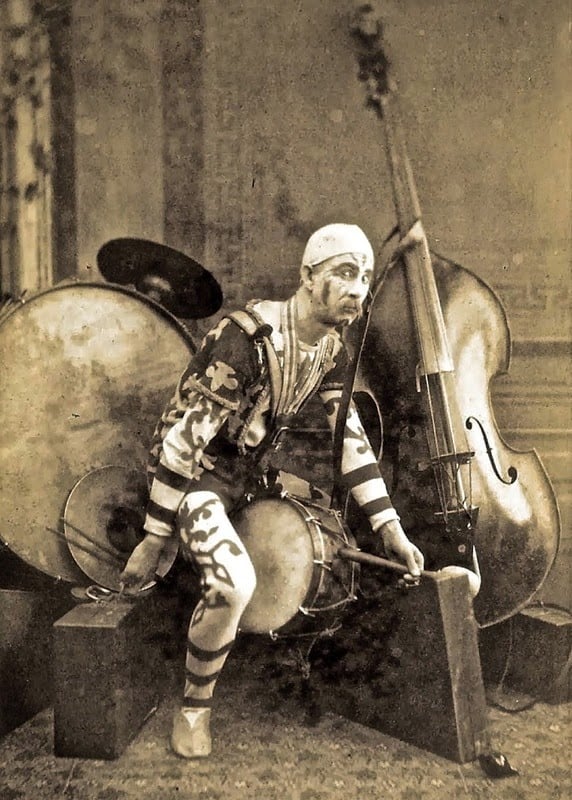
    It’s foolish to attempt to play something like the Schubert Octet all by yourself. Many have tried – mad dreamers! – only to come up looking ridiculous. Not even the gloss of extraneous percussion instruments or transposition to the banjo can disguise the bald fact of the matter – that to really enjoy this work as Franz Schubert intended, you can’t do better than eight superb musicians from the Marlboro Music Festival.

    On the next “Music from Marlboro,” we’ll hear Schubert’s Octet in F major, D. 803, performed in its entirety, by violinists Joseph Genualdi and Felix Galimir, violist Steven Tenenbom, cellist Peter Wiley, double-bassist Peter Lloyd, clarinetist Shannon Scott, bassoonist Alexander Heller, and hornist David Jolley. Marlboro musicians toured the piece, alongside Mozart’s “Eine kleine Nachtmusik,” in 1987.

    Tune in for this expansive masterwork a little earlier than usual – there’s too much melody and charm to be confined within a single hour – this Wednesday evening at 5:50 EST. It pays to be a team player. One can’t outscore the Octet, on WWFM – The Classical Network and wwfm.org.

    Marlboro School of Music and Festival: Official Page

Tag Cloud

Aaron Copland (92) Beethoven (95) Composer (114) Film Music (123) Film Score (143) Film Scores (255) Halloween (94) John Williams (187) KWAX (229) Leonard Bernstein (101) Marlboro Music Festival (125) Movie Music (138) Opera (202) Philadelphia Orchestra (89) Picture Perfect (174) Princeton Symphony Orchestra (106) Radio (87) Ralph Vaughan Williams (85) Ross Amico (244) Roy's Tie-Dye Sci-Fi Corner (290) The Classical Network (101) The Lost Chord (268) Vaughan Williams (103) WPRB (396) WWFM (881)

DON’T MISS A BEAT

Receive a weekly digest every Sunday at noon by signing up here


RECENT POSTS