Tag: Jerry Goldsmith

  • Jerry Goldsmith Overshadowed Genius

    Jerry Goldsmith Overshadowed Genius

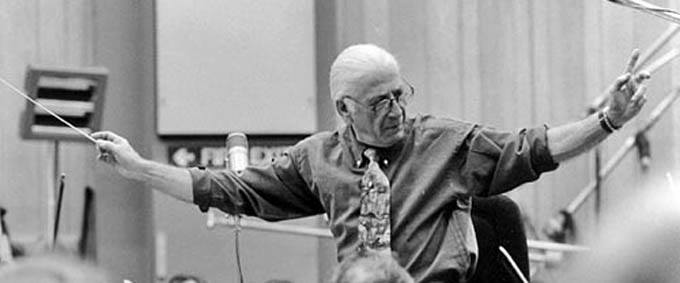
    Two days after John Williams’ birthday falls the anniversary of the birth of Jerry Goldsmith. Unfortunately, this would essentially become the story of Jerry’s life, as despite being three years Williams’ senior and having cracked the A-list ahead of his younger colleague, Goldsmith often seemed to be caught in Williams’ wake.

    Sure, he distinguished himself with some of the great film scores of his time, including those for “The Sand Pebbles” (1966), “The Blue Max” (1966), “The Flim-Flam Man” (1967), “Planet of the Apes” (1968), “Patton” (1970), “Papillon” (1973), “Chinatown” (1974), “The Wind and the Lion” (1975), “MacArthur” (1977), “The Boys from Brazil” (1978), “The Great Train Robbery” (1979), “Alien” (1979, butchered in the sound editing), and “Star Trek: The Motion Picture” (1979). For television, he wrote for “Dr. Kildare,” “The Twilight Zone,” “Gunsmoke,” “The Man from U.N.C.L.E.,” and “The Waltons.”

    But by the 1980s, the films began to get weaker. It seemed like Goldsmith was always getting tossed the projects Williams passed on, or cheap knockoffs of Williams’ successes. By his final decade, he was stuck writing for such garbage as “The Mummy” (1999), “The Haunting” (1999), and “Looney Tunes: Back in Action” (2003). A notable exception was “L.A. Confidential” (1997), but rarely were his later projects up to his talent. I can recall many a moviegoing experience in which Goldsmith’s music wound up being the only redeeming quality.

    Furthermore, he had a reputation for being able to compose at white heat, so he was frequently called upon to write replacement scores for films like “The River Wild” (1994), “Air Force One” (1997), and “The 13th Warrior” (1999). He composed and recorded the score to “Chinatown,” one of the best of the 1970s, in only ten days.

    Criminally, he was honored with but a single Academy Award, for his influential score to “The Omen” (1976).

    Goldsmith died in 2004, at the age of 75. If he were to come back today, he would mop the joint with all the Hans Zimmers of this world. Like the John Henry of Hollywood composers, he’d be churning out quality film scores to put all the cheap-ass computer steam-drillers to shame.

    Happy birthday, Jerry Goldsmith!


    The Man from U.N.C.L.E.

    Planet of the Apes

    Patton

    Chinatown

    The Wind and the Lion

    The Omen

    Star Trek: The Motion Picture

  • Madness & Movie Music The Piano’s Dark Side

    If the definition of insanity is doing the same thing over and over and expecting a different result, then surely Hanon etudes are a ticket to the madhouse.

    This week on “Picture Perfect,” get keyed-up with music from movies about madness and the piano.

    Whenever he hears a loud, discordant sound, unhinged pianist-composer Laird Cregar is compelled to commit murder, in the 1945 film “Hangover Square.” Bernard Herrmann wrote the moody, romantic score, which includes a piano concerto, played by Cregar’s character during the film’s conflagration finale.

    Peter Lorre is an unstable musicologist who is haunted by the disembodied hand of a murdered pianist with a penchant for Brahms’ arrangement of Bach’s Chaconne, in “The Beast with Five Fingers,” from 1946. Max Steiner was the composer. The hand is played by concert pianist Victor Aller, brother-in-law of Felix Slatkin and Leonard Slatkin’s uncle.

    Alan Alda plays a frustrated pianist who falls in with a ring of Satanists, in “The Mephisto Waltz” from 1971. This time, Jerry Goldsmith blends Franz Liszt with amplified instruments and electronics to memorably eerie effect. Five years later, Goldsmith would win his only Academy Award for his music to “The Omen.”

    Finally, Hans Conried plays a dictatorial pedagogue in “The 5,000 Fingers of Dr. T,” released in 1953. “5,000 Fingers” holds the distinction of being the only feature ever written by Dr. Seuss. The film sports an outrageous production design (including a gargantuan keyboard for 500 enslaved boys) and whimsical songs.

    The composer was Frederick Hollander. Born in London, Hollander attained fame in Germany as Friedrich Hollander. His best-known international success was “The Blue Angel,” starring Marlene Dietrich, who introduced his song, “Falling in Love Again.” With the rise of the Nazis, Hollander fled to the United States, where he worked on over 100 films.

    We go crazy for the keyboard this week. Practice makes psychotic on “Picture Perfect,” music for the movies, now in syndication on KWAX, the radio station of the University of Oregon!


    Clip and save the start times for all three of my recorded shows:

    PICTURE PERFECT, the movie music show – Friday at 8:00 PM EDT/5:00 PM PDT

    SWEETNESS AND LIGHT, the light music program – ALL NEW! – Saturday at 11:00 AM EDT/8:00 AM PDT

    THE LOST CHORD, unusual and neglected rep – Saturday at 7:00 PM EDT/4:00 PM PDT

    Stream them, wherever you are, at the link!

    https://kwax.uoregon.edu/

  • Supporting the Arts Small Acts Big Impact

    Supporting the Arts Small Acts Big Impact

    I’ll probably never have the bank account to know what it’s like to be a big-time patron of the arts on the scale of a Medici or a Guggenheim; but thanks to crowdfunding platforms even I am able to do my own small part to help underwrite projects that are of particular interest to me.

    So I can feel an extra degree of satisfaction that there’s a two-volume chronicle of Jerry Goldsmith’s career and music on the way and that Intrada Records has just completed sessions for a compact disc release of Frank Skinner’s score to “Abbott and Costello Meet Frankenstein,” also imminent.

    I’m especially proud to have been able to kick in for a couple of CDs of Vaughan Williams world premieres for Albion Records, the recording branch of the Ralph Vaughan Williams Society, including “Beyond My Dreams,” devoted to the composer’s incidental music for Greek plays (other than “The Wasps”), released in 2017, and “Royal Throne of Kings,” devoted to his music for Shakespeare, newly issued.

    This Saturday will mark Vaughan Williams’ birthday anniversary, and since I believe some potential listeners are not seeing my Facebook teasers for my light music show, “Sweetness and Light,” until too late, if I post them the morning of broadcast, this week I am giving you several days’ notice that I will be including selections from the new Shakespeare disc in a program that will emphasize RVW’s lighter music.

    So if you’re a Ralph Vaughan Williams’ fan (he’s one of my favorite composers), do take note! We’ll be humming along with Uncle Ralph on “Sweetness and Light,” this Saturday morning at 11:00 EDT/8:00 PDT, exclusively on KWAX, the radio station of the University of Oregon!

    Stream it wherever you are at the link:

    https://kwax.uoregon.edu/

    Ogle the complete Albion Records catalogue here:

    Albion Records

  • Going Ape for Classic Movie Music

    Going Ape for Classic Movie Music

    With the publicity machine going full-throttle for the new “Planet of the Apes” movie, I thought we’d take the opportunity this week, on “Picture Perfect,” to look back to Jerry Goldsmith’s music for the original 1968 classic.

    Goldsmith incorporated all sorts of unusual effects into his groundbreaking score. He employed such instruments as tuned mixing bowls, a bass slide-whistle, and the cuika, a Brazilian wind instrument used to mimic the hooting of excited apes. He instructed his hornists to play without mouthpieces, and he manipulated percussion through the use of an Echoplex.

    Barbaric and unnerving, with little in the way of lyricism, I can’t imagine anything like it being used in a major Hollywood film today. Well, from my description, I guess I can, but Goldsmith was the real deal – a talented composer with real tools (not just a laptop) at his disposal.

    While my initial impulse had been to fill out the hour with music from some of the other films in the “Apes” franchise, after listening for a while, the grimness and brutality became a bit too unremitting, so instead we’ll swing with the gorilla theme.

    Among the other selections will be an extended passage from the Dian Fossey biopic, “Gorillas in the Mist,” which starred Sigourney Weaver and featured music by Maurice Jarre, of “Lawrence of Arabia” and “Doctor Zhivago” fame, though from his later, lamentable “electronic” period.

    We’ll also hear a bit from the “Mighty Joe Young” remake, since, at the time I recorded the show, I couldn’t get a hold of Roy Webb’s score for the original (since remedied). The music is pretty much standard James Horner (eg. “Titanic”), though he does incorporate a Swahili choir.

    Finally, we’ll sample from Max Steiner’s landmark score to the 800-pound gorilla of all monkey movies, 1933’s “King Kong.”

    I hope you’ll join me as we go ape this week, on “Picture Perfect,” music for the movies, now in syndication on KWAX, the radio station of the University of Oregon!


    Remember, KWAX is on the West Coast, so there’s a three-hour difference for those of you listening in the East. Here are the respective air-times for all three of my recorded shows (with East Coast conversions in parentheses):

    PICTURE PERFECT, the movie music show – Friday on KWAX at 5:00 PM PACIFIC TIME (8:00 PM EASTERN)

    SWEETNESS AND LIGHT, the light music program – ALL NEW! – Saturday on KWAX at 8:00 AM PACIFIC TIME (11:00 AM EASTERN)

    THE LOST CHORD, unusual and neglected rep – Saturday on KWAX at 4:00 PM PACIFIC TIME (7:00 PM EASTERN)

    Stream all three, at the times indicated, by following the link!

    https://kwax.uoregon.edu/

    “Take your stinkin’ paws off me…!” (with Goldsmith’s music, including cuika effects):

    https://www.youtube.com/watch?v=enRpeRUawNY

  • Remembering Jerry Goldsmith Film Music Legend

    Remembering Jerry Goldsmith Film Music Legend

    When he was a kid, Jerry Goldsmith loved going to the movies to enjoy the music – just the way I loved going to the movies as a kid to enjoy Jerry Goldsmith!

    Goldsmith, born on this date in 1929, wrote indelible scores for dozens of films, such as “The Sand Pebbles” (1966), “The Blue Max” (1966), “The Flim-Flam Man” (1967), “Planet of the Apes” (1968), “Patton” (1970), “Papillon” (1973), “Chinatown” (1974), “The Wind and the Lion” (1975), “MacArthur” (1977), “The Boys from Brazil” (1978), “The Great Train Robbery” (1979), “Alien” (1979, butchered in sound editing), and “Star Trek: The Motion Picture” (1979).

    For television, he wrote for “Dr. Kildare,” “The Twilight Zone,” “Gunsmoke,” “The Man from U.N.C.L.E.” and “The Waltons.”

    By the 1980s, the films began to get weaker. It seemed like Goldsmith was always getting tossed the projects John Williams passed on, or cheap knockoffs of Williams’ successes. By his final decade, he was stuck writing for such garbage as “The Mummy” (1999), “The Haunting” remake (1999), and “Looney Tunes: Back in Action” (2003). A notable exception was “L.A. Confidential” (1997), but rarely were his later projects up to his talent.

    Goldsmith had a reputation for being able to compose at white heat, so he was frequently called upon to write replacement scores for films like “The River Wild” (1994), “Air Force One” (1997) and “The 13th Warrior” (1999). He composed and recorded the score to “Chinatown,” one of the best of the 1970s, in only ten days.

    Incredibly, he was honored with but a single Academy Award (of 18 nominations), for his influential score to “The Omen” (1976). Goldsmith died in 2004, at the age of 75. If he were to come back today, he would mop the joint with all the moody droners and computer noodlers, with their narrow palettes and paucity of inspiration.

    Happy birthday, Jerry. I hope they’re still making good movies wherever you are.


    Goldsmith discusses film music, circa 1986

    Documentary from 1993

    https://www.youtube.com/watch?v=qUemenAQYQ4

    Introducing and conducting his music with the National Philharmonic in 1989

    Introducing and conducting his music, and others’, with the BBC Concert Orchestra in 1994

    Part 1 https://www.youtube.com/watch?v=SR6c8QWIh90

    Part 2 https://www.youtube.com/watch?v=oqofviC4PG4

Tag Cloud

Aaron Copland (92) Beethoven (95) Composer (114) Film Music (123) Film Score (143) Film Scores (255) Halloween (94) John Williams (187) KWAX (229) Leonard Bernstein (101) Marlboro Music Festival (125) Movie Music (138) Opera (202) Philadelphia Orchestra (89) Picture Perfect (174) Princeton Symphony Orchestra (106) Radio (87) Ralph Vaughan Williams (85) Ross Amico (244) Roy's Tie-Dye Sci-Fi Corner (290) The Classical Network (101) The Lost Chord (268) Vaughan Williams (103) WPRB (396) WWFM (881)

DON’T MISS A BEAT

Receive a weekly digest every Sunday at noon by signing up here


RECENT POSTS