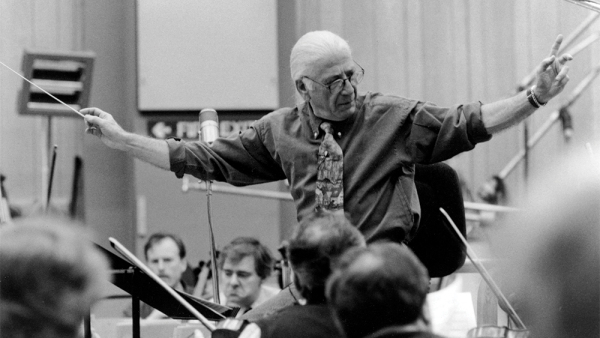
Tag: Jerry Goldsmith

  • Remembering Jerry Goldsmith Film Music Legend

    Remembering Jerry Goldsmith Film Music Legend

    When he was a kid, Jerry Goldsmith loved going to the movies to enjoy the music – just the way I loved going to the movies as a kid to enjoy Jerry Goldsmith!

    Goldsmith, born on this date in 1929, wrote indelible scores for dozens of films, such as “The Sand Pebbles” (1966), “The Blue Max” (1966), “The Flim-Flam Man” (1967), “Planet of the Apes” (1968), “Patton” (1970), “Papillon” (1973), “Chinatown” (1974), “The Wind and the Lion” (1975), “MacArthur” (1977), “The Boys from Brazil” (1978), “The Great Train Robbery” (1979), “Alien” (1979, butchered in sound editing), and “Star Trek: The Motion Picture” (1979).

    For television, he wrote for “Dr. Kildare,” “The Twilight Zone,” “Gunsmoke,” “The Man from U.N.C.L.E.” and “The Waltons.”

    By the 1980s, the films began to get weaker. It seemed like Goldsmith was always getting tossed the projects John Williams passed on, or cheap knockoffs of Williams’ successes. By his final decade, he was stuck writing for such garbage as “The Mummy” (1999), “The Haunting” remake (1999), and “Looney Tunes: Back in Action” (2003). A notable exception was “L.A. Confidential” (1997), but rarely were his later projects up to his talent.

    Goldsmith had a reputation for being able to compose at white heat, so he was frequently called upon to write replacement scores for films like “The River Wild” (1994), “Air Force One” (1997) and “The 13th Warrior” (1999). He composed and recorded the score to “Chinatown,” one of the best of the 1970s, in only ten days.

    Incredibly, he was honored with but a single Academy Award (of 18 nominations), for his influential score to “The Omen” (1976). Goldsmith died in 2004, at the age of 75. If he were to come back today, he would mop the joint with all the moody droners and computer noodlers, with their narrow palettes and paucity of inspiration.

    Happy birthday, Jerry. I hope they’re still making good movies wherever you are.


    Goldsmith discusses film music, circa 1986

    Documentary from 1993

    https://www.youtube.com/watch?v=qUemenAQYQ4

    Introducing and conducting his music with the National Philharmonic in 1989

    Introducing and conducting his music, and others’, with the BBC Concert Orchestra in 1994

    Part 1 https://www.youtube.com/watch?v=SR6c8QWIh90

    Part 2 https://www.youtube.com/watch?v=oqofviC4PG4

  • Viking Movie Music Swords Fjords and Soundtracks

    Viking Movie Music Swords Fjords and Soundtracks

    We’ve got the need for mead!

    This week on “Picture Perfect,” it’s an hour of swords and fjords, as we travel north for music from movies about the Norsemen.

    In “The Long Ships” (1963), two Viking brothers, played by the unlikely pair of Richard Widmark and Russ Tamblyn, make off with a king’s funeral ship – and the king’s daughter – as they set sail on a quest for the fabled “Mother of Voices,” an enormous solid gold bell – also coveted by a Moorish prince, played by the late Sidney Poitier. Needless to say, camp value is high. The music for this British-Yugoslavian production is by the Serbian composer Dusan Radic.

    “Prince Valiant” (1954), based on the enduring comic strip by Hal Foster, is set in the days of King Arthur, though Val himself is a Viking prince of the kingdom of Scandia. And indeed Vikings play an important role in the film. Victor McLaglen is Val’s Viking pal Boltar, Janet Leigh is Princess Aleta, James Mason the villainous Sir Brack, and Sterling Hayden a ridiculous Gawain. Robert Wagner dons the signature page-boy haircut.

    The score is every bit as vivid as the film’s Technicolor. We’ll hear selections from a very special recording, with the composer himself, Franz Waxman, conducting.

    Michael Crichton’s 1976 novel, “Eaters of the Dead,” presents an unlikely, fish-out-of-water alliance, between historic Persian ambassador of the 10th century, Ahmad ibn Fadlan, and a band of Vikings. They overcome their cultural differences to face off against the Wendol, humanoid creatures who periodically emerge from the mist to feed on human flesh.

    Crichton’s story was filmed in 1997 and ultimately released as “The 13th Warrior” (1999), with Antonio Banderas as Ibn Fadlan. The production was plagued by misfortune. The original director, John McTiernan, who found success with “Die Hard,” was fired for running over-budget, and Crichton himself was brought in to re-shoot a number of the scenes. Nevertheless, the film proved to be a box office failure. But any movie to feature a Jerry Goldsmith score – and Vikings! – can’t be all bad.

    The legendary Jack Cardiff, who actually directed “The Long Ships,” provided the stunning cinematography for “The Vikings” (1958). The film stars Kirk Douglas, Tony Curtis, Janet Leigh, and Ernest Borgnine. Although unintentionally amusing on several levels, “The Vikings” is highly regarded for its attention to detail and stabs at historical accuracy – particularly in regard to its Viking dragon boats.

    Also impressive is the haunting score by Mario Nascimbene, which we’ll hear in a digital re-recording, issued on the Prometheus Records label, featuring the City of Prague Philharmonic Orchestra and Chorus, conducted by Nic Raine. The recording is like mead from Valhalla.

    I hope you’ll join me for an hour of runes and tunes. It’s the definitive mix-tape for your dragonship, on “Picture Perfect, music for the movies, now in syndication on KWAX, the radio station of the University of Oregon!


    Remember, KWAX is on the West Coast, so there’s a three-hour difference for those of you listening in the East. Here are the respective air-times for all three of my recorded shows (with East Coast conversions in parentheses):

    PICTURE PERFECT, the movie music show – Friday on KWAX at 5:00 PM PACIFIC TIME (8:00 PM EST)

    SWEETNESS AND LIGHT, the light music program – ALL NEW! – Saturday on KWAX at 8:00 AM PACIFIC TIME (11:00 AM EST)

    THE LOST CHORD, unusual and neglected rep – Saturday on KWAX at 4:00 PM PACIFIC TIME (7:00 PM EST)

    Stream all three, at the times indicated, by following the link!

    https://kwax.uoregon.edu/

  • Classic Christmas TV Specials Music

    Classic Christmas TV Specials Music

    This week on “Picture Perfect,” we’ll think inside the box, with music from classic Christmas television specials.

    “The Snowman” (1982), based on the picture book by Raymond Briggs, is about a boy whose snowman comes to life and whisks him away on a journey to the North Pole. The show became enormously popular in the UK and through occasional showings on U.S. television. It was nominated for an Academy Award for Best Animated Short. Like the book, the film is wordless, using animation and music to tell its story, with the exception of an enchanting interlude, known as “Walking in the Air,” which employs a boy treble. “Walking in the Air” is easily the best-known music by Howard Blake. Blake turned 85 in October. Happy belated birthday!

    The television film “The Homecoming” (1971) stars Patricia Neal and Richard Thomas in a heart-warming story about a rural family Christmas in 1933. Written by Earl Hamner, the film’s success spawned the television series “The Waltons.” Jerry Goldsmith wrote the music. He would return to work on “The Waltons” – though as of “The Homecoming,” he had yet to write the show’s indelible theme.

    An adaptation of Charles Dickens’ “A Christmas Carol” (1954) was the subject of a special episode of the anthology series “Shower of Stars.” Fredric March plays Ebenezer Scrooge, and Basil Rathbone is Jacob Marley’s ghost. But it is Ray Middleton, who appears as both Scrooge’s nephew and the Spirit of Christmas Present, who is given arguably the show’s most memorable tune, “A Very Merry Christmas.” The teleplay and lyrics are by Maxwell Anderson, and the music is by Bernard Herrmann!

    Finally, Christmas time is here, happiness and cheer, with “A Charlie Brown Christmas” (1965). We’ll hear the Vince Guaraldi Trio perform selections from this most beloved of Christmas classics.

    For once, the snow has nothing to do with your television reception. I hope you’ll join me for a cookie plate full of classic Christmas specials, on “Picture Perfect,” now in syndication on KWAX, the radio station of the University of Oregon!


    Remember, KWAX is on the West Coast, so there’s a three-hour difference for those of you listening in the East. Here are the respective air-times of my recorded shows (with East Coast conversions in parentheses):

    PICTURE PERFECT, the movie music show – Friday on KWAX at 5:00 PM PACIFIC TIME (8:00 PM EST)

    THE LOST CHORD, unusual and neglected rep – Saturday on KWAX at 4:00 PM PACIFIC TIME (7:00 PM EST)

    Also, a reminder that tomorrow morning I’LL BE ADDING A THIRD SHOW to the mix: SWEETNESS AND LIGHT will debut at 8:00 AM PACIFIC TIME (11:00 AM EST) with a seasonal playlist calculated to charm and to cheer. I hope you’ll be able to join me then.

    Stream all three shows, at the times indicated, at the link!

    https://kwax.uoregon.edu/

  • King Arthur Movie Music on KWAX

    King Arthur Movie Music on KWAX

    This week on “Picture Perfect,” the Once and Future King of film music shows continues on KWAX, with selections from movies inspired by the legends of King Arthur.

    The legends provide so much grist for “Prince Valiant” (1954), based on Hal Foster’s enduring comic strip, set in the days of Arthur, though Val himself is a Viking prince of the kingdom of Scandia. Janet Leigh plays Princess Aleta, James Mason the villainous Sir Brack, Victor McLaglen Val’s Viking pal Boltar, and Sterling Hayden a preposterous Gawain. For the title role, Robert Wagner dons the signature page-boy haircut. The score, by Franz Waxman, is every bit as vivid as the film’s Technicolor, and a clear prototype for the exuberant, leitmotif-driven music of John Williams.

    “The Mists of Avalon” (2001), adapted from Marion Zimmer Bradley’s novel, takes the ingenious approach of retelling the Arthurian stories from the perspective of the oft-marginalized female characters. The revisionist approach breathes fresh life into the familiar tales, so that the book was greeted with critical and popular acclaim upon its release in 1983. A television miniseries, starring Julianna Margulies, Angelica Huston and Joan Allen, was produced for TNT, with music by Lee Holdridge.

    “First Knight” (1995) features an unlikely cast of Sean Connery as Arthur, Richard Gere as Lancelot, and Julia Ormond as Guinevere. The film is unique, to my knowledge, in being based on the writings of medieval French poet Chrétien de Troyes, as opposed to the more frequently-employed source, Sir Thomas Malory.

    The score is by Jerry Goldsmith. It was actually a bit of a rush job for Goldsmith, who stepped up at the very last minute to replace Maurice Jarre. Jarre had been approached to write music for what was originally a three-hour cut of the film. However, he only had four weeks in which to do so. Goldsmith, very well-known for his ability to write at white heat, was able to complete the score, and record the music in the allotted time.

    “Knights of the Round Table” (1953) may lack the gravitas and grit of “Excalibur” – in my opinion, the most powerful of the Arthurian films – but it does sport some undeniably satisfying 1950s spectacle. The glossy and pat MGM production stars Robert Taylor as Lancelot, Ava Gardner as Guinevere, and Mel Ferrer as Arthur. The fine score is by Miklós Rózsa, from the height of his “historical epic” phase.

    It’s more than just a knight at the movies. Polish up on music for the films of King Arthur, on “Picture Perfect,” now in syndication on KWAX, the radio station of the University of Oregon!

    For streaming information, see below.


    Keep in mind, KWAX is on the West Coast, so there’s a three-hour difference for the Trenton-Princeton area. Here are the respective air-times of my recorded shows (with East Coast conversions in parentheses):

    PICTURE PERFECT, the movie music show – Friday on KWAX at 5:00 PACIFIC TIME (8:00 PM EDT)

    THE LOST CHORD, unusual and neglected rep – Saturday on KWAX at 4:00 PACIFIC TIME (7:00 PM EDT)

    Stream them here!

    https://kwax.uoregon.edu/

  • Exotic Scores: Movie Music from the East

    Exotic Scores: Movie Music from the East

    As a long-time local radio host only recently set adrift, I am thankful for the life raft of syndication. Which means armchair travelers can still join me, via internet streaming, on KWAX, the radio station of the University of Oregon.

    Orientalism is a term used to describe evocations of the East by Western writers, artists, and designers. This week on “Picture Perfect,” while I acknowledge the complexities and pitfalls inherent to “exoticism,” I hope you’ll enjoy musical selections from four films set in faraway lands.

    Two of these are loosely based on tales from “The Arabian Nights,” depicting the East as a kind of fairy world. The Alexander Korda production of “The Thief of Bagdad” (1940) features Sabu as the thief, Conrad Veidt as a slippery vizir, and a scene-stealing Rex Ingram as the djinn. The score is one of the earliest and most charming of Miklós Rózsa.

    “The Seventh Voyage of Sinbad” (1958) is really a showcase for the special effects of Ray Harryhausen. In particular, it contains a kind of rehearsal, in the skeleton duel, for the classic sequence in “Jason and the Argonauts” (in which Harryhausen ups the ante to seven skeletons!). The alternately sinuous and percussive music, by Bernard Herrmann, fits the images like a Persian slipper.

    Director David Lean was inspired by the historical exploits and complex character of T.E. Lawrence, in the undertaking of “Lawrence of Arabia” (1962). The film won seven Academy Awards and made international superstars of Peter O’Toole and Omar Sharif. Maurice Jarre won the first of his three Oscars for his music. Jarre himself conducted on the film’s soundtrack, even though, for contractual reasons, Sir Adrian Boult received the screen credit.

    Finally, Sean Connery is Mulay Ahmed Muhamed Raisuli the Magnificent, sharif of the Riffian Berbers, in John Milius’ “The Wind and the Lion” (1975). The score represents composer Jerry Goldsmith at his finest. In fact, so happy was he with the effort that he was convinced that he finally had a lock on the Oscar. Then he went to see “Jaws.” Goldsmith would receive his only Academy Award, finally, the next year for his music to “The Omen.”

    I hope you’ll join me for these examples of Orientalism at the movies – a theme that’s really an excuse for me to play some of my favorite scores – this Friday evening on KWAX!

    See below for streaming information.


    Keep in mind, KWAX is on the West Coast, so there’s a three-hour difference for the Trenton-Princeton area. Here are the respective air-times of my recorded shows (with East Coast conversions in parentheses):

    PICTURE PERFECT, the movie music show – Friday on KWAX at 5:00 PACIFIC TIME (8:00 PM EDT)

    THE LOST CHORD, unusual and neglected rep – Saturday on KWAX at 4:00 PACIFIC TIME (7:00 PM EDT)

    Stream them here!

    https://kwax.uoregon.edu/


    PHOTO: Rex Ingram as the Djinn in “The Thief of Bagdad”

Tag Cloud

Aaron Copland (93) Beethoven (95) Composer (114) Film Music (129) Film Score (143) Film Scores (255) Halloween (94) John Williams (192) KWAX (229) Leonard Bernstein (103) Marlboro Music Festival (125) Movie Music (144) Mozart (88) Opera (206) Philadelphia Orchestra (89) Picture Perfect (174) Princeton Symphony Orchestra (108) Radio (88) Ross Amico (244) Roy's Tie-Dye Sci-Fi Corner (290) The Classical Network (101) The Lost Chord (268) Vaughan Williams (103) WPRB (396) WWFM (881)

DON’T MISS A BEAT

Receive a weekly digest every Sunday at noon by signing up here


RECENT POSTS