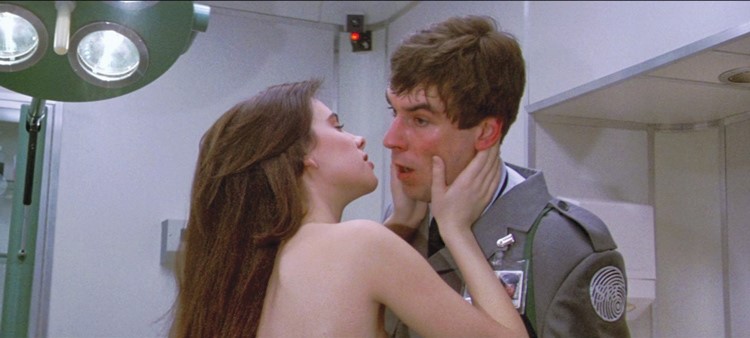
Full-frontal vampires from outer space? This is an existential threat that needs to be encountered head-on! And Roy and I are just the guys to do it. Our blather about “Lifeforce” (1985) has been posted here:
Is there anything creepier than creepy kids? Especially when they turn out to be the spawn of Satan? Next week, Halloween month continues with a Revelatory conversation about Richard Donner’s diabolical hit “The Omen” (1976).
Join us in a chorus of “Ave Satani” in the comments section – this is Jerry Goldsmith’s only Oscar-winning score – as we count to 666 on the next Roy’s Tie-Dye Sci-Fi Corner, when we livestream on Facebook, next Friday evening at 7:30 EDT!
The conversation will be all about “spy-fi” on the next “Roy’s Tie-Dye Sci-Fi Corner.”
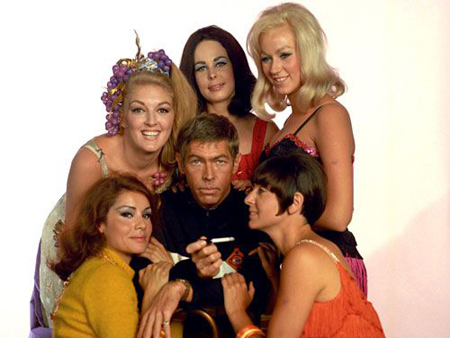
A polymath on the level of Doc Savage (he’s a karate champion, brain surgeon, swordsman, and nuclear physicist), but with the sex appeal, sophistication, and gadgetry of James Bond (his cigarette lighter contains 82 death-dealing devices), Derek Flint effortlessly surfs the swinging ‘60s super-spy tsunami.
There were two Flint films – “Our Man Flint” (1966) and “In Like Flint” (1967) – with talk of producing more, but according to star James Coburn, the studio simply wasn’t set on investing very much in the franchise. Bond knockoffs were rather thick on the ground at the time. Nevertheless, Flint proved to be a breakout role for Coburn. “Our Man Flint” firmly established him as an above-the-title leading man, and one of the era’s reigning tough guys.
Of course, none of it is supposed to be taken very seriously (it’s not for nothing that the sequel, “In Like Flint,” is Austin Powers’ favorite movie), but that doesn’t keep Jerry Goldsmith from lavishing the film with his characteristic invention, including a breezy theme and abundant felicitous touches in the orchestration (requisite surf guitar, jazzy sax, romantic strings, accordion, electronics, mandolin, and Latin percussion). The composer had plenty of experience honing his espionage skills from his work on “The Man from U.N.C.L.E.”
I hope you’ll join us, as Roy and I will be at our manliest (and flintiest) when discussing “Our Man Flint,” on the next Roy’s Tie-Dye Sci-Fi Corner. Your license to kill will be waiting in the comments section when we livestream on Facebook, this Friday evening at 7:30 EDT.
If you are a fan of either John Williams or Jerry Goldsmith, you will be transfixed by this virtual conversation, documented in 2021, but reposted this week by The Legacy of John Williams. It’s one of those rare instances where I thought I’d sample some of it with the idea of watching the rest later, and before I knew it, I wound up watching the whole blessed two hours!
Participants include names familiar to film score fanatics – writer Jeff Bond, producer Mike Matessino, and engineer Bruce Botnick, composer David Newman (who played violin on a number of Williams and Goldsmith scores of the late ‘70s and early ‘80s), studio pianist Mike Lang (who worked with Williams, Goldsmith, and Henry Mancini), and conductor Leonard Slatkin (who grew up in Hollywood and later conducted Williams’ film and concert works, as well as Goldsmith’s “Music for Orchestra”).
The geekier you are about film music, the more you will love this. Lots of behind-the-scenes reminiscences and entertaining anecdotes about the artists and the industry. Enjoy!
After “Jaws” and “Star Wars,” John Williams became everyone’s first choice. Too often, Jerry Goldsmith was left with the dregs.
But the man was a professional, a true work horse, who also had a rare talent for speed. He wrote the replacement score for “Chinatown” in ten days. When Randy Newman was dropped from “Air Force One,” again he saved the day, writing and recording the music in less than two weeks.
Unfortunately, not every film was “Chinatown.” For every “Planet of the Apes,” “Patton,” and “Papillon,” there was “The Mummy” (with Brendan Fraser), “The Haunting” (remake), and “Looney Tunes: Back in Action.”
Williams got “Superman.” Goldsmith got “Supergirl.” Williams got “Raiders of the Lost Ark.” Goldsmith got “King Solomon’s Mines” (with Richard Chamberlain). Williams got “E.T. The Extra-Terrestrial.” Goldsmith got “Baby: The Secret of the Lost Legend.”
But even when the movies were terrible, Goldsmith’s music was like a consolation prize. And nothing can take away the classics. He was one of the last of the greats, and he lived through a great era, so we certainly have enough to cherish. He just had the bad fortune to have more stamina than the movies themselves, which got weaker and weaker and weaker.
The composer himself expressed frustration at his music being drowned out by ever more-elaborate sound effects, which is why his scores tended to become more streamlined – and less memorable – in the ‘90s. He would have lost his mind in these days of laptop editing, when movies can be trimmed and shuffled within an inch of their lives, right up until the day of distribution.
For television, he wrote music for “Dr. Kildare,” “The Twilight Zone,” “Gunsmoke,” “The Man from U.N.C.L.E.,” “The Waltons,” and “Barnaby Jones.” He was the recipient of five Emmy Awards.
Incredibly, despite EIGHTEEN nominations, he was honored with but a single Oscar, for his influential score to “The Omen” (1976). Goldsmith died in 2004, at the age of 75. If he were to come back today, he would mop the joint with all the Hans Zimmer knockoffs.
To honor Goldsmith, and as kind of a belated tribute to special effects artist Douglas Trumbull, who died earlier this week, let’s take a look at the show-stopping drydock sequence from “Star Trek: The Motion Picture” (1979).
In a tight spot in post-production when the effects work was proving to be lackluster, director Robert Wise reached out to and implored Trumbull to work his magic. Trumbull was already a legend in the field, having worked on “2001: A Space Odyssey,” “Silent Running,” and “Close Encounters of the Third Kind.”
“Star Trek” would require more composites than “Star Wars” and “Close Encounters” combined. Paramount Pictures was over a barrel, with an impending deadline that would result in a mega-lawsuit from exhibitors if it didn’t deliver.
Trumbull accepted the challenge, but he drove a hard bargain. In exchange for his services, he leveraged a considerable fee, release from his Paramount contract, and ownership of the technology he developed for “Brainstorm,” his dream project, long languishing in development hell, so that he could shop it around to other studios. Without flinching, Paramount blurted “Yes!” Trumbull assembled his crew, divided them into three teams, and they worked seven days a week, 24 hours a day, for the next seven months, to bring the picture in on time.
Say what you want about the movie, but the effects and the music are unimpeachable – especially this sequence, which Trumbull directed himself – a perfect marriage of music and visuals of a kind you will not find in movies today. This is how it’s done, kids.
As a post-script, we’ll be celebrating the legacy of Douglas Trumbull on the next Roy’s Tie-Dye Sci-Fi Corner. Because Roy will be participating in a live theater event with Country Gate Players this Saturday (“Radio Noir Murders” at 6 pm at Belvidere Manor in Belvidere, NJ), we’ll be taking the week off from our movie-fueled digressions. But we’ll be back at the base of Devil’s Tower, watching for your Kodály hand signals in the comments section, when we livestream on Facebook, NEXT Friday evening, February 18, at 7:30 EDT!
This week on “Picture Perfect,” it’s an hour of swords and fjords, as we travel north for music from movies about the Norsemen.
In “The Long Ships” (1963), two Viking brothers, played by the unlikely pair of Richard Widmark and Russ Tamblyn, make off with a king’s funeral ship – and the king’s daughter – as they set sail on a quest for the fabled “Mother of Voices,” an enormous solid gold bell – also coveted by a Moorish prince, played by the late Sidney Poitier. Needless to say, camp value is high. The music for this British-Yugoslavian production is by the Serbian composer Dusan Radic.
“Prince Valiant” (1954), based on the enduring comic strip by Hal Foster, is set in the days of King Arthur, though Val himself is a Viking prince of the kingdom of Scandia. And indeed Vikings play an important role in the film. Victor McLaglen is Val’s Viking pal Boltar, Janet Leigh is Princess Aleta, James Mason the villainous Sir Brack, and Sterling Hayden a ridiculous Gawain. Robert Wagner dons the signature page-boy haircut.
The score is every bit as vivid as the film’s Technicolor. We’ll hear selections from a very special recording, with the composer himself, Franz Waxman, conducting.
Michael Crichton’s 1976 novel, “Eaters of the Dead,” presents an unlikely, fish-out-of-water alliance, between historic Persian ambassador of the 10th century, Ahmad ibn Fadlan, and a band of Vikings. They overcome their cultural differences to face off against the Wendol, humanoid creatures who periodically emerge from the mist to feed on human flesh.
Crichton’s story was filmed in 1997 and ultimately released as “The 13th Warrior” (1999), with Antonio Banderas as Ibn Fadlan. The production was plagued by misfortune. The original director, John McTiernan, who found success with “Die Hard,” was fired for running over-budget, and Crichton himself was brought in to re-shoot a number of the scenes. Nevertheless, the film proved to be a box office failure. But any movie to feature a Jerry Goldsmith score – and Vikings! – can’t be all bad.
The legendary Jack Cardiff, who actually directed “The Long Ships,” provided the stunning cinematography for “The Vikings” (1958). The film stars Kirk Douglas, Tony Curtis, Janet Leigh, and Ernest Borgnine. Although unintentionally amusing on several levels, “The Vikings” is highly regarded for its attention to detail and stabs at historical accuracy – particularly in regard to its Viking dragon boats.
Also impressive is the haunting score by Mario Nascimbene, which we’ll hear in a digital re-recording, issued on the Prometheus Records label, featuring the City of Prague Philharmonic Orchestra and Chorus, conducted by Nic Raine. The recording is like mead from Valhalla.
I hope you’ll join me for an hour of runes and tunes. It’s the definitive mix-tape for your dragonship, on “Picture Perfect, music for the movies, this Saturday evening at 6:00 EST, on WWFM – The Classical Network and wwfm.org.