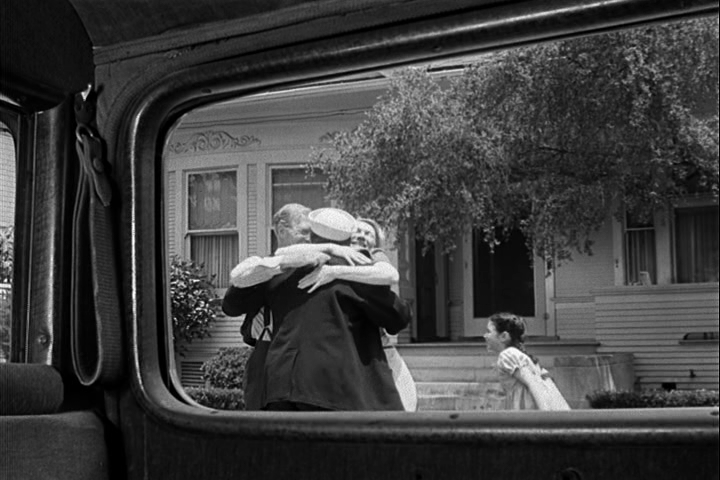
This week on “Picture Perfect,” it will be a much-needed reality check, as we pause to give thanks for the blessings of family, community, and country. Join me for selections from “The Cummington Story” (Aaron Copland), “Field of Dreams” (James Horner), “The Best Years of Our Lives” (Hugo Friedhofer), and “Lincoln” (John Williams). We’ll tune out the noise and focus on what’s really important for Thanksgiving, on “Picture Perfect,” music for the movies, this Saturday evening at 6:00 EST, on WWFM – The Classical Network and wwfm.org.
PHOTO: Homer’s homecoming in “The Best Years of Our Lives”
This week on “Picture Perfect,” we’re ready to take flight, at our new time – Saturday at 7 pm – with music from movies about airports and airplanes.
In the original “Airport” (1970), producer Irwin Allen established the prototype for disaster movies of all stripes by placing an all-star, aging cast in spectacular peril. Burt Lancaster! Dean Martin! George Kennedy! Jean Seberg! Jacqueline Bisset! Helen Hayes! The list goes on and on, longer than the longest runway. The bongo-laden theme is by veteran film composer Alfred Newman,” from the last of his over 200 scores.
Another movie with something of the same feel is “The V.I.P.s” (1963), allegedly inspired by the real-life love-triangle of Vivien Leigh, Laurence Olivier, and Peter Finch. The story is set at London Heathrow Airport, where flights are delayed because of a dense fog. The film was written by Terrence Rattigan and the parts cast from another laundry list of stars, including Elizabeth Taylor, Richard Burton, Louis Jourdan, Maggie Smith, Rod Taylor, and Orson Welles, with Margaret Rutherford in an Academy Award-winning performance. The music is by Miklós Rózsa.
By contrast, Steven Spielberg’s “The Terminal” (2004) is an (intentionally) comic take on the predicament of a hapless Eastern European who finds himself in a kind limbo, trapped in an international arrivals terminal in New York, after his country erupts into civil war, so that his passport and other documentation are no longer valid. His plight mirrors that of real-life Mehran Karimi Nasseri, an Iranian who lived for 17 years in a terminal at Charles de Gaulle Airport.
Tom Hanks plays the unfortunate traveler, who makes the terminal his home, and Catherine Zeta-Jones the airline attendant with whom he strikes up a relationship. The music is by regular Spielberg collaborator John Williams, and I think you’ll find it quite different from the Williams known for his work on “Star Wars” and “Indiana Jones.”
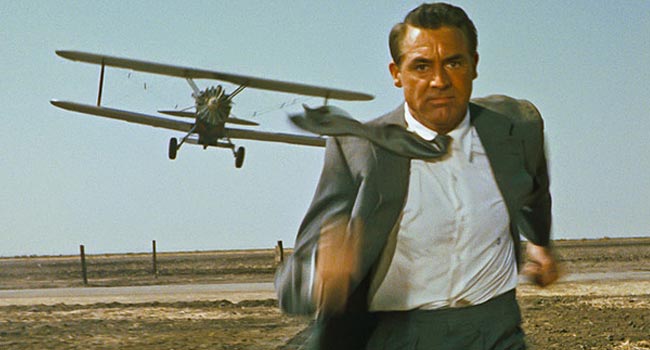
Finally, we’ll turn to the Alfred Hitchcock thriller “North by Northwest” (1959), a film in which Cary Grant encounters love and danger in, on, and from a variety of planes, trains, and automobiles. Planes are particularly significant. During the course of the film, it’s revealed that the title is in reference to a Northwest Airlines flight; Eve Kendall (Eva Marie Saint) must do all she can to avoid getting on a plane with Phillip Vandamm (James Mason); and of course, Roger Thornhill (Grant) flees from a strafing crop duster. Bernard Herrmann’s opening fandango propels us into the adventure.
Rush more to Rushmore. Departure time is this Saturday evening at 6:00 EDT, on “Picture Perfect” – music for the movies – on WWFM – The Classical Network and wwfm.org.
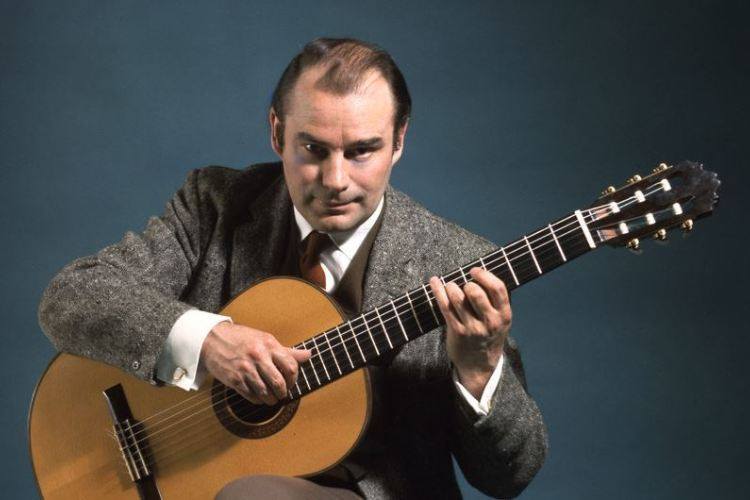
The classical music world is left unstrung. One of the foremost guitarists of his generation, Julian Bream, has died.
Bream, who was essentially self-taught on his instrument, was an acknowledged master of over 400 years of repertoire. Not content to live in the past, he also commissioned new works from – or had them written for him by – Sir Malcolm Arnold, Sir Richard Rodney Bennett, Leo Brouwer, Hans Werner Henze, Sir Peter Maxwell Davies, Toru Takemitsu, Sir Michael Tippett, and Sir William Walton, to name but a few.
He set up his own consort, with which he revived music of the Tudor era and made many recordings on the lute. His services as a lutenist were employed for the premiere of Benjamin Britten’s “Gloriana,” written to celebrate the coronation of Elizabeth II. Bream subsequently arranged the opera’s courtly dances for the instrument, which he then recorded. In turn, Britten composed several other works for Bream, including at least one milestone of the 20th century classical guitar repertoire, his “Nocturnal, after John Dowland.”
In a valedictory comment, quoted by the BBC, Bream offered, “I devoted my life to music for a reason, and the reason wasn’t because I wanted to get on or make money, but to try to fulfil myself and also to give people pleasure. That’s been my credo.”
Julian Bream was 87 years-old.
Twin titans of the guitar, Bream and John Williams (not to be confused with the film composer), in concert:
Bream attempts to woo Stravinsky with the lute:
“Nocturnal, after John Dowland”:
Charming documentary, “Julian Bream: My Life in Music”:
Is “Close Encounters of the Third Kind” the most musical non-musical blockbuster ever made?
I don’t know at what point I recognized Zoltán Kodály’s contribution to “CE3K.” It was certainly not as an 11-year-old boy, which is how old I was at the time I was first spooked and awed by Steven Spielberg’s UFO masterpiece. But somewhere along the way, Kodály took on more significance than simply an exotic-looking name on a chart.
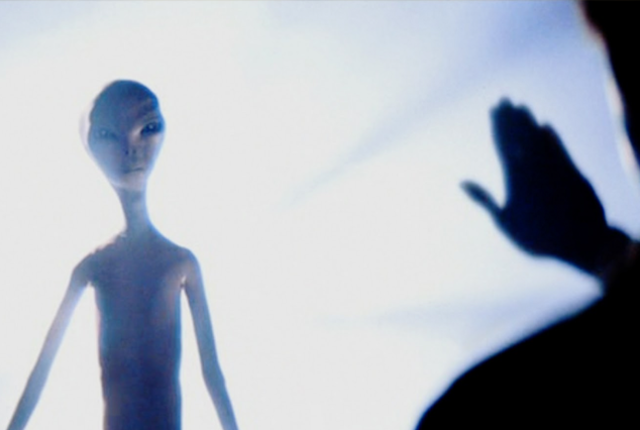
In addition to being one of Hungary’s most respected composers – with his friend, Béla Bartók, at the forefront of the whole Hungarian nationalist movement – Kodály was extremely influential in the field of music education. The hand signals employed by François Truffaut’s Claude Lacombe, when he addresses a conference of UFO scientists and researchers, correspond to specific musical tones. The signals are an integral part of the Kodály method, and they contribute to the film’s memorable climax. Millions who have never heard of Kodály outside the context of “CE3K” will be familiar with the five-signal sequence.
Of course, music imbues just about every aspect of Spielberg’s storytelling. Composer John Williams went through over 300 permutations of the five-notes-to-a-theme before arriving at the now-iconic motive that ties the whole film together. There was no “aha! moment.” It was only after Spielberg learned there were over 130,000 possibilities that they just settled on a sequence they thought would be effective. A significant portion of the score for the last half hour of “CE3K” would be recorded in advance of the actual filming. It’s a rare luxury for composers to have a film cut to their music, as opposed to the other way around, but this is what was done, necessarily, for the film’s climactic encounter.
At the time, Williams’ “CE3K” theme was widely parodied and likely as well recognized as his theme for “Jaws.” His score would be nominated for an Academy Award in 1978. He actually wound up losing to himself, for “Star Wars.” A banner year for John Williams!
Interestingly, the composer tailored a cello solo specifically for Eleanor Aller Slatkin, formerly of the legendary Hollywood String Quartet. Aller was the widow of violinist Felix Slatkin and the mother of conductor Leonard Slatkin. She had been active in Hollywood since the 1940s, introducing Erich Wolfgang Korngold’s Cello Concerto in the film “Deception,” with Bette Davis and Claude Rains. Paul Henreid “played” the concerto onscreen.
French pianist and educator Odette Gartenlaub, a Messiaen pupil and solfège authority who taught at the Paris Conservatory, has a cameo during the climactic extraterrestrial communication scene.
And of course, “When You Wish Upon a Star” is heard on a music box early in the narrative, only to be picked up in Williams’ underscore during the film’s apotheosis. Spielberg said that he relied on the spirit of the song as a kind of guide for the overall feeling he wanted “CE3K” to convey.
“Close Encounters” is a work of great humanity, wonder and hope. Is it any wonder that music would play such an important role? In a story in which so many of the human characters experience frustration in their spoken interactions, running up against all kinds of barriers to effective communication, the key to universal understanding turns out to be music. It is one of the most satisfying and uplifting movies about music ever made. Unusually, it also seems to get everything right.
There were many experienced hands involved in the writing of the film, but in the end it was Spielberg who received the sole screen credit. Somebody really knew their music. I wonder who directed Spielberg to Kodály?
For further reflections on “CE3K,” join Roy Bjellquist and me – with a special appearance by my brilliant cousin, Joseph R. Metz – on the next “Roy’s Tie-Dye Sci-Fi Corner,” to be live-streamed on Facebook this Friday evening at 7:00 EDT.
COVID may have robbed us of a “Picture Perfect” tenth anniversary celebration. Luckily, there’s something else to make noise about! On the eve of Independence Day, we’ll drown our disappointment with an hour of cinematic fifes and drums.
We’ll hear selections from the 2000 film “The Patriot,” in which slow-burning pacifist Mel Gibson is pushed too far by ruthless British officer Jason Isaacs and reverts to his bloody French and Indian War ways. Wow! Who knew Mel had a temper? By the end of the film, he is literally waving the flag to John Williams’ triumphant score.
In a somewhat gentler spirit, but no less subtle, we’ll also hear a suite from the 1942 Jack Benny-Ann Sheridan fixer-up comedy, “George Washington Slept Here,” based on the play by Moss Hart and George S. Kaufman – not really about the Revolution, beyond the fact that the ramshackle Pennsylvania farm house purchased by a transplanted New York couple is alleged to have been the resting place of the Revolution’s most famous general. The music is by Adolph Deutsch.
What happened with “Revolution?” The 1985 film seemed to have everything going for it. The director was Hugh Hudson, whose “Chariots of Fire” was the big winner at the 1981 Academy Awards; its star was Al Pacino; and its composer was John Corigliano, who went on to win the Pulitzer Prize for Music for his Symphony No. 2 and an Academy Award for “The Red Violin.” Yet “Revolution” bombed horribly – so horribly that Pacino gave up making movies for the next four years! James Galway plays the flute and penny whistle on the film’s soundtrack, as he would later for the more successful “The Lord of the Rings.”
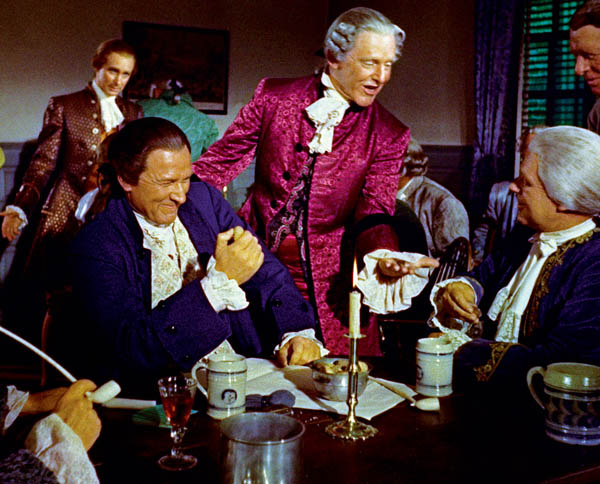
Finally, we’ll hear music from the longest continuously-shown film in cinematic history, “Williamsburg: The Story of a Patriot,” created exclusively for the tourist attraction of Colonial Williamsburg. The film features future “Hawaii Five-O” star Jack Lord, and the score is by none other than Bernard Herrmann.
Here’s a clip from “Williamsburg,” with some of Herrmann’s music:
We celebrate Independence Day this week – and ten years of “Picture Perfect,” music for the movies – this Friday evening at 6:00 EDT, on WWFM – The Classical Network and wwfm.org.
PHOTO: George Washington wagers he can crack a walnut with his bare hand in “Williamsburg: The Story of a Patriot”