Tag: KWAX

  • Comic Strip Heroes Music From the Movies on KWAX

    Comic Strip Heroes Music From the Movies on KWAX

    Get out your Silly Putty! There will be plenty of vibrant colors for you to enjoy this week on “Picture Perfect,” when the focus will be on comic adventurers – as in heroes from the funnies.

    We’ll have music from movies inspired by the two-dimensional cliffhangers of newspaper favorites Prince Valiant, The Phantom, and Dick Tracy, as well as the longer-form, Golden Age adventures of Tintin.

    “Prince Valiant” (1954) brings to life Hal Foster’s enduring Sunday strip about the exploits of a Viking prince at the court of King Arthur. Robert Wagner dons the signature page-boy haircut at the head of a hodge podge cast that also includes Janet Leigh, James Mason, Sterling Hayden, and Victor McLaglen (as Val’s Viking pal Boltar). The film also happens to feature one of Franz Waxman’s most rousing scores, clearly a prototype for the kind of music that later made John Williams a household name.

    Then Billy Zane is “The Ghost Who Walks,” in a big screen adaptation of Lee Falk’s “The Phantom” (1996). Like Batman, The Phantom harnesses personal tragedy – in his case, the murder of his father – to a thirst for justice. He also happens to be part of an ancient lineage of Phantoms, who don the purple suit and fight crime from a secluded skull cave in a remote African country. The memorable, though somewhat monothematic, score is by David Newman, one of the sons of legendary Hollywood composer Alfred Newman.

    Warren Beatty directs an amusing adaptation of Chester Gould’s “Dick Tracy” (1990), replete with primary color production design and meticulously applied prosthetic makeup, transforming some of the most respected actors of the day (including Al Pacino, Dustin Hoffman, and James Caan) into a live-action Rogue’s Gallery. Both design and makeup were recognized with Academy Awards, as was Stephen Sondheim, for his original song “Sooner or Later (I Always Get My Man),” sung in the film by Madonna. We won’t hear Sondheim’s song, but we will hear some of Danny Elfman’s underscore, which harkens back to Hollywood’s Golden Age.

    Finally, we’ll turn from American newspaper strips to the comic albums of Belgian cartoonist Hergé, and his most famous creation, Tintin, an intrepid journalist whose stories seem always to embroil him in globetrotting adventures. Developed for the screen by Steven Spielberg and Peter Jackson, “The Adventures of Tintin” (2011) was shot as 3-D motion capture animation.

    After 50 years in the business, during which he wrote music for all manner of films, in virtually every genre, John Williams finally got a crack at scoring an animated feature. The result was a double Academy Award nomination, as Williams had also written the music that year for Spielberg’s “War Horse.” Not bad for a 79 year-old composer.

    Unfortunately, “Tintin” never gained the kind of traction with the public that the filmmakers had hoped for, otherwise the score would certainly be much better known, as it is cut from the same cloth – and is of the same high quality – as those for the “Star Wars,” Indiana Jones, and Harry Potter series.

    We’ll see you in the funny pages, this week on “Picture Perfect,” music for the movies, now in syndication on KWAX, the radio station of the University of Oregon!


    Remember, KWAX is on the West Coast, so there’s a three-hour difference for the Trenton-Princeton area. Here are the respective air-times of my recorded shows (with East Coast conversions in parentheses):

    PICTURE PERFECT, the movie music show – Friday on KWAX at 5:00 PACIFIC TIME (8:00 PM EST)

    THE LOST CHORD, unusual and neglected rep – Saturday on KWAX at 4:00 PACIFIC TIME (7:00 PM EST)

    Stream them here!

    https://kwax.uoregon.edu/

  • Thanksgiving Movie Music on KWAX

    Thanksgiving Movie Music on KWAX

    “Do any human beings ever realize life while they live it? Every, every minute?”

    This poignant observation, from Thornton Wilder’s “Our Town,” stands as a timely reminder that there are things we should all be thankful for, while they – and we – are here to appreciate them.

    This week on “Picture Perfect,” we’ll set the table for Thanksgiving.

    None other than Aaron Copland wrote the music for the big screen adaptation of Wilder’s Pulitzer Prize winning play (first performed in Princeton in 1938). The composer was at the height of his “populist” period. “El Salon Mexico” and “Billy the Kid” had already been written, and “Fanfare for the Common Man,” “Lincoln Portrait,” “Rodeo” and “Appalachian Spring” would follow within just a few years. Clearly, there was no better choice to capture the essence of small town America.

    The concert version of “Our Town” has been in circulation for decades, but it was only in 2011 that a complete recording of the score was made available, briefly, as a digital download.

    Gary Cooper and Dorothy McGuire star in “Friendly Persuasion” (1956), based on the novel by Jessamyn West. The film’s portrayal of family and the resolution of moral conflict, as pacifist Quakers deal with issues both big and small – from the American Civil War, to the introduction of a “sinful” musical instrument into the household – make “Friendly Persuasion,” in my opinion, a good choice for this time of year.

    The film was up for six Oscars, with Dimitri Tiomkin’s score nominated twice. The title song went on to become the popular hit “Thee I Love.” Only Dimitri Tiomkin would use balalaikas to depict Quaker life!

    “Witness” (1985) may seem like an unusual choice for Thanksgiving, with its themes of police corruption and violence, but when honest cop Harrison Ford goes on the lam, he experiences the “plain” lifestyle of a close-knit Amish community. The highlight of Maurice Jarre’s score is a sequence called “Building the Barn,” in which the community comes together to raise a barn for a newly married couple.

    Finally, we’ll hear selections from “Plymouth Adventure” (1952), with its depictions of William Bradford, John Alden, Miles Standish, and Priscilla Mullins. Spencer Tracy stars as the cynical captain of The Mayflower, Gene Tierney is his forbidden love interest, Van Johnson appears as Alden, and Lloyd Bridges is the first mate.

    The music is by Miklós Rózsa, who already, at this stage of his career, was MGM’s go-to composer for historical drama. Seven years later, Rózsa would take home his third Academy Award for his classic score to “Ben-Hur.”

    It’s never too early to give thanks. There’s not a turkey among them, this week on “Picture Perfect,” music for the movies, now in syndication on KWAX, the radio station of the University of Oregon!


    Remember, KWAX is on the West Coast, so there’s a three-hour difference for the Trenton-Princeton area. Here are the respective air-times of my recorded shows (with East Coast conversions in parentheses):

    PICTURE PERFECT, the movie music show – Friday on KWAX at 5:00 PACIFIC TIME (8:00 PM EST)

    THE LOST CHORD, unusual and neglected rep – Saturday on KWAX at 4:00 PACIFIC TIME (7:00 PM EST)

    Stream them here!

    https://kwax.uoregon.edu/


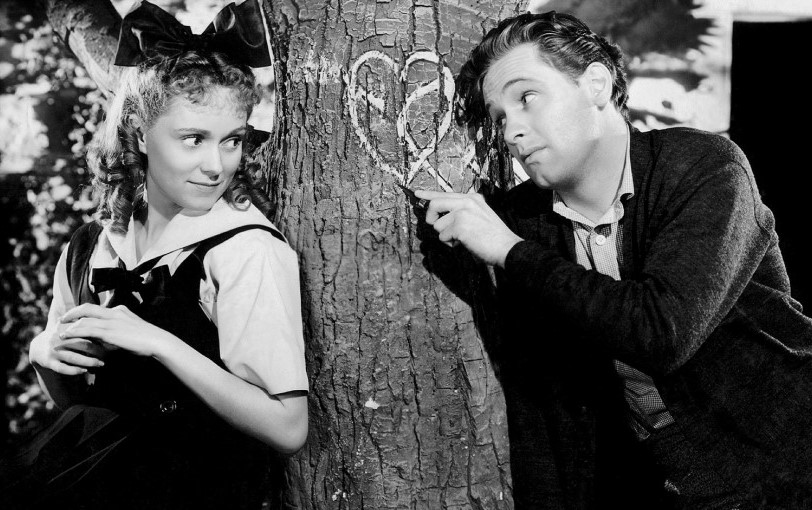
    Martha Scott and William Holden make their mark in “Our Town” (1940)

  • Ennio Morricone Maestro of the Spaghetti Western

    Ennio Morricone Maestro of the Spaghetti Western

    It often frustrated Ennio Morricone that he was so identified with the spaghetti western. After all, he composed music for some 500 film and television productions, of which only a few dozen were set in a highly stylized American west – more often than not recreated in Spain. It’s the price to pay for having brilliantly revitalized an exhausted genre.

    Primarily for budgetary reasons (the Italians didn’t have the luxury of Hollywood’s overflowing coffers), but also, in part, as a reaction to the ballad scores of Dimitri Tiomkin and the neo-Coplandisms of Elmer Bernstein, Morricone brought his own quirky sensibility to bear on the classic western iconography. His music is offbeat, ear-catching, and almost absurdly cool.

    This week on “Picture Perfect,” we’ll celebrate Morricone’s birthday (he was born on this date in 1928) with a heaping helping of spaghetti and selections from his scores for “A Fistful of Dollars” (1964), “For a Few Dollars More” (1965), “Once Upon a Time in the West” (1968), “Navajo Joe” (1966), and “The Good, the Bad and the Ugly” (1966).

    His striking music for Sergio Leone’s “Dollars” trilogy, especially that for “The Good, the Bad and the Ugly,” became some of the most iconic of all time, frequently parodied, and as much a part of our collective cultural consciousness as that for “Jaws” and “Psycho.”

    Morricone died in 2020 at the age of 91. His only competitive Oscar was for the Quentin Tarantino’s “The Hateful Eight” (allegedly a spaghetti western homage) in 2016. Previously, he was nominated for “Days of Heaven” (1978), “The Mission” (1986), “The Untouchables” (1987), “Bugsy” (1991), and “Malena” (2000). He received an honorary award from the Academy in 2007.

    Get ready for a serenade of clangy surfer guitars, whistles, harmonicas, whips, gunshots, jaw harps, preening trumpets, coyote howls, shrieks, wails, and barking male choruses.

    Happy birthday, Ennio Morricone. Grazie, Maestro, for all the Colts and carbs. We’ll be ladling out the spicy marinara on “Picture Perfect,” music for the movies, now in syndication on KWAX, the radio station of the University of Oregon!


    Remember, KWAX is on the West Coast, so there’s a three-hour difference for the Trenton-Princeton area. Here are the respective air-times of my recorded shows (with East Coast conversions in parentheses):

    PICTURE PERFECT, the movie music show – Friday on KWAX at 5:00 PACIFIC TIME (8:00 PM EST)

    THE LOST CHORD, unusual and neglected rep – Saturday on KWAX at 4:00 PACIFIC TIME (7:00 PM EST)

    Stream them here!

    https://kwax.uoregon.edu/


    The Spaghetti Western Database – SWDb

  • Ernest Fanelli’s Lost Mummy Masterpiece

    Ernest Fanelli’s Lost Mummy Masterpiece

    By the time his music was performed publicly, it had been 18 years since the composer had stopped writing.

    Ernest Fanelli is one of those poor, unsung prophets of music history who wrote works brimming with colorful ideas, expressed well ahead of their time. He was underappreciated, unnoticed, or fell short of his overall potential, yet later masters capitalized, either wittingly or unwittingly, on his remarkable innovations. Others undoubtedly lifted his discoveries to greater heights, but that doesn’t change the fact that Fanelli got there first.

    This week on “The Lost Chord,” with Halloween only days away, we rediscover this forgotten composer and exhume his seminal masterpiece, “The Romance of the Mummy.”

    It’s fairly obvious that Fanelli’s unpublished manuscript fueled the imagination of Claude Debussy, who in turn not only influenced the course of French music, but also changed the way artists and audiences thought about music heading into 20th century. That’s not to say that Fanelli was of the same caliber as Debussy. But like Hans Rott, whose lone symphony clearly influenced Mahler, he is an essential footnote in the history of a new kind of music.

    Episodes from “The Romance of the Mummy” anticipate not only Debussy and Ravel, but also Paul Dukas and Florent Schmitt, Holst, Sibelius, Respighi, Richard Strauss and even Stravinsky, a figure Fanelli would not have known. Not all of these composers were familiar with Fanelli’s work – in many cases, it’s simply a matter of music history finally catching up – but Debussy most probably was. When Fanelli’s “Mummy” was finally given its first public hearing, Debussy did his best to distance himself from the composer. He was even known to have done an about-face if he happened to walk into a café and saw Fanelli sitting at the piano.

    Fanelli lived from 1860 to 1917. A French composer of Italian descent, he studied at the Paris Conservatory for a stint – allegedly under Charles-Valentin Alkan (although it’s unlikely, since Alkan had already quit the Conservatory by the time he entered). Later, he returned to study under Léo Delibes. Fanelli was unable to complete either course, due to lack of funds. In the meantime, he eked out a career as a percussionist.

    He was seeking employment as a copyist in 1912, when he showed Gabriel Pierné an example of his handwriting from one of his unpublished manuscripts, written some 30 years earlier. Pierné was so taken by the actual music that he arranged for the “Mummy’s” belated premiere.

    “The Romance of the Mummy,” based on a novel by Théophile Gautier, tells the tale of an English archaeologist, who exhumes and falls in love with – well, a mummy. Papyrus rolls in her mausoleum reveal her back-story and fate. She is Tahoser, who falls in love of Poeri, a handsome Hebrew. The Pharaoh (unnamed, though it would have been Ramses II) desires Tahoser for himself. However, the lovely young woman falls ill when she finds Poeri is in love with Rachel. She is healed by the prophet Moses, who initiates her into the cult of Jehovah. Pharaoh becomes an enemy of the Jewish people and abducts Tahoser. When he dies in the Red Sea, in circumstances described in the Book of Exodus, Tahoser is crowned Queen of Egypt. Hence, her presence in the pharaoh’s tomb.

    The first set of tableaux is titled “Thebes,” and is made up of the subsections “Before Tehoser’s Palace,” “On the Nile,” and “Triumphal Return of the Pharaoh.”

    It was the conductor Adriano who discovered a second set of tableaux in the music library of Radio France, titled “Festivities in the Pharaoh’s Palace.” The three subsections of the second set are called “In a Room in the Palace – The Naked Jugglers,” “Grotesque Dance of the Egyptian Jesters,” and “Triumphant Hymns – Orgy.” The music received its first performance only in 2002 for this release, issued on the Marco Polo label.

    Is it love or infatuation? Peer behind the bandages of music history on “Mummy Dearest,” on “The Lost Chord,” now in syndication on KWAX, the radio station of the University of Oregon!


    Remember, KWAX is on the West Coast, so there’s a three-hour difference for the Trenton-Princeton area. Here are the respective air-times of my recorded shows (with East Coast conversions in parentheses):

    PICTURE PERFECT, the movie music show – Friday on KWAX at 5:00 PACIFIC TIME (8:00 PM EDT)

    THE LOST CHORD, unusual and neglected rep – Saturday on KWAX at 4:00 PACIFIC TIME (7:00 PM EDT)

    Stream them here!

    https://kwax.uoregon.edu/

  • Exorcist Curse Strikes Rescheduled Discussion

    Exorcist Curse Strikes Rescheduled Discussion

    In case you haven’t heard yet, our discussion about “The Exorcist,” which was to have taken place tonight on Roy’s Tie-Dye Sci-Fi Corner, has had to be rescheduled. Roy and I are now planning our palaver about Pazuzu for this Sunday. If there was ever any doubt, the “Exorcist curse” is real! Be sure to join us in the comments section. Captain Howdy will be our moderator, when we livestream on Facebook, YouTube, etc., this Sunday evening at 7:00 EDT!

    https://www.facebook.com/roystiedyescificorner

    Actually, now you’re free to listen to “Picture Perfect,” my film music show, on KWAX tonight at 8:00 EDT!

    Stream it here:

    https://kwax.uoregon.edu/

Tag Cloud

Aaron Copland (92) Beethoven (95) Composer (114) Film Music (123) Film Score (143) Film Scores (255) Halloween (94) John Williams (187) KWAX (229) Leonard Bernstein (101) Marlboro Music Festival (125) Movie Music (138) Opera (202) Philadelphia Orchestra (89) Picture Perfect (174) Princeton Symphony Orchestra (106) Radio (87) Ralph Vaughan Williams (85) Ross Amico (244) Roy's Tie-Dye Sci-Fi Corner (290) The Classical Network (101) The Lost Chord (268) Vaughan Williams (103) WPRB (396) WWFM (881)

DON’T MISS A BEAT

Receive a weekly digest every Sunday at noon by signing up here


RECENT POSTS