Tag: Marlboro Music Festival

  • Schubert Octet Marlboro Music Festival WWFM

    Schubert Octet Marlboro Music Festival WWFM

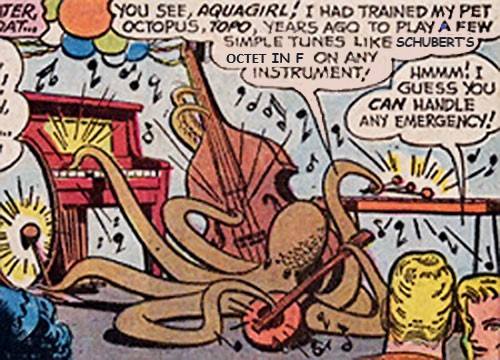
    Just as the octopus can extend its mastery to eight instruments, so can “Music from Marlboro” expand to an hour and ten minutes.

    Join me this afternoon at a special time to enjoy a complete performance of Franz Schubert’s Octet in F major, D. 803. Not to denigrate the musical abilities of a mollusk, but a cephalopod would have to go an awfully long way to match the prowess of Joseph Genualdi and Felix Galimir, violins; Steven Tenenbom, viola; Peter Wiley, cello; Peter Lloyd, double bass; Shannon Scott, clarinet; Alexander Heller, bassoon; and David Jolley, horn. Musicians from the Marlboro Music Festival took the piece on tour, with Mozart’s “Eine kleine Nachtmusik,” in 1987.

    Tune in ten minutes earlier than usual for Schubert’s expansive masterwork, the Octet in F major – in its entirety – on the next “Music from Marlboro,” this Wednesday evening at 5:50 EDT, on WWFM – The Classical Network and wwfm.org.

    Marlboro School of Music and Festival: Official Page

  • Sibelius & Schubert Marlboro Chamber Music

    Sibelius & Schubert Marlboro Chamber Music

    Save me, Sibelius! I can’t take it any longer.

    We’ll attempt to beat the heat with the one and only chamber work from the great Finnish master’s maturity – the String Quartet in D minor. It’s subtitle, “Voces Intimae,” suggests a looking inward. That’s fine with me. There’s no sun inside.

    The piece was composed in 1909, between the Third and Fourth Symphonies. Sibelius wrote to his wife, Aino, “It turned out as something wonderful. The kind of thing that brings a smile to your lips at the hour of death. I will say no more.” Ah, sweet nothings.

    We’ll hear it performed at the 2005 Marlboro Music Festival, by Dan Zhu and Sarah Kapustin, violins; Samuel Rhodes, viola; and Amir Eldan, cello.

    Then we’ll enjoy another presentiment of death – Franz Schubert’s Introduction and Variations on his lied, “Trock’ne Blumen” (“Withered Flowers”), from the song cycle “Die schöne Müllerin.” Paula Robison will be the flutist and Marlboro co-founder Rudolf Serkin the pianist, in a recording from 1968.

    Nothing refreshes on a hot day like cold wind from the grave, on this week’s “Music from Marlboro” – chamber music performances from the legendary Marlboro Music Festival – this Wednesday evening at 6:00 EDT, on WWFM – The Classical Network and wwfm.org.

    Marlboro School of Music and Festival: Official Page

  • Marlboro Music B-Flat Bliss Mozart Beethoven

    Marlboro Music B-Flat Bliss Mozart Beethoven

    With heat index values of 105, there is nothing to be done but be flat – or B flat, as the case may be.

    On this week’s “Music from Marlboro,” I’ll make few demands on a sweltering listenership by offering works by Mozart and Beethoven, both in the key of B flat.

    Beethoven’s Piano Trio, Op. 97, known as the “Archduke,” was one of 14 works the composer wrote for his friend and patron Archduke Rudolf of Austria. Rudolf, an amateur pianist, was the youngest child of Holy Roman Emperor Leopold II.

    Beethoven himself appeared at the keyboard at the work’s premiere in 1814. His encroaching deafness so diminished his former prowess as a performer that he retired from concertizing after a repeat performance a few weeks later. The violinist and composer Louis Spohr summed up the discomfort and pity felt by those in attendance, “I am deeply saddened by so hard a fate.”

    The music remains unbowed. Today, the “Archduke” Trio is as noble and inspiring as ever.

    We’ll hear it performed at the 2006 Marlboro Music Festival by pianist Mitsuko Uchida – Marlboro’s sole artistic director since 2013 (next year she’ll be joined by Jonathan Biss) – violinist Soovin Kim, and cellist David Soyer of the legendary Guarneri Quartet.

    The hour will open with a delightful work by Mozart – his Sonata in B-flat for Bassoon and Cello, K. 292. The 1975 performance will feature bassoonist Alexander Heller and a 19 year-old cellist named Yo-Yo Ma.

    The performances are unfailingly at pitch, even when we’re all flat. Join me for music in B flat on this week’s “Music from Marlboro,” this Wednesday evening at 6:00 EDT, on WWFM – The Classical Network and wwfm.org.

    Marlboro School of Music and Festival: Official Page

  • Dvořák & Janáček: Czech Masterworks from Marlboro

    Dvořák & Janáček: Czech Masterworks from Marlboro

    What’s a party without a little Czechs Mix?

    On the next “Music from Marlboro,” for your Wednesday cocktail hour, we’ll snack on two masterworks by Antonin Dvořák and Leoš Janáček.

    Dvořák’s unpretentious “Serenade for Winds” was given its premiere in 1878. The composer was 37 years-old. The serenade is written in the tried-and-true “Slavonic style” that established Dvořák’s fame. Its instrumentation and emphasis on melody recall occasional and ceremonial serenades of the 18th century.

    We’ll hear a recording made in 1957, with oboists Alfred Genovese and Earl Shuster, clarinetists Harold Wright and Richard Lesser, bassoonists Anthony Cecchia and Roland Small, hornists Myron Bloom, Richard Mackey, and Christopher Earnest, cellists Yuan Tung and Dorothy Reichenberger, and double bassist Raymond Benner, all under the direction of Louis Moyse.

    Janáček String Quartet No. 2 is a serenade of a different sort. The composer’s remarkably prolific Indian summer can be attributed in part to the sublimated passion he felt for Kamila Stösslová, a married woman some 38 years his junior. The quartet, composed in 1928, when the composer was about 74 years-old, was inspired by their long and intimate – though unconsummated – relationship, detailed in their more than 700 letters. The work has been described as a “manifesto on love.”

    We’ll hear Janáček’s “Intimate Letters” performed at the 2002 Marlboro Music Festival by violinists Nicholas Kendall and Hiroko Yajima, violist Richard O’Neill, and cellist Alexis Pia Gerlach.

    You bring the drinks; I’ll supply the music – on the next “Music from Marlboro,” this Wednesday evening at 6:00 EDT, on WWFM – The Classical Network and wwfm.org.

    Marlboro School of Music and Festival: Official Page

  • Verdi, Mendelssohn & Italian Music from Marlboro

    Verdi, Mendelssohn & Italian Music from Marlboro

    Viva Italia!

    We’re off to sunny Italy for this week’s “Music from Marlboro.”

    Like a kind of musical Hannibal, Giuseppe Verdi brought elephants to the operatic stage. The premiere of “Aida” in Cairo in 1871 featured a dozen pachyderms and fifteen camels into the bargain. But when a Naples performance of Verdi’s grandest grand opera was delayed, the composer sought diversion on a much smaller scale. Verdi tossed off his first piece of chamber music at the age of 60.

    The String Quartet in E minor was given an informal performance at the Hotel delle Crocelle on April 1, 1873. Said Verdi of his latest creation, “I don’t know whether the Quartet is beautiful or ugly, but I do know that it’s a Quartet!” We’ll get to hear it in a 1969 performance featuring violinists Pina Carmirelli and Endre Granat, violist Martha Strongin Katz, and cellist Ronald Leonard.

    Felix Mendelssohn’s Symphony No. 4 – known as the “Italian” – had its origins in a European tour undertaken by the composer between 1829 and 1831. Mendelssohn’s Italian sojourn threw him into ecstasies. In a letter to his parents, he effused, “Italy at last! …[W]hat I have all my life considered as the greatest possible felicity is now begun, and I am basking in it. …[T]hank you, my dear parents, for having given me all this happiness.”

    The composer did his best to capture his impressions in music. The symphony’s first performance in London in 1833, which Mendelssohn himself conducted, made him the most emulated composer in England for the remainder of the 19th century. However, despite the work’s overwhelmingly positive reception, he continued to feel a nagging dissatisfaction with it. He revised the symphony in 1834, with plans for further changes, and the score was never published in his lifetime. He even claimed that it caused him some of the bitterest moments of his career. Naturally, it went on to become his best-loved symphony.

    We’ll hear Pablo Casals lead an enviable roster of musicians from the 1963 Marlboro Music Festival. It’s difficult to single anyone out, but Bernard Goldberg, John Mack, Myron Bloom, Shmuel Ashkenasi, Jaime Laredo, Caroline Levine, Irene Serkin, Sidney Curtiss, Samuel Rhodes, Herman Busch, Lynn Harrell, Julius Levine, and all four members of the Guarneri String Quartet are among the personnel. Casals was affiliated with Marlboro for the last 13 years of his life, from 1960 until his death, at the age of 96, in 1973.

    We’ve got sunshine on a rainy day on the next “Music from Marlboro,” this Wednesday evening at 6:00 EDT, on WWFM – The Classical Network and wwfm.org.


    This summer’s Marlboro Music Festival continues through August 12. Find out more at marlboromusic.org.

    Marlboro School of Music and Festival: Official Page
Tag Cloud

Aaron Copland (92) Beethoven (95) Composer (114) Film Music (123) Film Score (143) Film Scores (255) Halloween (94) John Williams (187) KWAX (229) Leonard Bernstein (101) Marlboro Music Festival (125) Movie Music (138) Opera (202) Philadelphia Orchestra (89) Picture Perfect (174) Princeton Symphony Orchestra (106) Radio (87) Ralph Vaughan Williams (85) Ross Amico (244) Roy's Tie-Dye Sci-Fi Corner (290) The Classical Network (101) The Lost Chord (268) Vaughan Williams (103) WPRB (396) WWFM (881)

DON’T MISS A BEAT

Receive a weekly digest every Sunday at noon by signing up here


RECENT POSTS