Tag: Marlboro Music Festival

  • British Composers at Marlboro: Vaughan Williams & Bax

    British Composers at Marlboro: Vaughan Williams & Bax

    On this week’s “Music from Marlboro,” we’ll be doing some real Channel surfing – the English Channel, that is – with two works by British composers who were steeped in cross-cultural currents.

    Ralph Vaughan Williams studied in Paris with Maurice Ravel for three months in 1907-08. Ravel took few pupils, but he said of Vaughan Williams, “he is my only pupil who does not write my music.” For his part, Vaughan Williams credited Ravel with helping him to overcome a heavy Germanic influence. Ravel had the effect of lightening the textures in Vaughan Williams’ music and sharpening his focus.

    Vaughan Williams’ “Phantasy Quintet” of 1912 was one of numerous works commissioned from England’s great composers by one Walter Wilson Cobbett, a businessman and amateur musician whose dual passions were chamber music and music of the Elizabethan era. (“Phantasy” was Cobbett’s preferred spelling.) The quintet is full of Tudor inflections and stamped by Vaughan Williams’ tell-tale love of folk music. The composer doubles his violas, and the instrument is heard to great effect throughout the piece. We’ll hear a performance from the 1975 Marlboro Music Festival, with James Buswell and Sachiko Nakajima, violins; Philipp Naegele and Caroline Levine, viola; and Anne Martindale, cello.

    Sir Arnold Bax composed his evocative “Elegiac Trio” in 1916. The work, scored for flute, viola, and harp, appeared the year after Claude Debussy’s trio for the same instrumental combination. Its alluring melancholy emerged from a world at war. Bax was especially affected by escalating tensions between England and his beloved Ireland, which had just boiled over into violence with the Easter Rising. We’ll hear a performance of the trio from 1978, with Carol Wincenc, flute; Caroline Levine, viola; and Moya Wright, harp.

    Ravel too had his influences. His String Quartet in F major, composed in 1903, when he was 28 years-old, bears a superficial resemblance to Debussy’s famous quartet. But whereas Debussy’s aim was to obscure the rules of classical harmony in a sensual pursuit of greater artistic freedom – he confided to his diary, “Any sounds in any combination and in any succession are henceforth free to be used in a musical continuity” – Ravel returned to classical standards, revealing his mastery through quiet innovation within traditional forms. We’ll hear a performance from 2007, with Soovin Kim and Jessica Lee, violins; Jonathan Vinocour, viola; and Scott Bae, cello; from a concert that took place at the Isabella Stewart Gardner Museum in Boston, MA.

    Musicians from Marlboro tour several times throughout the year. The final tour of this season will take place from April 29 to May 6, with stops in Greenwich, CT (at Greenwich Library); New York City (Weill Recital Hall at Carnegie Hall); Philadelphia (Perleman Theater at the Kimmel Center for the Performing Arts); Washington, DC (Freer Gallery’s Meyer Auditorium); and Boston (the Isabella Stewart Gardner Museum). On the program will be Haydn’s String Quartet in D major, Op. 20, No. 4; Krzysztof Penderecki’s String Trio; and Johannes Brahms’ String Quintet No. 1 in F major, Op. 88. You’ll find more information at marlboromusic.org.

    It’s a Franco-British alliance this week, on “Music from Marlboro.” Join me Wednesday at 6 p.m. EDT, on WWFM – The Classical Network and wwfm.org.

    Marlboro School of Music and Festival: Official Page


    A bewhiskered Maurice Ravel in 1907, the year he met Ralph Vaughan Williams

  • Stokowski Strauss Hindemith Marlboro School

    Stokowski Strauss Hindemith Marlboro School

    He shook hands with Mickey Mouse, married Gloria Vanderbilt, and signed a ten-year recording contract at the age of 90. Why, it’s LEOPOLD! Join me this afternoon at 4:00 on The Classical Network as we dip a toe into the recorded legacy of Leopold Stokowski, on his birthday.

    It’s also the anniversary of the birth of famed film composer Miklós Rózsa. Rózsa titled his autobiography “A Double Life.” Following his lead, we’ll hear examples of both his film and concert music. And I suppose – Franz von Suppé also having been born on this date – we’ll toss in one of Suppé’s frothy overtures, as well. Like Stokowski, Suppé got a fair amount of mileage out of being parodied in cartoons, so we should all be thankful for the movies, for having granted wide exposure to all three of today’s birthday celebrants.

    At 6:00, it’s another “Music from Marlboro.” This week, we’ll hear works by two composers of German origin, who travelled very different routes, Richard Strauss (1864-1949) and Paul Hindemith (1895-1963).

    Both men found much notoriety as nerve-shattering iconoclasts – Strauss with his operas “Salome” and “Elektra” and Hindemith with his raucous works of the 1920s. Then they settled into respectability, Strauss ageing into the elder statesman of Romantic opulence, and Hindemith becoming an influential teacher at Yale. The two men chose different paths during the Nazi Regime. Hindemith, denounced as an “atonal noisemaker” by Goebels, left for America, by way of Switzerland and Turkey, while Strauss, in his 70s with the outbreak of war, remained at home, hoping to preserve and promote German music and to protect his Jewish daughter-in-law and grandchildren. While understanding Strauss’ importance as a propaganda tool, Goebels wasn’t too fond of his music, either, referring to him privately as a “decadent neurotic.”

    But we’ll avoid all that, and instead listen to Strauss at the very beginning of his career, in 1883-84, and a Piano Quartet in C minor completed at the age of 20. Interestingly for this composer who became celebrated for the apotheosis of the lavish tone poem, Strauss here channels his admiration for Johannes Brahms, and in a genre not generally associated with a follower of the post-Wagnerian “New Music School.” Brahms was at the height of his fame while the young Strauss was living in Berlin. In fact, Strauss attended the premiere of Brahms’ Fourth Symphony. This performance of the Piano Quartet promises to be a very special one, with Walter Klien at the keyboard, heard at the 1972 Marlboro Music Festival, in his early 40s and at the peak of his powers.

    Hindemith was evidently feeling his oats when he launched into his series of Kammermusiken, 20th century analogues to the Bach Brandenburg Concertos, but with a little bit of an ironic edge. Hindemith was about 26 when he wrote his exuberant Kammermusik No. 1, in 1922, the piece sounding like a post-modern mash-up of “Petrushka,” the Rondo-Burleske from Mahler’s Ninth Symphony, and hot jazz. Watch out for that siren! The performance, from 2016, will feature an ensemble of 12 Marlboro musicians under the direction of another great pianist, Leon Fleisher.

    Two young composers show what they can do, one in reverence and the other evidently not, on “Music from Marlboro,” this Wednesday evening at 6:00 EDT, on WWFM – The Classical Network and wwfm.org.

    Marlboro School of Music and Festival: Official Page

  • Michael Tree: Guarneri Quartet’s Legacy at Marlboro

    Michael Tree: Guarneri Quartet’s Legacy at Marlboro

    A Tree grew at Marlboro. And so did everyone around him.

    Michael Tree, of course, was violist of the landmark Guarneri Quartet that did so much to foster a love of chamber music in generations of musicians and audiences. Tree died on March 31 at the age of 84. He was preceded in death by Guarneri founding cellist David Soyer in 2010.

    All the Guarneri personnel – including violinists Arnold Steinhardt and John Dalley – have ties to the Marlboro Music School and Festival. Indeed, the quartet got its start at Marlboro in 1964. The four young men (all, except Soyer, in their early 20s) had played together at the festival in various permutations for two summers, when they were convinced by Rudolf Serkin and Alexander Schneider to form a more permanent union. Soyer retired from the ensemble in 2001. He was replaced by pupil-made-good Peter Wiley, formerly of the Beaux Arts Trio. Wiley has been active at Marlboro since the 1970s.

    The quartet officially disbanded in 2009, after a 45 year run. Even so, its members would occasionally reunite to play with various ad hoc ensembles.

    Unfortunately the Guarneri Marlboro concerts were not formally recorded. The Marlboro recording studio was not set up until 1965. Some recordings surfaced many years later, but these have not been vetted for broadcast. How fascinating it would have been to hear the Guarneri in Hindemith’s String Quartet No. 3! Happily, most of the quartet’s early repertoire was later documented on commercial releases.

    What made this Tree especially great is that he nurtured the countless seedlings around him. He shared his invaluable insights and experience as a senior artist at Marlboro for 18 seasons. We’ll celebrate his legacy with performances of works by two very different composers. Tree will lend his violistic talents to Beethoven’s Serenade in D major, Op. 25, with flutist Christine Nield and violinist Young Uck Kim, at the 1980 Marlboro Music Festival, and Frank Bridge’s String Quartet No. 1 in E minor, with violinists Timothy Fain and Tien Hsin Cindy Wu and cellist Peter Myers, recorded in 2009.

    Michael Tree remembers his roots even as he branches out, on the next “Music from Marlboro,” this Wednesday evening at 6:00 EDT, on WWFM – The Classical Network and wwfm.org.

    Marlboro School of Music and Festival: Official Page

  • Celebrating Serkin A Marlboro Music Birthday

    Celebrating Serkin A Marlboro Music Birthday

    This week on “Music from Marlboro,” we’ll serve up a great big musical cake for Rudolf Serkin’s birthday.

    Serkin, one of the indisputably great pianists of the 20th century, co-founded, with Adolf and Hermann Busch, and Marcel, Blanche, and Louis Moyse, the Marlboro Music School and Festival in 1951. Above and beyond his own artistic achievements, Serkin inspired countless young musicians, both as a pedagogue at – and then director of – the Curtis Institute of Music in Philadelphia and as artistic director of the Marlboro Music Festival for 40 years, until his death in 1991.

    We’ll supplement that cake with a little sherbet – better make that Schubert – and a special recording of the Piano Trio No. 2 in E-flat major, op. 100, set down in Brattleboro, VT, right at the very beginning, in October of 1951, with Serkin and the Brothers Busch. This is music-making between friends – and relatives – of the highest caliber.

    Then we’ll enjoy an additional treat in the form of Schubert’s “Auf dem Strom” (“On the River”). Serkin will join Philadelphia-based soprano Benita Valente and hornist Myron Bloom for a performance of this work that was composed in tribute to Beethoven. Ludwig Rellstab’s text was originally intended for the older master. The song was first performed on the only concert devoted exclusively to Schubert’s music during Schubert’s lifetime, which took place on the first anniversary of Beethoven’s death, March 26, 1828. The Marlboro performance dates from 1960.

    I hope you’ll join me in celebrating Rudolf Serkin, on the anniversary of his birth, with an all-Schubert program, this Wednesday evening at 6:00 EDT, on WWFM – The Classical Network and wwfm.org.

    Marlboro School of Music and Festival: Official Page


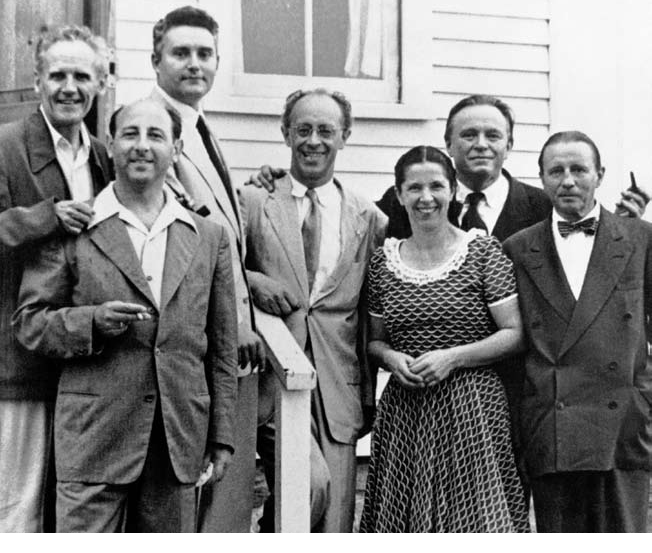
    PHOTO: Serkin (center) with his Marlboro family, co-founders Marcel Moyse, Louis Moyse, Blanche Moyse, Adolf Busch, and Hermann Busch (with cellist Nathan Chaikin second from left)

  • Bach at Marlboro: Casals, Serkin & More

    Bach at Marlboro: Casals, Serkin & More

    If, like me, you’re in the Northeast, hopefully you’re enjoying winter’s last gasp (on the second day of spring!) from someplace warm and comfortable, preferably with a mug of tomato soup and a toasted cheese sandwich at your side, and plenty of great music at the touch of a button or the click of a mouse.

    Although The Classical Network’s daylong celebration of Bach’s birthday has been postponed due to the inclement weather, nothing, not even Mother Nature, can impede an all-Bach “Music from Marlboro.” Join me for sublime music-making by the likes of Marlboro legends Pablo Casals, Felix Galimir, Mieczyslaw Horszowski, and Rudolf Serkin. Even the personnel of the Marlboro Festival Orchestra is stuffed with already-legendary and soon-to-be-legendary performers. It doesn’t get any better than this.

    Unfortunately, my original cut for the 58:30 show was an hour and four minutes! There was so much wonderful material, I couldn’t bring myself to delete any of the music, but I had to cut my text to the bone. So here is some of the background material that was left on the cutting room floor.

    About Pablo Casals: The legendary cellist was affiliated with the Marlboro Music Festival for the last 13 years of his life, from 1960 to 1973. It was Casals who, at the age of 13, rediscovered Bach’s cello suites in a thrift shop in Barcelona. His 1939 recordings established the works as cornerstones of the modern repertoire. Casals’ loving, humanistic interpretations of Bach’s orchestral works (as well as those of Mozart, Beethoven, Schubert, Mendelssohn, and Schumann) at Marlboro form a remarkable capstone to an enviable career. We’ll hear Casals in 1965, conducting Marlboro musicians, including trumpeter Robert Nagel, flutist Ornulf Gulbransen, oboist John Mack, and violinist Alexander Schneider, in Bach’s Brandenburg Concerto No. 2.

    About Mieczyslaw Horszowski: The great pianist died in 1993, just shy of his 101st birthday. He had one of the longest careers of any performing artist. Horszowski was a pupil of Theodor Leschetizky, who was a pupil of Carl Czerny, who in turn was a pupil of Beethoven. Horszowski played Beethoven’s Piano Concerto No. 1 in public for the first time in 1901! He joined the faculty of the Curtis Institute of Music in 1942. He remained there for over 50 years, giving his last lesson a week before his death. We’ll hear Horszowski in 1982, performing Bach’s Keyboard Concerto No. 7 in G minor, BWV 1058.

    About Felix Galimir: This marvelous musician had an amazing career. He was a violinist with the Vienna Philharmonic and the NBC Symphony (under Toscanini), formed the Galimir Quartet, and was in residence at Marlboro from 1954 until his death in 1999. Galimir will be on the podium, accompanying the venerable Horszowski in the aforementioned Bach concerto.

    About Rudolf Serkin: The visionary Serkin co-founded the Marlboro Music Festival in 1951, with Adolf and Herman Busch, and Marcel, Blanche, and Louis Moyse. In addition to being one of the most revered pianists of his generation, he managed to direct the festival for 40 years, until his death in 1991. We’ll listen to Serkin’s probing and intimate account, from 1976, of Bach’s 14 Canons, BWV 1087, on the first eight notes of the aria ground from the “Goldberg Variations.”

    Along the way, we’ll also hear a Trio Sonata in G major, BWV 1038, performed in 1974 by flutist Michel Debost, violinist Pina Carmirelli, cellist Ronald Leonard, and harpsichordist Mark Kroll!

    Not much talk from me, but lots of great music, as we celebrate Bach on “Music from Marlboro,” this Wednesday evening at 6:00 EST, on WWFM – The Classical Network. Please support us in advance of our belated Bach birthday celebration (which will take place tomorrow, hopefully, if we’re not under ten feet of snow) at wwfm.org. Thank you for your support, and Happy Birthday, Bach!

    Marlboro School of Music and Festival: Official Page

Tag Cloud

Aaron Copland (92) Beethoven (95) Composer (114) Film Music (123) Film Score (143) Film Scores (255) Halloween (94) John Williams (187) KWAX (229) Leonard Bernstein (101) Marlboro Music Festival (125) Movie Music (138) Opera (202) Philadelphia Orchestra (89) Picture Perfect (174) Princeton Symphony Orchestra (106) Radio (87) Ralph Vaughan Williams (85) Ross Amico (244) Roy's Tie-Dye Sci-Fi Corner (290) The Classical Network (101) The Lost Chord (268) Vaughan Williams (103) WPRB (396) WWFM (881)

DON’T MISS A BEAT

Receive a weekly digest every Sunday at noon by signing up here


RECENT POSTS