Tag: Miklos Rozsa

  • Stokowski Strauss Hindemith Marlboro School

    Stokowski Strauss Hindemith Marlboro School

    He shook hands with Mickey Mouse, married Gloria Vanderbilt, and signed a ten-year recording contract at the age of 90. Why, it’s LEOPOLD! Join me this afternoon at 4:00 on The Classical Network as we dip a toe into the recorded legacy of Leopold Stokowski, on his birthday.

    It’s also the anniversary of the birth of famed film composer Miklós Rózsa. Rózsa titled his autobiography “A Double Life.” Following his lead, we’ll hear examples of both his film and concert music. And I suppose – Franz von Suppé also having been born on this date – we’ll toss in one of Suppé’s frothy overtures, as well. Like Stokowski, Suppé got a fair amount of mileage out of being parodied in cartoons, so we should all be thankful for the movies, for having granted wide exposure to all three of today’s birthday celebrants.

    At 6:00, it’s another “Music from Marlboro.” This week, we’ll hear works by two composers of German origin, who travelled very different routes, Richard Strauss (1864-1949) and Paul Hindemith (1895-1963).

    Both men found much notoriety as nerve-shattering iconoclasts – Strauss with his operas “Salome” and “Elektra” and Hindemith with his raucous works of the 1920s. Then they settled into respectability, Strauss ageing into the elder statesman of Romantic opulence, and Hindemith becoming an influential teacher at Yale. The two men chose different paths during the Nazi Regime. Hindemith, denounced as an “atonal noisemaker” by Goebels, left for America, by way of Switzerland and Turkey, while Strauss, in his 70s with the outbreak of war, remained at home, hoping to preserve and promote German music and to protect his Jewish daughter-in-law and grandchildren. While understanding Strauss’ importance as a propaganda tool, Goebels wasn’t too fond of his music, either, referring to him privately as a “decadent neurotic.”

    But we’ll avoid all that, and instead listen to Strauss at the very beginning of his career, in 1883-84, and a Piano Quartet in C minor completed at the age of 20. Interestingly for this composer who became celebrated for the apotheosis of the lavish tone poem, Strauss here channels his admiration for Johannes Brahms, and in a genre not generally associated with a follower of the post-Wagnerian “New Music School.” Brahms was at the height of his fame while the young Strauss was living in Berlin. In fact, Strauss attended the premiere of Brahms’ Fourth Symphony. This performance of the Piano Quartet promises to be a very special one, with Walter Klien at the keyboard, heard at the 1972 Marlboro Music Festival, in his early 40s and at the peak of his powers.

    Hindemith was evidently feeling his oats when he launched into his series of Kammermusiken, 20th century analogues to the Bach Brandenburg Concertos, but with a little bit of an ironic edge. Hindemith was about 26 when he wrote his exuberant Kammermusik No. 1, in 1922, the piece sounding like a post-modern mash-up of “Petrushka,” the Rondo-Burleske from Mahler’s Ninth Symphony, and hot jazz. Watch out for that siren! The performance, from 2016, will feature an ensemble of 12 Marlboro musicians under the direction of another great pianist, Leon Fleisher.

    Two young composers show what they can do, one in reverence and the other evidently not, on “Music from Marlboro,” this Wednesday evening at 6:00 EDT, on WWFM – The Classical Network and wwfm.org.

    Marlboro School of Music and Festival: Official Page

  • Epic Biblical Film Scores for Passover & Easter

    Epic Biblical Film Scores for Passover & Easter

    Passover begins tonight, and Sunday is Easter. Time to Bible-up!

    This week on “Picture Perfect,” religion takes a back seat to spectacle, with an hour of music from mid-century Hollywood epics, including “Samson and Delilah” (Victor Young), “Solomon and Sheba” (Mario Nascimbene), “Sodom and Gomorrah” (Miklós Rózsa) and “The Ten Commandments” (Elmer Bernstein).

    We begin and end with two Cecil B. DeMille productions. DeMille could always be counted on to give his audience a good show. Both “Samson” and “The Ten Commandments” feature sultry temptresses, violent, bare-chested men, and plenty of austere moralizing. The climactic special effects in both films are still sublime.

    Tyrone Power was originally cast as Solomon in King Vidor’s “Solomon and Sheba.” However, he died of a massive heart attack during shooting (at the age of 44), paving the way for Yul Brynner to assume the role of the wise king. Brynner, of course, would later become DeMille’s pharaoh Rameses. With Gina Lollobrigida as the Queen of Sheba, you know there has to be an orgiastic dance.

    Miklós Rózsa characterized “Sodom and Gomorrah” as “an intriguing subject which developed into a bad picture,” and most critics agreed. Any film that casts Stewart Granger as Lot should be taken with a pillar of salt. Rózsa determined not to score any more Biblical epics after “Sodom,” though his music is nothing to be ashamed of. It possesses that classic Rózsa epic sound, much beloved thanks to his work on “Quo Vadis,” “Ben-Hur” and “King of Kings.”

    Chariots! Tunics! Histrionic acting! The music will be epic, this Friday evening at 6:00 EDT, on WWFM – The Classical Network. (Please note: if the time happens to conflict with your Seder, the show will be posted next week as a webcast, at wwfm.org.)


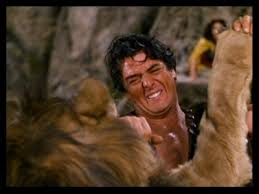
    PHOTOS: Victor Mature’s stuffed lion vs. Charlton Heston’s cotton candy beard

  • Film Composers’ Concert Music

    Film Composers’ Concert Music

    What’s that you say? You could care less about the Oscars? Perhaps then you’d be interested in a little counterprogramming. This Sunday night on “The Lost Chord,” we’ll both deny and complement the ceremony by listening to concert works by composers better known for their work in film.

    Franz Waxman was a two-time Academy Award winner, honored with back-to-back Oscars, in 1950 and 1951, for his work on “Sunset Boulevard” and “A Place in the Sun.” Some of his other classic scores include those for “The Bride of Frankenstein,” “Rebecca,” “Rear Window,” “Peyton Place” and “The Nun’s Story.”

    In 1955, he was traveling from California to Zurich to conduct a new piece commissioned by Rolf Liebermann. When Waxman reached New York he was met with a request from Lieberman’s office for program notes for the impending premiere. Waxman was forced to admit he hadn’t yet begun work on the piece, which he had planned to write during the ocean voyage. Fortunately, he was accustomed from his experience in Hollywood to write very quickly. The result was his “Sinfonietta for String Orchestra and Timpani.”

    Five-time Academy Award winner John Williams – whose 51st nominated score, for “Star Wars: The Last Jedi,” is in contention tonight – is of course very well-known for his collaborations with George Lucas and Steven Spielberg. Over the years, he’s also accrued an impressive quantity of concertos. One of the more immediately attractive of these is his Tuba Concerto of 1985, written for the 100th anniversary of the Boston Pops.

    Finally, we’ll turn to three-time Academy Award winner Miklós Rózsa, honored for his work on Alfred Hitchcock’s “Spellbound” in 1945, the Ronald Colman thriller “A Double Life” in 1947, and “Ben-Hur” in 1959. He also composed quite a bit of concert music, including concertos for Jascha Heifetz, Gregor Piatigorsky, Janos Starker, Leonard Pennario and Pinchas Zukerman.

    Rózsa, Hungarian by birth, turned to film after a period of struggle as a young artist in Paris, where he learned from Arthur Honegger that he was able to pay the rent by supplementing his concert music with cinematic efforts. Rózsa’s “Theme, Variations and Finale,” Op. 13, of 1933, preceded the start of his film career by a few years. He revised the piece in 1943, by which time he had already completed his classic fantasy scores for Alexander Korda’s “The Thief of Bagdad” and “Jungle Book,” and was on the verge of becoming a leading composer of film noir.

    “Theme, Variations and Finale” received performances by Charles Munch, Karl Böhm, Georg Solti, and Eugene Ormandy. It was also one of the works that featured on the legendary concert that launched Leonard Bernstein with the New York Philharmonic, on November 14, 1943, when the young assistant conductor substituted at the last minute for an ailing Bruno Walter.

    I hope you’ll join me for an hour of concert music by composers better known for their work in film – “Against Type” on “The Lost Chord” – this Sunday night at 10:00 EST, on WWFM – The Classical Network and wwfm.org.

    PHOTOS: Has anyone here seen Kelly? (Clockwise from left) John Williams wins the Oscar for “Star Wars;” Franz Waxman and Miklós Rózsa receive their awards from the hands of Gene Kelly

  • Restoration Era Film Scores & Charles II

    Restoration Era Film Scores & Charles II

    Get out the pancake makeup, and don’t skimp on the beauty marks. This week on “Picture Perfect,” the focus will be on Charles II and the Restoration.

    The film “Restoration” (1995) featured quite a cast, with a pre-“Iron Man” Robert Downey, Jr., as a young doctor torn between duty and debauchery. He succumbs to the latter at the court of Charles II, played by Sam Neill, before finding redemption as he battles the Great Plague and braves the Fire of London. The film also stars David Thewlis, Polly Walker, Meg Ryan, Ian McKellan and Hugh Grant.

    The main title of James Newtown Howard’s score takes its impetus from Henry Purcell’s “The Fairy Queen.” And indeed there are baroque inflections throughout.

    George Sanders plays Charles in “The King’s Thief” (1955). Edmund Purdom is a highwayman who pilfers an incriminating book from David Niven. An aristocratic schemer, Niven will stop at nothing to get it back. The swashbuckling score is by Miklós Rózsa.

    I don’t recall Charles making an appearance in “The Draughtsman’s Contract” (1982), Peter Greenaway’s saucy though strangely aloof Restoration opus. However, there is plenty of licentiousness and an abundance of outlandish wigs. And, it being a Greenaway film, it is certainly strange in more ways than one. Michael Nyman’s score puts a minimalist spin on baroque sources.

    Finally, “Forever Amber” (1947) is based on a then-scandalous novel by Kathleen Winsor, about an ambitious young woman’s rise through the bedchambers of the Royal Court. The film was directed by Otto Preminger. Linda Darnell is Amber. Once again, George Sanders plays Charles, eight years before reprising the role for “The King’s Thief.” Cornel Wilde, Richard Greene and Jessica Tandy are also in the cast. Philadelphia-born composer David Raksin, of “Laura” fame, plays fast and loose with music of the era.

    Bwoo-hoo-hoo-hoo! It’s so naughty! Join me for music from movies set during the Restoration, on “Picture Perfect,” this Friday evening at 6, on WWFM – The Classical Network and wwfm.org.

  • Thief of Bagdad Rozsa Score Rediscovered

    Thief of Bagdad Rozsa Score Rediscovered

    If your three wishes would encompass a complete recording, in up-to-date sound, of one of the most enchanting film scores by Miklós Rózsa, you needn’t hold out for the discovery of a magic lamp. I hope you’ll join me for a recent release of a two-CD set, on the Prometheus label, of music from the classic 1940 fantasy-adventure “The Thief of Bagdad.” The City of Prague Philharmonic and Nic Raine have recorded the score, note-complete, with ample bonus material. Tune in to be transported. Take the magic carpet ride, this Friday at 6 p.m. EDT, on WWFM – The Classical Network and wwfm.org.
Tag Cloud

Aaron Copland (92) Beethoven (95) Composer (114) Film Music (123) Film Score (143) Film Scores (255) Halloween (94) John Williams (187) KWAX (229) Leonard Bernstein (101) Marlboro Music Festival (125) Movie Music (138) Opera (202) Philadelphia Orchestra (89) Picture Perfect (174) Princeton Symphony Orchestra (106) Radio (87) Ralph Vaughan Williams (85) Ross Amico (244) Roy's Tie-Dye Sci-Fi Corner (290) The Classical Network (101) The Lost Chord (268) Vaughan Williams (103) WPRB (396) WWFM (881)

DON’T MISS A BEAT

Receive a weekly digest every Sunday at noon by signing up here


RECENT POSTS