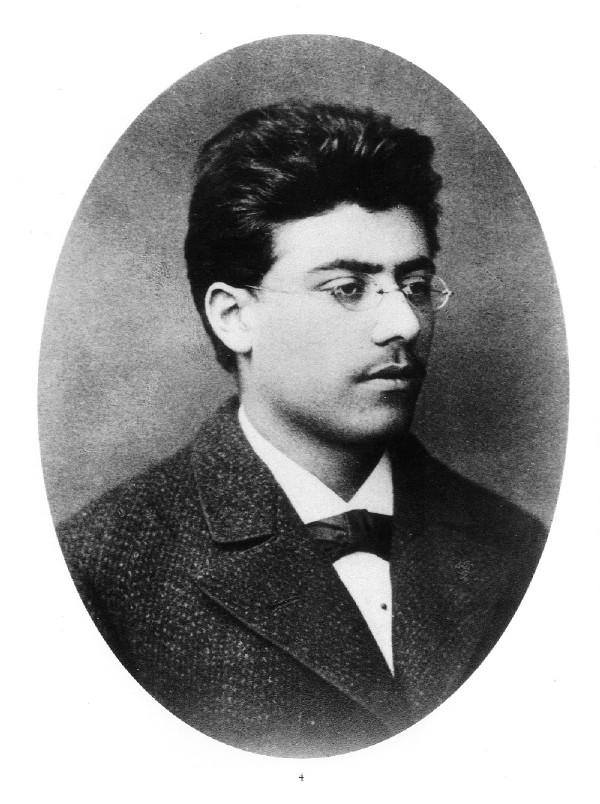
He was a brilliant improviser on the organ, Anton Bruckner’s favorite student. Gustav Mahler, his roommate, declared him “the founder of a new symphony.”
It must have seemed very new at the time. When he submitted the first movement to a composition contest, the jury (with the exception of Bruckner) was beyond dismissive, even condescending, in its remarks. When he showed Johannes Brahms the manuscript, Brahms told him he had no talent and that he should give up composing.
Hans Rott (1858-1884) lacked Mahler’s resolve, and his productivity was further hampered by encroaching mental illness. In 1880, while traveling, Rott pulled a revolver on a fellow passenger, convinced that Brahms had filled his train with dynamite. He was diagnosed with hallucinatory insanity and persecution mania. He died in an asylum, of tuberculosis, at the age of 25.
Had fate dealt him a different hand, it’s entirely possible Rott would have developed into a composer as well-known as his contemporaries. It’s obvious from his only symphony, which dates from the final year of his studies, 1878, that Mahler was greatly influenced by his classmate. In fact, it’s startling to find so many “Mahlerian” characteristics already in evidence in this work that predated Mahler’s 1st.
Hear it this afternoon, on Hans Rott’s birthday. Rott’s symphony will be among my featured works, from noon to 4 p.m. EDT. We’ll also observe the anniversary of the births of composers Benedetto Marcello and Jerome Moross, and conductor William Steinberg, on WWFM – The Classical Network and wwfm.org.
PHOTOS: Future master of the fin-de-siècle symphony, Gustav Mahler (left), and his roommate, who showed him the way
Leave a Reply