This week on “Picture Perfect,” at a time when political tensions run high, I have the bad fortune to have selected a rerun centering on films that explore the dark underbelly of small-town life and the consequences of bucking conformity. This is not a veiled dig at those who live in less-populous areas. I prefer to live there myself!
Be that as it may, in the interest of balance (though again, wholly by coincidence), next week, the focus will shift to film noir in the gritty city. So no rioting, if you please!
The events of “Peyton Place” (1957) unfold in a picturesque New Hampshire town, in which all sorts of sordid goings-on roil beneath the surface. Grace Metalious’ runaway bestseller spawned a film, starring Lana Turner, and also a subsequent TV series, with Mia Farrow. Neither version is nearly as seedy as the original, which was about an idyllic New England community whose residents have more than their share of skeletons in the closet. The score includes one of Franz Waxman’s best-known themes.
“Far from Heaven” (2002) is set in a Connecticut suburb during the 1950s. Therefore, it makes sense that the filmmakers deliberately attempt to conjure the vibe of a Douglas Sirk film. In common with Sirk melodramas like “All That Heaven Allows” and “Imitation of Life,” “Far from Heaven” deals with social issues, in this instance regarding race, class, gender roles, and sexual orientation.
The score was the last by the great Elmer Bernstein, who had actually been composing for film since the ‘50s. Over the course of his career, Bernstein was nominated for 14 Academy Awards. However, despite his work on such classics as “The Ten Commandments,” “The Magnificent Seven” and “To Kill a Mockingbird,” his only Oscar win came with, of all things, “Thoroughly Modern Millie,” in 1967. He received his final nomination for his work on this film.
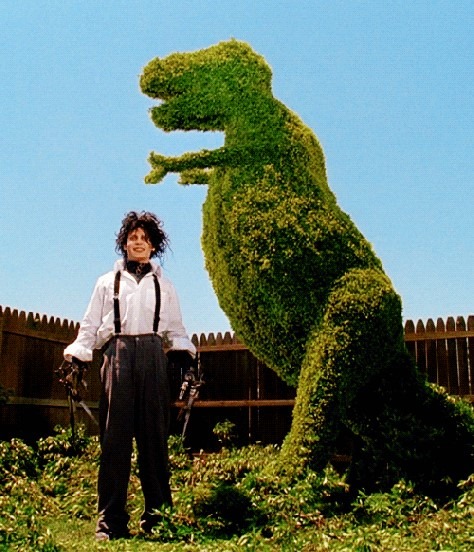
“Edward Scissorhands” (1990) is Tim Burton’s satirical-yet-touching update of the “Frankenstein” tale, transported to a contemporary American suburb. An artificial man with unusual appendages gradually wins over his suspicious neighbors with his aptitude for hairstyling and lawn sculpture. However, things quickly go south. For the very differences for which Edward was briefly celebrated, he is now hunted by an angry mob.
Burton presents a cookie-cutter suburbia, simultaneously tacky and anonymous. The houses are painted in faded pastels, and everyone follows the same routine. The score, by Danny Elfman, alternately antic and romantic, has proved to be one of his most memorable.
Finally, we turn to “Kings Row” (1942), based on the novel by Henry Bellamann. The film is a spiritual forerunner not only of “Peyton Place,” but also, to an extent, of David Lynch’s “Blue Velvet” and “Twin Peaks,” in the sense that it presents life in an idyllic small town that nonetheless casts some very long shadows.
The film of “Kings Row” accomplishes a remarkable balancing act, in that it manages to maintain an air of hope and optimism, despite all the horrible things that happen to a number of the characters. To this end, it pulls some of the punches thrown by the original book, in part as a concession to the Hays Code, which forced some of the rougher themes to be altered, dropped, or implied. Bellamann’s novel is a much bleaker experience.
The score is by Erich Wolfgang Korngold, at this point in his career associated with historical adventure films, as Errol Flynn’s regular composer. He wrote the brash theme music for “Kings Row” wholly in this vein, allegedly on an initial assumption drawn merely from the film’s title.
Good fences make good neighbors. Join me for “Suburban and Small Town Blues” this week, on “Picture Perfect,” music for the movies, this Saturday evening at 6:00 EST, on WWFM – The Classical Network and wwfm.org.
As of this writing, we are less than $2,000 away from the completion of our fall fundraiser! Your contribution in any amount will help us attain our $70,000 goal. We’ve come a long way, thanks to engaged listeners like you. It’s easy to make a donation. Simply follow the link below. Thank you for your support of classic film scores on YOUR classical music station, WWFM The Classical Network!
Leave a Reply