The Czech writer Milan Kundera has died. His father was concert pianist and musicologist Ludvik Kundera, a colleague of Leoš Janáček. Ludvik headed the Janáček Music Academy in Brno from 1948 to 1961.
Milan himself had considered a career in music, but instead gravitated toward literature. After he was busted down by the Communist Party for his subversive views, he supplemented his income as a jazz musician. He eventually fled Czechoslovakia in 1975 to make Paris his home.
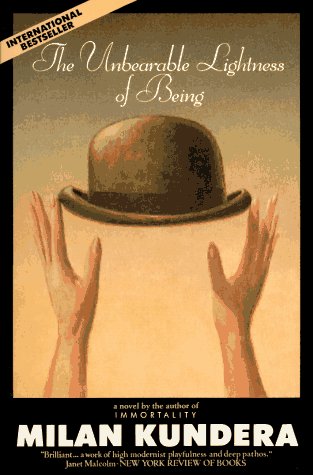
There was plenty of Janáček on the soundtrack of Philip Kaufman’s film adaptation of Kundera’s most famous novel, “The Unbearable Lightness of Being,” which starred Daniel Day Lewis, Juliette Binoche, and Lena Olin. Kundera described his novels as polyphonic symphonies, and he likened “The Book of Laughter and Forgetting” to a set of Beethoven variations.
For a time, he taught film theory at Prague’s Academy of Performing Arts. Among his students was Miloš Forman, who would go on to direct the Academy Award winning adaptation of Peter Schaffer’s play, “Amadeus.”
“They [human lives] are composed like music,” Kundera observes in “The Unbearable Lightness of Being.” “Guided by his sense of beauty, an individual transforms a fortuitous occurrence (Beethoven’s music, death under a train) into a motif, which then assumes a permanent place in the composition of the individual’s life. Anna could have chosen another way to take her life. But the motif of death and the railway station, unforgettably bound to the birth of love, enticed her in her hour of despair with its dark beauty. Without realizing it, the individual composes his life according to the laws of beauty even in times of greatest distress.
“It is wrong, then, to chide the novel for being fascinated by mysterious coincidences (like the meeting of Anna, Vronsky, the railway station, and death or the meeting of Beethoven, Tomas, Tereza, and the cognac), but it is right to chide man for being blind to such coincidences in his daily life. For he thereby deprives his life of a dimension of beauty.”
At the time of his death, Kundera was 94-years-old.
Kundera’s obituary in the New York Times
https://www.nytimes.com/2023/07/12/world/europe/milan-kundera-dead.html
Trailer for “The Unbearable Lightness of Being”
The soundtrack
Once again, I neglected to observe Janáček’s birthday this year. (Janáček was born on July 3, 1854.) Here I celebrate in 2019:
Leave a Reply to สล็อตเว็บตรงCancel reply