For me, Holy Week usually means it’s time to trot out Wagner’s “Parsifal,” but in light of the death of tenor Peter Seiffert, here’s a delectable clip (at the link) from “Lohengrin,” with Seiffert’s then-wife Lucia Popp. Lohengrin was a Seiffert specialty, a role he sang several times at the Bayreuth Festival. In 2003, his recording of Wagner’s “Tannhäuser,” with Daniel Barenboim and the Staatskapelle Berlin, was recognized with a Grammy Award for Best Opera Recording. Everyone loves to point out the fact that Popp was 15 years his senior. So what? I’d have married her myself! Popp died of brain cancer in 1993 at the age of 54, a great loss. Seiffert later married soprano Petra-Maria Schnitzer, who survives him. He was 71 years-old. R.I.P.
Grammy-winning “Tannhäuser,” in more immediate sound
Norman O’Neill was born 150 years ago today. Who exactly was he?
O’Neill is probably the least known member of the Frankfurt Group – sometimes identified as the Frankfurt Gang – an informal collective of young musicians who came together at the Hoch Conservatory in Frankfurt-am-Main during the 1890s. The group also included Balfour Gardiner, Roger Quilter, Cyril Scott, and, the youngest of the bunch, the piano prodigy Percy Grainger.
Later, though technically not “in” the Gang, other figures to become closely associated with it included Frederick Delius, Sir Thomas Beecham, and the composer Frederic Austin.
The Hoch Conservatory of the day had a reputation for being one of the finest conservatories in Europe. Clara Schumann had been on the faculty there until 1892 – within a few years of the Frankfurt Group’s arrival.
Two of the Gang attended twice. Cyril Scott arrived early, at the age of 12, and later returned for a second stint. Balfour Gardiner took a break to attend Oxford. Grainger was 13 at the time he was admitted. He was to remain at the conservatory for four-and-a-half years.
What united this brilliant array of young talent in a foreign land? Well, there was shared language and culture, of course, but also a determination to break away from the predominant, Teutonic musical thinking of the time, and especially the place, to create a fresh “English” art.
O’Neill, the son of Irish painter George Bernard O’Neill and Emma Stuart Callcott (daughter of glee composer William Hutchins Callcott), married pianist Adine Berthe Maria Ruckert. Ruckert, a pupil of Clara Schumann, was also a teacher. She would later become head music mistress at the St. Paul’s Girls’ School. Gustav Holst, who was director of music there, became a frequent visitor at their house.
O’Neill himself studied with Arthur Somervell and Iwan Knorr. Back in London, he served as treasurer of the Royal Philharmonic Society and taught harmony and composition at the Royal Academy of Music.
In 1934, he was on his way to a recording session when he stepped off the curb and was struck by a carrier tricycle. He developed blood poisoning and died less than three weeks later, on March 3, eleven days shy of his 59th birthday.
O’Neill’s concert output includes symphonic suites, chamber music, and instrumental works. Most of these pre-date World War I. After the war, as music director of the Haymarket Theatre, he devoted himself largely to music for the stage.
He achieved particular success with his music for J.M. Barrie’s “Mary Rose” (1920).
If I understand correctly, he was the first British composer to conduct his own music on record, when he led selections for a stage production of Maurice Maeterlinck’s “The Blue Bird” (1910).
O’Neill composed a lot of charming music that deserves to be resurrected, at the very least in new recordings. Even if no one else remembers him today, I will. Happy sesquicentenary to Norman O’Neill!
Piano Quintet in E minor (1902-03)
“La Belle Dame sans Merci,” after Keats (1908)
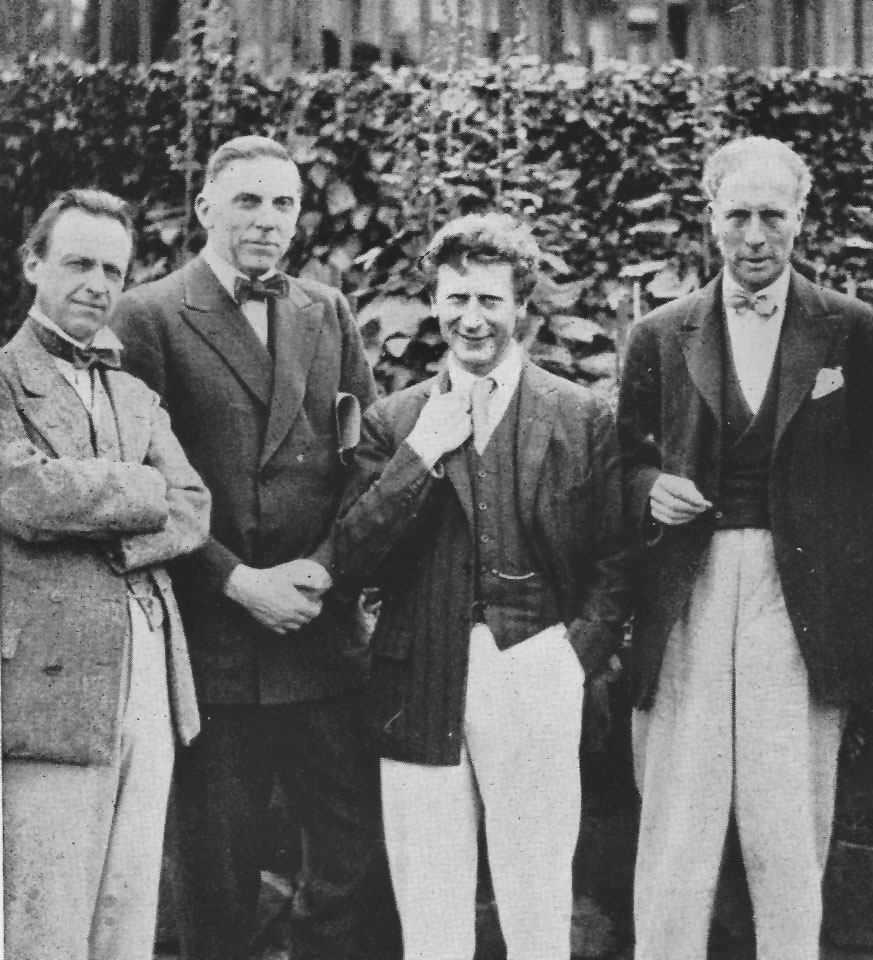
Frankfurt Gang reunion: (left to right) Cyril Scott, Roger Quilter, Percy Grainger, and Norman O’Neill in 1930
With Passover upon us, last week I was going through my collection, looking for something to listen to, and I was astonished by how many recordings I have of works inspired by Moses, the plagues, the Exodus, and the Ten Commandments. In the oratorio department alone, there’s Handel’s “Israel in Egypt,” Leopold Koželuch’s “Moise in Egitto,” Paul Dessau’s “Haggadah del Pesach,” and R. Nathaniel Dett’s “The Ordering of Moses.” I’m pretty sure somewhere I’ve also got a recording of Anton Rubinstein’s “Moses.”
Here’s another one I picked up from Princeton Record Exchange for $2 in 2022 and, like the Rubinstein, never got around to listening to it – until now. And it’s been in my player more or less all week. Max Bruch’s “Moses” is no Mendelssohn’s “Elijah,” but it’s agreeable enough, and it has its own rewards as entertainment, even if it never quite seems to achieve the lift – that level of transcendence – you experience when everything comes together in the greatest masterworks.
“Elijah” invites the most obvious comparison for several reasons. Aside from the fact that Elijah’s cup is present and filled at the Passover Seder, Mendelssohn’s dynamic, moving rendition of the prophet’s story was the most successful Biblical oratorio of the 19th century, and it’s the only one that still seems to get performed with any frequency.
Also, taking into account Bruch’s most popular works, most people I think would classify him as a composer of the Mendelssohnian variety, a conservative Romantic, as opposed to a radical, Wagnerian one. It’s not for no reason that in the glory days of the LP, Bruch’s evergreen Violin Concerto No. 1 was always on the flip side of recordings of Mendelssohn’s own masterpiece in the genre.
So imagine my surprise to discover that Bruch’s “Moses” contains at least as much Wagner as it does Mendelssohn. Perhaps even more so. The irony of classical music’s most notorious antisemite (i.e. Wagner) being mentioned in connection with an oratorio about the most revered of Jewish prophets is not lost on me. I hasten to add, I am speaking more of the Wagner of “Tannhäuser” and “Lohengrin” than of “The Ring” and “Tristan.” You won’t find any of the harmonic innovation, but you will find leitmotif and certainly a Wagnerian influence in the choral writing and in the dramatic vocal parts for Moses (bass), Aaron (tenor), and the Angel of the Lord (soprano).
All the soloists on this Orfeo recording from 1999, featuring the Bamberg Symphony conducted by Claus Peter Flor, do service to the material, with Michael Volle the standout in the title role.
Interestingly, another work it brings to mind is Josef Rheinberger’s “The Star of Bethlehem.” Different season, different faith, but something about Bruch’s handling of Moses’ inspirational leitmotif recalls – for me, anyway – Rheinberger’s Christmas cult classic, composed in 1890, five years before Bruch’s Passover oratorio. Again for this listener, Bruch’s “Moses” never achieves the same lift or touching sincerity.
Another widely-held assumption, of course, is that Bruch himself was Jewish. It’s easy to understand why, as his treatment of the Yom Kippur chant “Kol Nidre” for cello and orchestra is easily the most popular of the classical music settings. Bruch handles the tune with great sensitivity and evidently pours his heart into it. So it surprises many (as it did, later, the Nazis) to learn that Bruch was indeed Protestant. He did, however, recognize a good tune when he heard one, and clearly when he took up his pencil he was inspired.
It always knocks me off my pins to be reminded that Bruch was born in 1838 – five years after Brahms and three years before Dvořák – yet he died in 1920. Brahms checked-out in 1897 and Dvořák in 1904. Romanticism was still very much in its glorious twilight. What changes Bruch lived through! For someone who was clearly an heir of Mendelssohn to have experienced the era of “The Rite of Spring” boggles the mind.
Anyway, if you’re interested to hear what Bruch does with the Moses story, here’s a link. Just don’t go into it expecting anything special from the Golden Calf episode, which is nowhere near the level of that in Schoenberg’s “Moses und Aron.” It’s more like the Druid shenanigans of Mendelssohn’s “Die erste Walpurgisnacht” – more apt to amuse than to scandalize or to conjure any sense of genuine transgression or blasphemy.
A nice effort from Bruch, but unlikely to dislodge Elijah from his chariot. Still, someone might consider performing it sometime.
The Song of Songs. Attributed to King Solomon, this Biblical book contains some of the most ardent poetry ever written. Whether interpreted as the communion of man and woman, or as something of a more allegorical nature – the relationship, depending upon one’s system of belief, between God and Israel, between God and the Church, or between Christ and the human soul – over the centuries it has inspired some meltingly lovely music.
Since it is customary to read from the Song of Songs as part of the observance of Passover, this week on “The Lost Chord,” for Pesach, we’ll sample two complementary settings: one by Sir Granville Bantock – selections from his massive, 2 ½ hour oratorio – and one by Lukas Foss – a more intimate song cycle, in which divine and romantic love unite in understated metaphor.
What if I told you your temples behind your veil are like the halves of a pomegranate? If you fall for that, there’s plenty more where that came from, on “King Solomon’s Lines,” on “The Lost Chord,” now in syndication on KWAX, the radio station of the University of Oregon!
Clip and save the start times for all three of my recorded shows:
PICTURE PERFECT, the movie music show – Friday at 8:00 PM EDT/5:00 PM PDT
SWEETNESS AND LIGHT, the light music program – Saturday at 11:00 AM EDT/8:00 AM PDT
THE LOST CHORD, unusual and neglected rep – Saturday at 7:00 PM EDT/4:00 PM PDT
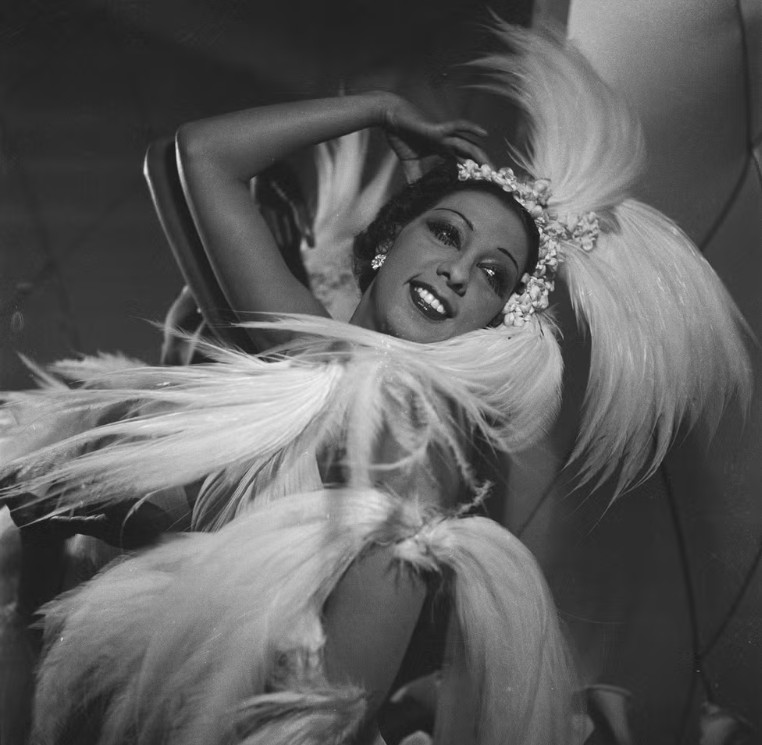
One selection I regret not including in this morning’s “April in Paris” playlist on “Sweetness and Light” is Josephine Baker’s “J’ai deux amours” (“I have two loves, my country and Paris”). Baker died 50 years ago today. Learn more about her remarkable life at the link, which includes access to an hour-long documentary.