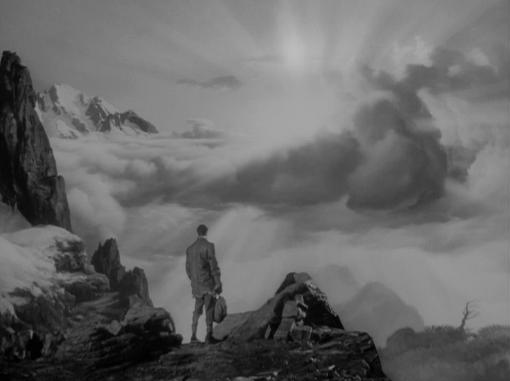
This week on “Picture Perfect,” we journey through the awe-inspiring landscapes of India and Tibet, even as we feel our way to the inner realms of spirit and psyche, with an hour of Himalayan adventures.
The Himalayas, in film, have frequently been the source of enlightenment; though occasionally their overwhelming influence has also led to madness. Intriguingly, the latter is the case in the Powell-Pressburger classic, “Black Narcissus” (1947). Psychological and emotional tensions abound in this tale of repressed nuns struggling to maintain their composure in a voluptuous Himalayan valley.
The stunning cinematography was by Jack Cardiff, and Brian Easdale (of “The Red Shoes” fame) wrote the music. Incredibly, the entire film was shot in England, mostly at Pinewood Studios. From a purely visual standpoint, “Black Narcissus” must be one of the most beautiful films ever made. It’s also one of the craziest, with unlikely object-of-desire Mr. Dean driving the sisters to the brink.
The Himalayas also form the backdrop to “Seven Years in Tibet” (1997), based on a memoir of Austrian mountaineer Heinrich Harrer. Harrer escapes from a British internment camp in India during the Second World War. He travels across Tibet to its capital, Lhasa, where he eventually becomes the tutor of the 14th Dalai Lama. In the film, Brad Pitt plays Harrer. John Williams wrote the music, and Yo-Yo Ma performs the cello solos.
“The Razor’s Edge” (1946) tells the story of a traumatized World War I veteran, who sets off in search of some kind of transcendent meaning to his existence. He finds it in India, at a Himalayan monastery. The 1946 adaptation of W. Somerset Maugham’s novel (which he claimed was thinly-veiled fact) features Tyrone Power, Gene Tierney, and Ann Baxter. The music is by Alfred Newman, who will conduct a selection from his score.
Finally, we’ll hear a suite from the Frank Capra classic, “Lost Horizon” (1937). Based on the book by James Hilton, the film stars Ronald Colman and an outstanding supporting cast, including Jane Wyatt, Thomas Mitchell, Edward Everett Horton, H.B. Warner, and Sam Jaffe. The novel, and the film, brought the term “Shangri-La” into popular usage, a Utopian paradise hidden in a secluded Himalayan valley, a place of ageless beauty and serenity.
“Lost Horizon” provided composer Dimitri Tiomkin (a pupil of Alexander Glazunov) with his first major project. The result is one of his most colorful scores. The recording is one of the gems of RCA’s Classic Film Scores series, originally issued in the early 1970s. Made in the presence of the composer, it features 157 performers, with the chorus standing on a platform behind the conductor, Charles Gerhardt, and the various percussionists stationed in the encircling balcony.
I can’t guarantee that you’ll find enlightenment, but there will be plenty to awe and inspire in these Himalayan adventures, on “Picture Perfect,” music for the movies, now in syndication on KWAX Classical Oregon!
——–
Clip and save the start times for all three of my recorded shows:
PICTURE PERFECT, the movie music show – Friday at 8:00 PM EST/5:00 PM PST
SWEETNESS AND LIGHT, the light music program – Saturday at 11:00 AM EST/8:00 AM PST
THE LOST CHORD, unusual and neglected rep – Saturday at 7:00 PM EST/4:00 PM PST
Stream them, wherever you are, at the link!
https://kwax.uoregon.edu
Category: Daily Dispatch
-
Long Life for Miniaturist György Kurtág
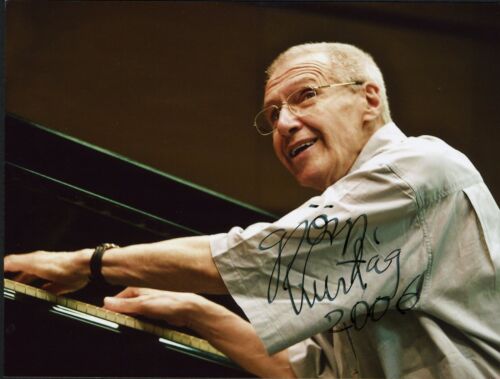
It is fortunate that György Kurtág has been so long-lived, since it wasn’t until his 60s, an age when most people contemplate retirement, that his international reputation really began to take off. But Kurtág was in it for the long haul. The aphoristic Hungarian master, still with us, was born on this date 100 years ago.
Kurtág forged a lifelong friendship with György Ligeti, while studying at Budapest’s Franz Liszt Academy, where he also met the woman who would become his wife. Márta, a pianist, died in 2019 at the age of 92.
Following the Hungarian uprising of 1956, Kurtág spent an extended period in Paris, where he studied with Olivier Messiaen, Darius Milhaud, and Schoenberg pupil Max Deutsch. It was also during this time that he was introduced to the music of Anton Webern and the plays of Samuel Beckett. When Ligeti directed him to a performance of Beckett’s “Endgame,” Kurtág described it as one of the strongest experiences of his life.
He returned to Budapest, where eventually he wound up teaching at his alma mater for 26 years. Gradually, he built a reputation as one of the most respected composers of his time. A meticulous artist, Kurtág’s works are like finely honed miniatures. But these are not pieces for display in the curio cabinet. Rather they are exquisitely crafted microcosms, notable for their poetry and flashes of expressive intensity.
It was surprising that a composer renowned for his work in smaller forms should turn to opera, especially at such a venerable age. Even so, “Fin de partie,” after “Endgame,” was enthusiastically received following its debut at La Scala in 2018.
Sadly, the U.S. premiere, which was to have taken place with the New York Philharmonic in 2021, was cancelled because of Covid. To my knowledge, it has yet to be performed in this country. Hopefully it will be rescheduled soon.
For now, raise a glass of pálinka to György Kurtág on his 100th birthday!
———
Zoltán Kocsis playing Kurtág in recital
https://www.youtube.com/watch?v=KHN58vAf3Y8
Wind Quintet, Op. 2
https://www.youtube.com/watch?v=FIFSR-1Af38
Six Short Pieces for Guitar
https://www.youtube.com/watch?v=9ZseIPZPFro
Interview with Kurtág
https://www.youtube.com/watch?v=F2p_R2m67Ys
“Fin de partie” (click closed caption for English titles)
https://www.youtube.com/watch?v=Bel9Sjfe2MA&t
Kurtág plays Mozart
https://www.youtube.com/watch?v=O5j9I4CauN0
Playing Bach with Márta
https://www.youtube.com/watch?v=Z8lTh58jhA8
Alas, some delectable videos have slipped away since the composer’s 95th birthday, including one of a performance of “Játékok” (“Games”), with Kurtág, Márta, and Kocsis, and another of “Seven Songs for Soprano and Cimbalom,” with Barbara Hannigan. -
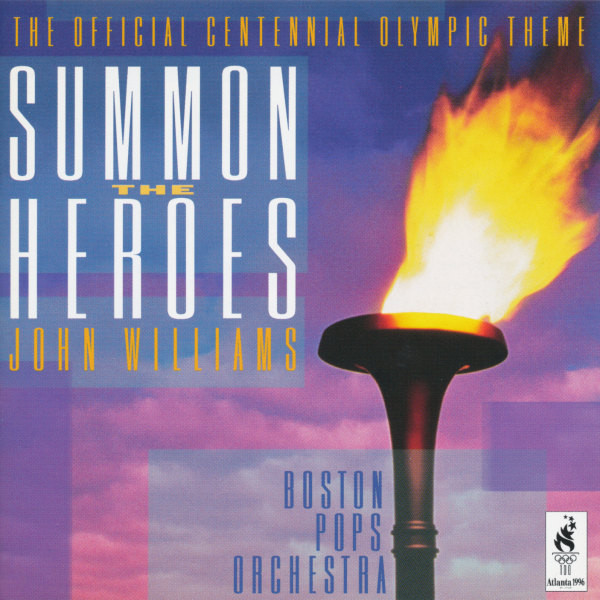
Summon the Heroes: John Williams Inspires Vic Damone to Save the Day
Anybody else watching the Olympics? I’ve been catching some, up to a couple hours a night. And I don’t usually watch TV. (I’m a movie guy.) But it’s been nice to follow some of the athletes and cocoon myself in nostalgia. And what could be more nostalgic than John Williams’ Olympic fanfares, two of which – “Olympic Fanfare and Theme,” composed for the 1984 games in Los Angeles, and “Summon the Heroes,” composed for the 1996 Games in Atlanta – are now staples of Olympics’ broadcasts. You can hear them, in arrangements by other hands, used as bumpers, as coverage fades into and out of commercial breaks, and as underscore in segues between events. (In 2016, I wrote a post speculating on Williams’ royalties package!)
Here’s a related anecdote, also prompted in part by my reading of Tim Greiving’s new John Williams’ biography, published by Oxford University Press. During a pledge drive at a certain local radio station around the turn of this century (a station I worked at for several decades, only to be let go, along with all the other local hosts, as a result of the pandemic), I had piled up some inspiring tracks, hoping to get the phones ringing. One of those was Williams’ “Summon the Heroes,” still fairly new at the time. Sure enough, it set the volunteers to work, and one of them walked in with a pledge sheet bearing a comment from Vic Damone.
Damone, the Italian-American crooner who had a big hit in 1947 with “I Have but One Heart,” auditioned a young Johnny Williams in 1955 and immediately hired him (after a falling out with Burt Bacharach) as his accompanist, arranger, and conductor. Damone goes into more detail in Greiving’s book. At the time, he basically said he used to tour with Johnny, and that Johnny was his pianist.
We’re usually giddy during pledge drives anyway, but getting a call from Vic Damone talking about John Williams got us all stirred up. So we started spinning more Williams and Damone’s recording of “Kismet.” (He played Caliph in the film, in which he sings “Stranger in Paradise” with Ann Blyth.) Damone must have been tickled pink, because he kept calling back and pledging more money – and it went on long after my shift!
I can say that Vic Damone was a huge hero that drive. One of the other announcers took it upon himself to hang a plaque on this hole in the wall where we used to eat our lunches when not sneaking them into the studio. It read: VIC DAMONE HOSPITALITY LOUNGE.
How Damone came to be listening that day, I don’t know. Not too much later, he suffered a stroke and spent his final years in Florida. But during that particular drive, John Williams really did summon a hero – Vic Damone!
“Summon the Heroes”
“Stranger in Paradise”
Williams’ arrangement of “Make Me Rainbows,” lyrics by Alan and Marilyn Bergman
A new musical called “My Fair Lady” was receiving its test run in Philadelphia when the sheet music was handed off to Damone and Williams by Mitch Miller, then working A&R at Columbia, Damone’s record label. Damone was partial to “I’ve Grown Accustomed to Her Face,” but Williams convinced him that “On the Street Where You Live” would be a much better fit. The problem was that the show’s producers were actually planning to cut the song. Once Miller and Percy Faith heard what Damone and Williams did with it, a recording session was hastily arranged. When Damone’s version became a major hit, it was decided to keep it in the show!
I venture to guess, this aspect of Williams’ career remains unknown to many of those who latched onto him through his blockbuster film scores. By the time he began to amass his shelf full of Oscars, he’d already been working as an arranger and jazz pianist and contributing to film and television productions for decades.
I have some reservations about Greiving’s biography (which could have used a more attentive editor), but it is valuable for having compiled so many previously uncollected details about the rise of “Johnny Williams.”
-
100 Years of Lee Hoiby
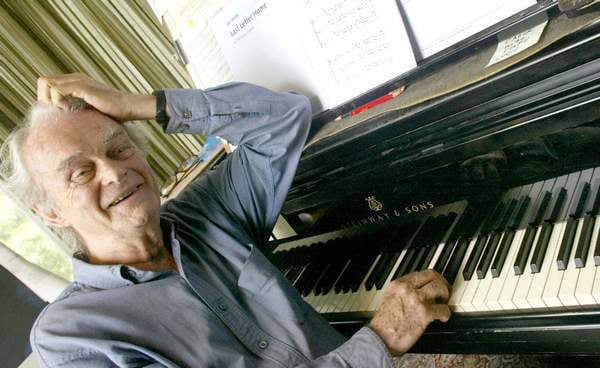
Today marks the 100th anniversary of the birth of American composer Lee Hoiby. Hoiby, a disciple of Gian Carlo Menotti, wrote a lot of vocal music and received particular acclaim for his operas. However, I first discovered him through an old recording of his Piano Concerto on the CRI label.
Hoiby, born in Madison in 1926, studied at the University of Wisconsin with Gunnar Johansen and Egon Petri. (His early ambition had been to become a concert pianist.) Then he struck out for California, where he studied at Mills College with Darius Milhaud. In San Francisco, he worked with a number of musicians whose thinking was decidedly outside-the-box, including Rudolf Kolisch, brother-in-law of Arnold Schoenberg, and Harry Partch.
It’s interesting, therefore, that his own music would wind up being so traditional. Chalk it up to further studies with Menotti at the Curtis Institute of Music in Philadelphia. It was Menotti who introduced Hoiby to opera, instilling in him a life-long love of the human voice. Hoiby was employed as an assistant on the Broadway debut productions of Menotti’s “The Consul” and “The Saint of Bleecker Street” (the latter of which earned his teacher a Pulitzer Prize). Menotti would produce Hoiby’s first opera, “The Scarf” (1958). Eight more would follow. The most highly-regarded of these is perhaps his Tennessee Williams adaptation, “Summer and Smoke” (1971).
Hoiby also had a powerful champion in Leontyne Price, who introduced many of his best-known arias and songs. He claimed Franz Schubert as an important influence. “What I learned from Schubert came from a long, deep and loving exposure to his songs. A lot happens on a subconscious level, so it’s hard to verbalize, but what I think his songs taught me have to do primarily with the line, the phrasing, the tessitura, the accentuations of speech, the careful consideration of vowels, the breathing required, and an extremely economical use of accompaniment material, often the same figure going through the whole song.”
I first encountered Hoiby’s opera – or perhaps monodrama – “Bon Appetit!” about five years ago, when it was streamed by Opera Philadelphia, with Jamie Barton as Julia Child. The work, Straussian (late Straussian) in its intimacy and word-painting, is through-sung, with a libretto essentially compiled from two transcripts of Child’s popular public television program, “The French Chef.” Most of it is lifted from an episode devoted to the creation of L’Éminence Brune, a classic French chocolate cake.
First performed at the Kennedy Center by Jean Stapleton with Hoiby at the keyboard in 1989, this is a work that seems to have really gained traction since the pandemic, since it requires a lone singer (no need for social distancing), often supported by a pianist (inexpensive). I was delighted to have been able to catch it live when it was performed at the Trenton State Museum in 2024, with mezzo-soprano Christine Meadows and the Philadelphia Virtuosi Chamber Orchestra, in a version for ten players, which I didn’t even know existed, enjoyment of the piece unquestionably enhanced by the additional musical colors.
Wholly by coincidence, not long after watching the Barton stream, I revisited a DVD I own of a production of “The Taming of the Shrew” that was staged by the American Conservatory Theater of San Francisco in 1976. Lo and behold, the incidental music is by Lee Hoiby!
The production is robust, Rabelaisian (influenced by commedia dell’arte, actually), and it moves like lightning. Come to think of it, it would be an appropriately festive viewing choice for Carnival. I guarantee it will charm your pantaloons off. And it is introduced by the late Hal Holbrook (with cigarette, no less).
Furthermore, it features Marc Singer as Petruchio, in a performance of astounding physicality. Indeed, it’s a wonder that any of the actors have enough breath to speak their lines. Singer went on to notoriety in the 1980s, when he seemingly singlehandedly sustained cable television through incessant repeats of his breakout feature, “The Beastmaster.”
Watch “The Taming of the Shrew” here, and see if you don’t owe me a debt of thanks. And note Hoiby’s contribution.
https://www.youtube.com/watch?v=ZMdXHoZD6Ag
Leontyne Price sings “Winter Song” (1950)
https://www.youtube.com/watch?v=McTpedYH15U
Schubert Variations (1981)
https://www.youtube.com/watch?v=X6K7IKG7oqs
Hoiby’s Piano Concerto (1957)
https://www.youtube.com/watch?v=jI_eCWlZ6_o&list=OLAK5uy_kddqucIKS2L3_HC4-JHoduWLauok6SEjM&index=5
Christine Meadows performs “Bon Appetit!”
https://www.youtube.com/watch?v=cTMg-mlzhRE
The primary episode of “The French Chef” adapted by Hoiby
https://www.facebook.com/watch/?v=1316700049262748
Audio of Jean Stapleton performance at the Kennedy Center
https://soundcloud.com/astrodreamer/bonappetit-jean-stapleton-composer-lee-hoiby
All roads lead to Lee Hoiby! Happy centenary! -

Real Presidents Don’t Lie (Compulsively)
My heart’s not really in Presidents Day this year. Draw your own conclusions. I started typing something up this morning, but as I warmed to the topic, it grew and grew, and then I didn’t have time to come back to it and wrangle it into shape. It’s a shame, because the material is time sensitive. Maybe I’ll rework it for the Fourth of July, when hardly anyone will see it. In the meantime, here’s a comic featuring antifa George Washington, making America great.
Also, to keep it musical, I’ll include a link to Virgil Thomson’s ballet, “Parson Weems and the Cherry Tree,” a Bicentennial commission which, for some reason, is not to be found on the internet in its orchestral guise. Who knew that my recording would turn out to be such a collector’s item? Here, the work is posted in a transcription for piano. If you’re interested, it plays continuously over twelve tracks.
Looking for Lincoln? Search for my post for February 12, Honest Abe’s birthday.
Neither of these guys could tell a lie. Remind you of anyone we know? Me neither. Happy Presidents Day.
Tag Cloud
Aaron Copland (94) Beethoven (95) Composer (114) Film Music (149) Film Score (143) Film Scores (255) Halloween (98) John Williams (197) KWAX (232) Leonard Bernstein (105) Marlboro Music Festival (125) Movie Music (164) Mozart (91) Opera (215) Philadelphia Orchestra (90) Picture Perfect (174) Princeton Symphony Orchestra (110) Radio (90) Ross Amico (244) Roy's Tie-Dye Sci-Fi Corner (290) The Classical Network (101) The Lost Chord (269) Vaughan Williams (107) WPRB (397) WWFM (881)