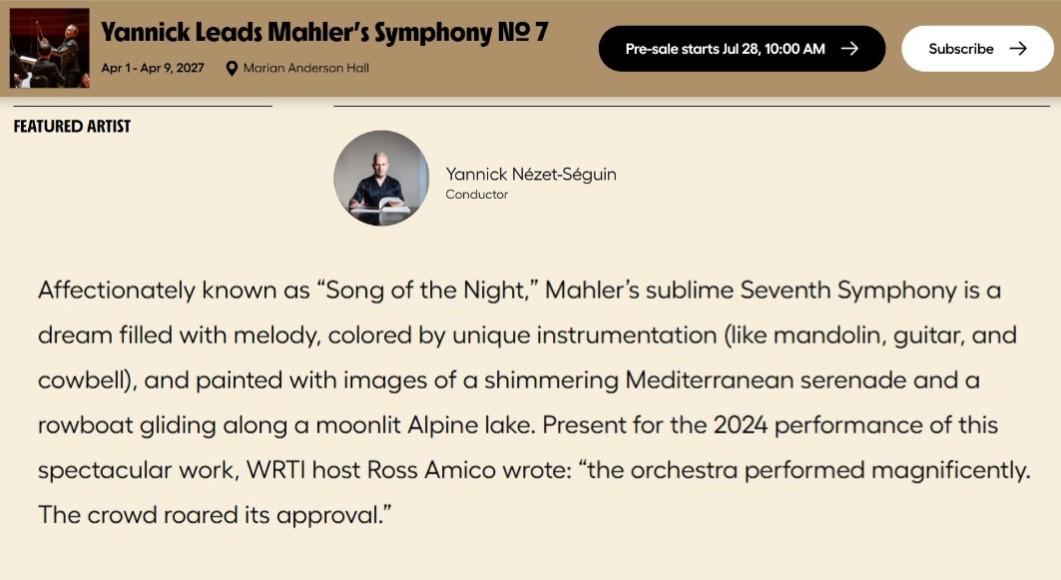
It’s that time of year when performing arts organizations are announcing their 2026-27 seasons. I was tipped off that the Philadelphia Orchestra posted their subscription info the other week, which I glanced through, just to see if there were any big surprises or must-see orchestral juggernauts among the well-tended warhorses. For one thing, I noted that Emanuel Ax will be bringing John Williams’ Piano Concerto, which I’ll be hearing with the New York Philharmonic in a couple of weeks. I also saw Mahler’s 7th Symphony will be back. And why not? Of Mahler’s nine numbered, completed symphonies, it’s not exactly overperformed. However, I did just hear it in Philly a year or two ago. I didn’t read any of the descriptions for any of the works, so it brought a chuckle when a few days later Kenneth Hutchins pointed out that I am actually quoted in the copy used to promote the Mahler!
Always happy to help out a Big Five orchestra…
You’ll find the complete Philadelphia Orchestra 2026-27 season here:
https://philorch.ensembleartsphilly.org/tickets-and-events/events?Title=2026-27
Category: Daily Dispatch
-
“Big Five” Orchestra Quotes Classic Ross Amico
-
Louisiana Purchases on “The Lost Chord”
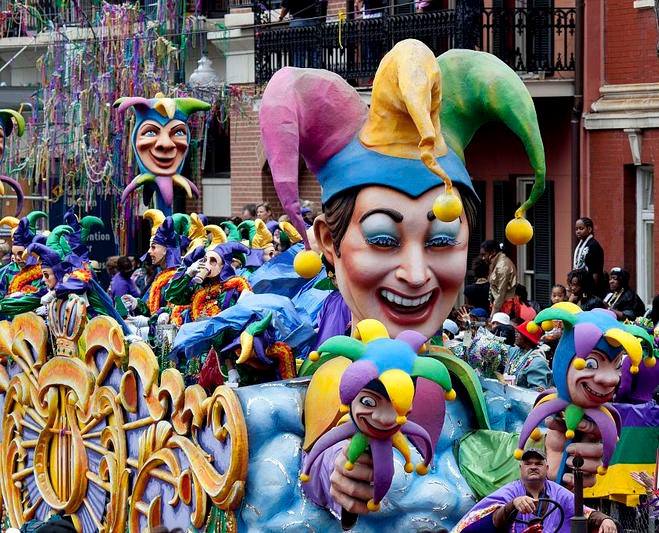
It’s Mardi Gras season! This week on “The Lost Chord,” we’ll adorn ourselves in purple, gold, and green, and carve ourselves some King Cake, as we listen to music from and about New Orleans.
Henry F. Gilbert, a slightly older contemporary of Charles Ives, and a composer of the New England School, was concerned with introducing folk song and the vernacular to the concert hall. His interest in the music of African Americans, then considered controversial, is reflected in works like “The Dance in Place Congo,” from 1908, a programmatic piece on Creole themes, suggestive of Sunday afternoon festivities of off-duty New Orleans slaves gathered in Congo Square.
We’ll also hear a piece by Chicago area composer Edward Joseph Collins, actually titled “Mardi Gras,” from 1923. Collins described the work as “boisterous and bizarre by turns,” evocative of the spirit of Carnival, with its enormous masks and clowns on stilts, colored streamers, confetti, lurid lights, fantastic floats and grotesque costumes.
Three Creole Romantics will offer some insiders’ views, as we hear works by Edmond Dédé, Charles Lucièn Lambert, and Louis Moreau Gottschalk, all figures born in New Orleans.
Laissez les bons temps rouler! I hope you’ll join me for “Louisiana Purchases,” on “The Lost Chord,” now in syndication on KWAX Classical Oregon!
——–
Clip and save the start times for all three of my recorded shows:
PICTURE PERFECT, the movie music show – Friday at 8:00 PM EST/5:00 PM PST
SWEETNESS AND LIGHT, the light music program – Saturday at 11:00 AM EST/8:00 AM PST
THE LOST CHORD, unusual and neglected rep – Saturday at 7:00 PM EST/4:00 PM PST
Stream them, wherever you are, at the link!
https://kwax.uoregon.edu -

Musical Confections for Valentine’s Day on “Sweetness and Light”
This morning on KWAX, it’s flowers and chocolate for breakfast. I’ll do my best to indulge your sweet tooth and lend a serotonin boost with a special Valentine’s Day sampler.
Luxuriate with an assortment of decadent Fritz Kreisler violin bonbons, a suite from Lord Berners’ ballet “Cupid and Psyche,” Victor Herbert’s orchestration of Franz Liszt’s “Liebestraum,” Henry Mancini’s arrangement of Nino Rota’s “Love Theme from Romeo and Juliet,” and some romantic reveries by Gilbert & Sillivan, Charles Ancliffe, and Leonard Bernstein.
Better limber up those lips. It will be an hour of musical confections for Valentine’s Day on “Sweetness and Light,” this Saturday morning at 11:00 EST/8:00 PST. Hear it exclusively on KWAX Classical Oregon!
Stream it, wherever you are, at the link:
https://kwax.uoregon.edu/ -

Metaphorical Big Cats on “Picture Perfect”
Friday the 13th! Beware of ladders, broken mirrors, and… black cats?
Unluckily, metaphorical big cats is the focus this week on “Picture Perfect.”
Simone Simon’s barely repressed desires are made manifest in Val Lewton’s “Cat People” (1942). Lewton was a master of suggestion, with a majority of the horrors in his films imagined, rather than seen. Part of the approach was practical, the result of shoestring budgets imposed by RKO. Whatever the case, the insinuating weirdness undeniably produced psychological chills. In fact, it was only as a concession to the studio that a literal big cat was included at all. The music was by RKO workhorse Roy Webb.
Sean Connery plays a Berber chieftain who faces off against Teddy Roosevelt in “The Wind and the Lion” (1975). In a letter to Roosevelt (played in the film by Brian Keith), Connery’s character writes, “I, like the lion, must stay in my place, while you, like the wind, will never know yours.” Jerry Goldsmith provided one of his best scores for the Moroccan adventure. In fact, he was fairly confident he finally had a lock on the Oscar. He experienced a harsh reality check when he went to see “Jaws.” (Goldsmith would win his only Academy Award the following year for his music to “The Omen.”)
Luchino Visconti’s epic telling of Giuseppe Tomasi di Lampedusa’s “The Leopard” (1963) is a melancholy exploration of the fading Sicilian aristocracy. A bewhiskered Burt Lancaster plays Prince Fabrizio, who feels himself slipping into obsolescence. Nino Rota gives the film a full-blooded, operatic soundtrack, full of lyricism and pathos.
Finally, Lyn Murray provides the breezy accompaniment for Alfred Hitchcock’s “To Catch a Thief” (1955), with Cary Grant a reformed burglar, known as The Cat, who attempts to clear himself of some “copycat” crimes while romancing Grace Kelly on the French Riviera.
We throw salt over our left shoulder and caution to the winds, with an hour of music for metaphorical big cats – any excuse to ignore Valentine’s Day and get “The Wind and the Lion” and “The Leopard” on the same program – on “Picture Perfect,” music for the movies, now in syndication on KWAX Classical Oregon!
——–
Clip and save the start times for all three of my recorded shows:
PICTURE PERFECT, the movie music show – Friday at 8:00 PM EST/5:00 PM PST
SWEETNESS AND LIGHT, the light music program – Saturday at 11:00 AM EST/8:00 AM PST
THE LOST CHORD, unusual and neglected rep – Saturday at 7:00 PM EST/4:00 PM PST
Stream them, wherever you are, at the link!
https://kwax.uoregon.edu -

Lincoln Portrait
Intelligent. Wise. Principled. Empathetic. Compassionate. Honest. Fair. Just. Kind. Courteous. Magnanimous. Visionary. Humble. Articulate. Witty. Corrigible. Hard-working. Courageous. Gracious. Resilient.
Aware of his shortcomings. Strove to improve himself. Assembled “team of rivals” to unify and learn from those with differing viewpoints. Understood leadership and sacrifice. Risked everything to preserve the Union.
16th president of the United States.
Abraham Lincoln was born on this date in 1809. They sure don’t make ‘em like they used to.“Do I not destroy my enemies when I make them my friends?”
———
James Earl Jones in Aaron Copland’s “Lincoln Portrait”
https://www.youtube.com/watch?v=DmfaH5kJv3U
Roy Harris (born on this date in 1898), Symphony No. 6 “Gettysburg”
https://www.youtube.com/watch?v=QJig7H0NJd8&t
Paul Turok, “Variations on an American Song: Aspects of Lincoln and Liberty” – conducted by Leonard Slatkin, newly-designated music director of the Nashville Symphony Orchestra
https://www.youtube.com/watch?v=JoD2TDrZ4Jg
Tag Cloud
Aaron Copland (94) Beethoven (95) Composer (114) Film Music (149) Film Score (143) Film Scores (255) Halloween (98) John Williams (197) KWAX (232) Leonard Bernstein (105) Marlboro Music Festival (125) Movie Music (164) Mozart (91) Opera (215) Philadelphia Orchestra (90) Picture Perfect (174) Princeton Symphony Orchestra (110) Radio (90) Ross Amico (244) Roy's Tie-Dye Sci-Fi Corner (290) The Classical Network (101) The Lost Chord (269) Vaughan Williams (107) WPRB (397) WWFM (881)