This has been floating around Facebook for a few years now, but it was recently forwarded to me by Mather Pfeiffenberger, and it’s still funny. We don’t really know precisely when Girolamo Frescobaldi was born. Some sources state he was baptized on September 9, 1583. Others claim he was born on September 12 or 13. Most just throw up their hands and say mid-September. I don’t claim to be a Frescobaldi scholar, but toss Lurch into the mix and you’ve got comedy gold, with a Deutsche Grammophon golden cartouche, no less. The little cherry on top is the ridiculous specificity. It could have been Bach. It could have been Scarlatti. But for me, the genius lay in the choice of Frescobaldi.
Bard may not have scheduled its upcoming mini-festival of the music of Friedrich Gernsheim as a mea culpa for August’s “Mozart and His World,” but I choose to take it as such. Not that “Mozart and His World” was not a success. Just the opposite! Music director and co-artistic director Leon Botstein announced from the podium that it was the most successful Bard Music Festival ever. But Bard is known for its questing spirit, flipping the monoliths of the standard repertoire to see what lurks beneath. Unquestionably there were plenty of discoveries to be made even with Mozart and his “wolf pack.” But Gernsheim is more in Bard’s wheelhouse.
Who exactly was Gernsheim? I didn’t know myself until I happened to catch one of his symphonies by chance on the radio. And it was an ear-opener! He can sound a bit like Brahms in his colors, but the similarity ends there. His symphonies, anyway (I’ve since acquired recordings of all of them), strike me as sounding more unbuttoned than Brahms’, more polymorphous, which make them less consistent, perhaps, but also more surprising. That said, I hope I’m not falling into the trap of something being more familiar being “better” when I say it doesn’t surprise me that Brahms’ symphonies gained more traction. But isn’t there room in concert programs for both?
Botstein will conduct the young but able performers of The Orchestra Now (TŌN), the graduate training ensemble he founded, in two of Gernsheim’s orchestral works on Friday evening at 7:00 (with the program repeated on Saturday) at the campus’ Fisher Center at Bard: “Zu einem Drama,” a late Romantic tone poem from 1902 (remember, Brahms died in 1897), and the Symphony No. 3, subtitled “Song of Miriam” (or simply “Miriam”), from 1887. The symphony was inspired by a performance Gernsheim had attended of Handel’s “Israel in Egypt,” after which he couldn’t get the Biblical character of Miriam out of his head.
On the second half of the program, Orion Weiss will be the soloist in Brahms’ Piano Concerto No. 2. Yes, Gernsheim and Brahms knew and admired one another.
On Saturday morning at 11:00, across campus at Bard’s Olin Hall, scholars and historians will discuss Gernsheim’s life, music, and legacy.
That will be followed on Saturday afternoon at 1:00 by a concert of the composer’s chamber music, including the Piano Quartet No. 3 and the Piano Quintet No. 2.
To round out the weekend, another chamber concert, Sunday morning at 11:00, will feature the String Quartet No. 2 and the String Quintet No. 2.
The scholarly panel and chamber music concerts are free, though reservations and a donation are encouraged. Seats for the orchestra concerts are reasonably priced.
I should add, the Nazis were not favorably disposed to Gernsheim’s music, because of his Jewish heritage, which may account to some extent for his subsequent neglect. TŌN is to be applauded for its efforts to restore Gernsheim’s reputation in what will be a multi-year project. A lot of this will be new territory for me (I’ve never heard any of the composer’s chamber music), so I am very much looking forward to it. It seems like a good time of year for a weekend or even a day trip to Upstate New York!
The inaugural Gernsheim Festival will be held at Bard College in Annandale-on-Hudson, NY, from Friday, September 18, to Sunday, September 20. For more information, visit:
I once shook the hand of Antonin Dvořák’s grandson. No, really! It was in 2014, at a reception for an exhibit of the manuscript of his grandfather’s “New World” Symphony – the first time the document had been back in the United States since the composer took it with him to Europe when he returned home in 1895.
Dvořák, arguably the most famous Bohemian (now Czech) composer, arrived in New York in 1892 to take up the directorship of the National Conservatory of Music. As an outsider, he was amazed at the unique musical impulses he detected all around him that seemed to go unnoticed by aspiring American composers, who were busy emulating European models.
In particular, Dvořák was fascinated by the Negro spiritual (as it was then identified), thanks in no small part to Harry T. Burleigh, a Black student at the conservatory, who he overheard singing in a corridor adjacent to his office. The exposure to this music struck Dvorak with the force of an epiphany.
Thereafter, Burleigh was a regular guest at the Dvořák home. He frequently sang for the composer and worked as his copyist beginning in 1893.
Reflecting on his own debt to the folk idioms of his native land in the development of a Czech national sound, Dvořák was eager to share his impressions with American composers, and to encourage them to embrace this unique and neglected resource.
“I am now satisfied that the future music of this country must be founded upon what are called Negro melodies,” he wrote. “This must be the real foundation of any serious and original school of composition to be developed in the United States. When I first came here last year I was impressed with this idea and it has developed into a settled conviction. These beautiful and varied themes are the product of the soil. They are American.”
This was quite the pronouncement for 1893.
Spirituals, of course, became an important part of the “New World” Symphony’s DNA. Since Dvořák’s masterwork was intended, in part, as instructional, leading American composers by example to a distinctly national sound, the significance of Burleigh’s influence is inescapable.
Burleigh also served as a double-bassist and timpanist in the school’s orchestra, which Dvořák conducted.
Another one of Dvořák’s students, William Arms Fisher, put words to the melody of the famous slow movement of the “New World” to create a kind of ersatz spiritual, “Goin’ Home.”
The “New World” manuscript was displayed at the Czech Center New York, where guests gathered following a performance of the symphony at Carnegie Hall – where the work was introduced in 1893 – on this occasion, by the Czech Philharmonic conducted by Jiři Bělohlávek. I had a chance to meet Bělohlávek briefly, although I got the impression that his conversational English was not very good. I had the privilege to hear him conduct a few times, though, including Dvořák’s “Rusalka” with Renée Fleming at the Met. I think it was in 2009.
On the occasion of the “New World” display, I wandered into another room, a quieter, more intimate space, where suddenly I was introduced to Dvořák’s grandson, who, if he spoke any English at all, he didn’t let on. But he shook hands firmly and with great mirth. And I’ll be darned if he wasn’t the spitting image of his grandfather and namesake. That was some uncanny valley experience!
Sadly, both Bělohlávek and Antonin Dvořák III died, within days of one another, in 2017.
On Dvořák’s birthday I remember them both, and of course the music of Antonin himself, which I have enjoyed so very much over the years, with great appreciation.
Happy birthday, sir!
———-
Bělohlávek conducts a selection from the “New World” in Prague
For Labor Day, Marc Blitzstein and Orson Welles stick it to the Man – or Mr. Mister, as the case may be – with “The Cradle Will Rock.”
The Philadelphia-born Blitzstein is probably best remembered for two things: for supplying the fine English translation/adaptation of Kurt Weill and Bertolt Brecht’s “The Threepenny Opera;” and for being the composer of this incendiary entertainment.
Not long before “Cradle”s scheduled premiere, on June 16, 1937, the Brechtian, pro-labor musical was shut down by the Works Progress Administration, allegedly due to budget cuts. However, the padlocks on the theatre, the security guards, and the unwillingness to release props or costumes seemed to bolster assertions that the play was censored for being too radical.
One must never toss a bone like that to Orson Welles. Welles turned it into a publicity coup by leading a 21-block march to a much larger theatre, where “The Cradle Will Rock” skirted union restrictions by scrapping the orchestra and having the actors perform their parts from the audience, while Welles and Blitzstein presided from the stage.
The stunt worked so well that the show was able to secure a private backer and all subsequent performances were done in the same manner, with the actors in the audience. The producer, John Houseman, was elated that such a practical solution should prove to be the key to the show’s success.
“There has always been the question of how to produce a labor show so the audience feels like it is a part of the performance,” he commented. “This technique seems to solve that problem and is exactly the right one for this particular piece.”
The success of “The Cradle Will Rock” led Welles and Houseman to form the Mercury Theatre.
But don’t take my word for it. Blitzstein tells the story himself in this reminiscence of the first performance of “The Cradle Will Rock.”
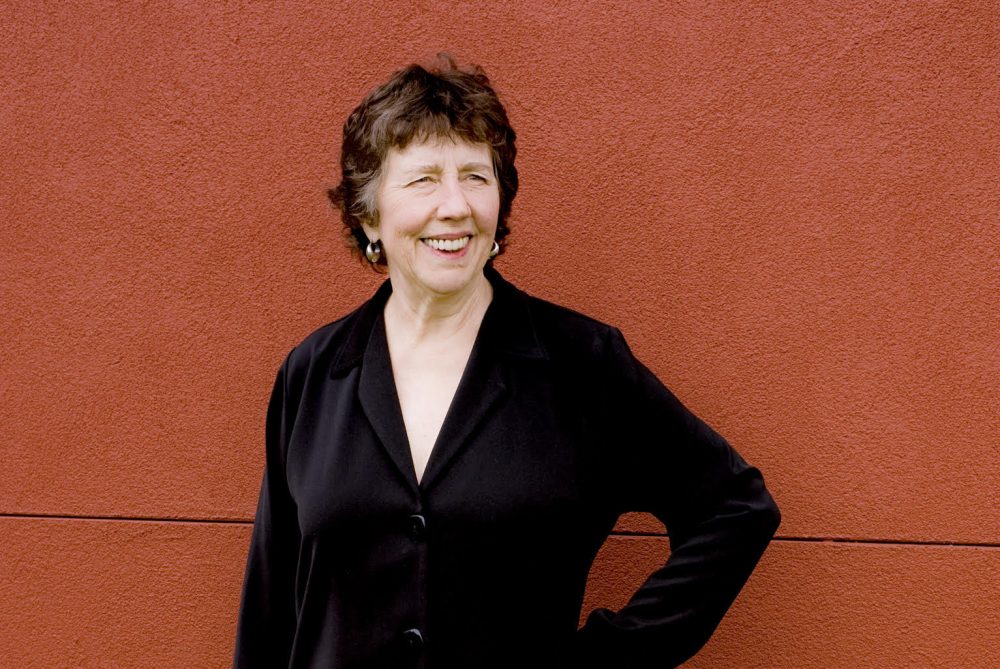
Here’s a good work for Labor Day, to mark Joan Tower’s birthday. However, “Made in America” (2004) really has nothing to do with manufacturing. Rather, it’s a musical appreciation of the United States by a composer who spent many of her formative years (ages 9-18) in Bolivia, where her father managed the tin mines.
Tower describes her inspiration for the work in her program notes:
“I crossed a fairly big bridge at the age of nine when my family moved to South America (La Paz, Bolivia), where we stayed for nine years. I had to learn a new language, a new culture, and how to live at 13,000 feet! It was a lively culture with many saints’ days celebrated through music and dance, but the large Inca population in Bolivia was generally poor and there was little chance of moving up in class or work position. When I returned to the United States, I was proud to have free choices, upward mobility, and the chance to try to become who I wanted to be. I also enjoyed the basic luxuries of an American citizen that we so often take for granted: hot running water, blankets for the cold winters, floors that are not made of dirt, and easy modes of transportation, among many other things. So when I started composing this piece, the song ‘America the Beautiful’ kept coming into my consciousness and eventually became the main theme for the work. The beauty of the song is undeniable and I loved working with it as a musical idea. One can never take for granted, however, the strength of a musical idea – as Beethoven (one of my strongest influences) knew so well. This theme is challenged by other more aggressive and dissonant ideas that keep interrupting, unsettling it, but ‘America the Beautiful’ keeps resurfacing in different guises (some small and tender, others big and magnanimous), as if to say, ‘I’m still here, ever changing, but holding my own.’ A musical struggle is heard throughout the work. Perhaps it was my unconscious reacting to the challenge of how do we keep America beautiful.”
The piece received its first performance in October 2005.
Tower is widely regarded as one of America’s foremost living composers, and is also one of the most successful women in the field.
The Princeton Symphony Orchestra will perform her Suite from Concerto for Orchestra on its season-opening concerts, alongside Rachmaninoff’s “Rhapsody on a Theme of Paganini” (with pianist Dmitry Shishkin) and Bartok’s Concerto for Orchestra (at Princeton University’s Richardson Auditorium, Oct. 17 & 18). For more information, visit princetonsymphony.org.