Tag: Bernard Herrmann

  • Christmas TV Specials Music Spotlight

    Christmas TV Specials Music Spotlight

    This week on “Picture Perfect,” at this most special time of the year, the focus will be on Christmas television specials.

    Keep an ear open for Howard Blake’s music for “The Snowman” (1982), which spawned his most enduring melody, “Walking in the Air;” selections from Jerry Goldsmith’s score for “The Homecoming: A Christmas Story” (1971), which was actually the pilot for the popular television series “The Waltons;” excerpts from an exceedingly rare soundtrack to a musical version of Charles Dickens’ “A Christmas Carol” (1954), with songs and underscore written by Bernard Herrmann; and finally, a sampler from Vince Guaraldi’s immortal music for “A Charlie Brown Christmas” (1965).

    You don’t need me to tell you that it’s going to be special. Join me for music from Christmas television specials, this Friday evening at 6 EST, on WWFM – The Classical Network and at wwfm.org.

  • De Palma’s Thrilling Scores Perfect Music

    De Palma’s Thrilling Scores Perfect Music

    Brian De Palma is an extraordinarily adept filmmaker, who has been criticized for his adherence to what has been perceived in some circles as genre trash. He has always been attracted to suspense and crime thrillers, usually of a particularly violent nature, many of them tinged with horror.

    This week on “Picture Perfect,” with Hallowe’en right around the corner, we’ll hear music from four of De Palma’s films.

    It’s hardly surprising that such an admirer of Alfred Hitchcock would also hire Hitchcock’s signature composer. Bernard Herrmann scored two films for De Palma – the first, “Sisters,” in 1973, and the second, “Obsession,” in 1976.

    “Obsession” is a spin on Hitchcock’s “Vertigo,” with a botched rescue attempt resulting in the death of a businessman’s kidnapped wife, and a seemingly chance encounter, years later, with a woman who is her doppelganger. The film stars Genevieve Bujold, John Lithgow, and a very tan Cliff Roberston.

    “The Fury,” from 1978, based on the novel by John Farris, is a supernatural thriller about two teenagers, endowed with the powers of telekinesis and extra-sensory perception, and the researchers who plan to use them for their own nefarious ends. For a time, Kirk Douglas has fun as a former CIA agent, and John Cassavetes is a particularly slimy villain. Cassavetes’ comeuppance makes for one of the most memorable movie endings of its era – and we’ll leave it at that!

    Critic Pauline Kael praised the music, which is by none other than John Williams – hot off his third Academy Award, for “Star Wars” – characterizing it as “as elegant and delicately varied a score as any horror film has ever had.”

    Of course, “The Fury” was not the first De Palma film to deal with telekinesis. His adaptation of Stephen King’s “Carrie,” from 1976, became one the decade’s landmark horror films. It broadened the popularity of King, whose first novel “Carrie” was, and propelled De Palma into the A-list of Hollywood directors. It also essentially launched the careers of Amy Irving, John Travolta, and Nancy Allen, among others. Sissy Spacek was nominated for an Academy Award for her performance in the title role, as was Piper Laurie as Carrie’s fundamentalist mother.

    The music was by Pino Donaggio. The director had wanted to continue his collaboration with Herrmann, but the composer died before the film could be completed. Donaggio, though classically trained, made his fortune writing popular songs. His biggest hit was “You Don’t Have to Say You Love Me,” as it is known in English. It was recorded by Dusty Springfield, with a well-known cover by Elvis Presley. Donnagio went on to become a regular De Palma collaborator, providing the music for seven of his films.

    Finally, we’ll turn our back on horror, to listen to music from a successful period crime thriller, loosely based on the real-life exploits of Eliot Ness and his fellow prohibition agents, “The Untouchables,” from 1987. Kevin Costner plays the by-the-book FBI agent who is given a valuable lesson in street smarts by an Irish beat cop played by Academy Award winning Sean Connery. (“He pulls a knife, you pull a gun. He sends one of yours to the hospital, you send one of his to the morgue. That’s the Chicago way, and that’s how you get Capone.”) Capone is played, incidentally, by a baseball bat wielding Robert De Niro.

    The score is by Ennio Morricone. Morricone, of course, was propelled to fame through his work on Sergio Leone’s spaghetti westerns. He applies some of that same mythmaking skill to this big screen adaptation, which had previously been published as a memoir and developed into a popular television series starring Robert Stack. The high point of the film must be the director’s nail-biting homage to Sergei Eisenstein, a slow motion shoot-out around a baby carriage as it teeters down the steps of Chicago Union Station.

    I hope you’ll join me for music from the films of Brian De Palma, on “Picture Perfect,” this Friday evening at 6:00 EDT, on WWFM – The Classical Network and at wwfm.org.

  • The Theremin’s Eerie Sound Celebrated

    The Theremin’s Eerie Sound Celebrated

    You all know the sound. That crazy, trilling electronic whistle that dips into a whoop. Or it starts in a trough and shoots up into the super stratosphere. It’s the sound of UFOs and mad science. It’s the sound of the theremin.

    The electronic instrument, invented by Léon Theremin in 1928, is played without physical contact. The proximity of the hands to two antennae determines volume and pitch.

    We’ll experience the instrument’s distinctive, extraterrestrial timbre, as we celebrate the birthday anniversary of Theremin today, by listening to performances by Clara Rockmore and to Bernard Herrmann’s suite from his influential film score for “The Day the Earth Stood Still” (which basically defined the sound of ‘50s science fiction).

    The instrument will be featured as part of a program that will also include birthday celebrations for eclectic Frenchman Jacques Ibert and Afro-English composer Samuel Coleridge-Taylor.

    Continuing with our ongoing salute to Brazil, to tie in with the Olympic Games in Rio, we’ll also hear Herrmann’s recording of Darius Milhaud’s “Saudades do Brasil.” The twelve dances that make up the suite are named for neighborhoods in Rio de Janeiro, where Milhaud lived for nearly two years as attaché to the French ambassador Paul Claudel.

    I hope you’ll join me today, from 4 to 7 p.m. EDT, when we’ll be mad for science and samba on WWFM – The Classical Network and at wwfm.org.


    More about Theremin and Rockmore here:

    http://www.huffingtonpost.com/network-awesome/from-russia-with-love-the_1_b_1384444.html

  • Bernard Herrmann Greatest Film Composer?

    Bernard Herrmann Greatest Film Composer?

    Is Bernard Herrmann the greatest film composer who ever lived?

    I can’t think of a single other composer who had a more assured sense of precisely what sound would perfectly complement a specific onscreen image. Most scores by film composers of Hollywood’s Golden Age were melody driven, and while Herrmann certainly could write a heart-rending melody with the best of them, he seemed to be more interested in timbre. What sounds could he create, no matter how outlandish, that would best convey the experience of fighting a giant crab?

    Only Herrmann would resolve to score a film like “The Day the Earth Stood Still” using two theremins, two Hammond organs, a large studio electric organ, three vibraphones, two glockenspiels, marimba, tam-tam, two bass drums, three sets of timpani, two pianos, celesta, two harps, electric strings and brass. On paper and in execution, it was the height of lunacy. Yet all at once, the theremin became shorthand for 1950s science fiction.

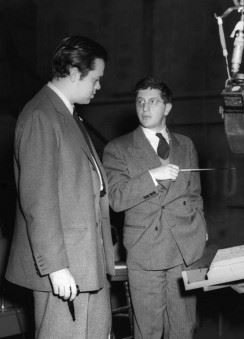
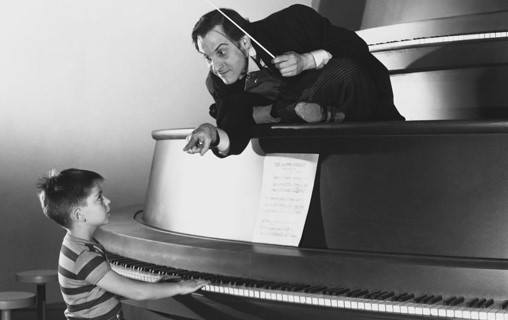
    Despite his stand-apart genius, Herrmann was honored with only a single Academy Award, in 1941 – the same year he followed Orson Welles to Hollywood to write the music for “Citizen Kane” – for “The Devil and Daniel Webster” (also known as “All That Money Can Buy”). He was nominated for his work on “Kane,” and then late in life for the music he wrote for Brian De Palma’s “Obsession” and Martin Scorsese’s “Taxi Driver” (both 1976). He died in his sleep only hours after completing the recording sessions for the latter.

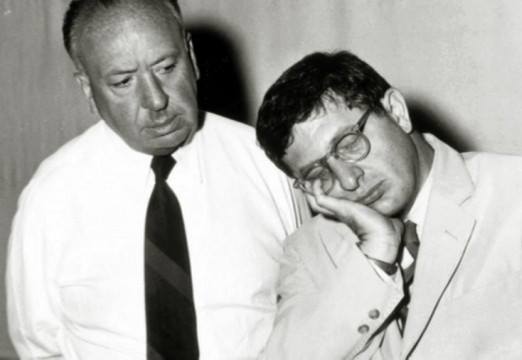
    Yet he left behind dozens of beloved and classic scores for films like “The Magnificent Ambersons,” “Jane Eyre,” “The Ghost and Mrs. Muir,” “The Day the Earth Stood Still,” “The Seventh Voyage of Sinbad,” and “Jason and the Argonauts,” to say nothing of those from his landmark association with Alfred Hitchcock, for films like “North by Northwest,” “Vertigo” and “Psycho.” How could “Psycho” not have received an Academy Award? It wasn’t even nominated!

    Almost certainly the reason for Herrmann’s neglect on the part of the establishment had less to do with his talent than with his prickly personality. He was a notorious crank. Many found him intimidating, but his acerbic behavior made for some great stories. Steven Spielberg, who had recently enjoyed his first great success with “Jaws,” met Herrmann at the recording session for “Taxi Driver.” When the young director expressed his admiration for the veteran composer’s work, the cantankerous Herrmann shot back, “Then why do you always hire John Williams?” He disagreed violently with studio executives and cab drivers alike – in fact seemed to go out of his way to do so – but many also attested to his kindness and warmth in private.

    Curiously, though his concert works have their moments, they don’t grip me from start to finish in a way that certain pieces by fellow film composers Erich Wolfgang Korngold, Miklós Rózsa, and Jerome Moross do. His was a peculiar kind of genius. He was perhaps the greatest film composer who ever lived.

    Happy birthday, Bernard Herrmann (1911-1975)!


    “The Day the Earth Stood Still” (1951):

    “The Ghost and Mrs. Muir” (1947):

    “Jason and the Argonauts” (1963):

    “Psycho” (1960):

  • Lost Worlds Fantasy Film Scores Radio Show

    Lost Worlds Fantasy Film Scores Radio Show

    This week on “Picture Perfect,” prepare to get “lost.” We’ll have an hour of music from fantasy films set in lost worlds.

    In “King Kong” (1933), filmmaker and entrepreneur Carl Denham hires a ship to an uncharted island, known only from a secret map in his possession. There the crew discovers the titular gorilla and other outsized and should-be-extinct creatures. Kong is abducted from his natural habitat – and you know the rest. The composer, Max Steiner, pulls out all the stops. “Kong” was one of the first films to demonstrate how truly powerful an orchestral soundtrack could be.

    Then we travel to the earth’s core, courtesy of Jules Verne, and “Journey to the Center of the Earth” (1959). James Mason is the professor who leads the expedition. The film sports one of Bernard Herrmann’s most outlandish soundscapes, the orchestra consisting of winds, brass and percussion, but also cathedral organ, four electric organs, and an obsolete Renaissance instrument called the serpent. Watch out for that giant chameleon!

    “One Million Years B.C.” (1966) is a guilty pleasure if ever there was one. Produced by Hammer, the studio that gave us all those repugnant yet somehow delicious Peter Cushing-Christopher Lee horror team-ups, the film features special effects by the legendary Ray Harryhausen and an equally legendary fur bikini, worn by Raquel Welch. The music is by Mario Nascimbene, who wrote one of my favorite scores for Kirk Douglas, for “The Vikings.” We’ll be listening to the film’s climactic volcano sequence.

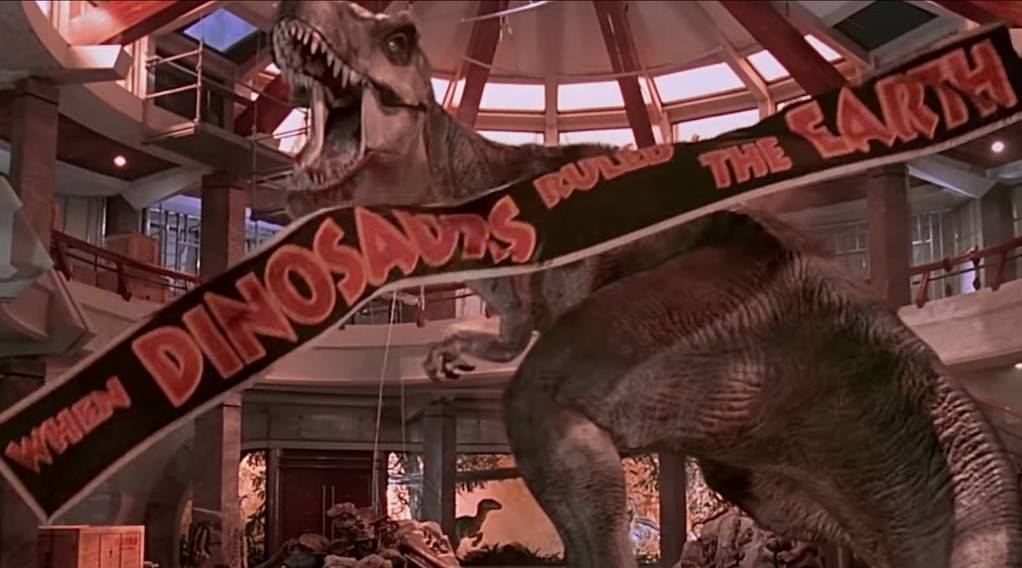
    As he did with the Indiana Jones films, director Steven Spielberg turned to B-movie source material for his visual inspiration for “Jurassic Park” (1993), based on the novel by Michael Crichton. The herky-jerky dinosaur effects of yore are replaced by state of the art computer-generated effects, in the story of a safari park on a remote island gone wrong.

    Sure, we’ve come a long way from Raquel Welch getting carried off by a pteranodon, but admit it, we all still want to see people fight dinosaurs. Instead of fudging history, now we can feel superior by fudging science. “Jurassic Park” plays on the most recent scientific thinking, with DNA extracted from mosquitoes trapped in amber, cloning, and the theory that dinosaurs were not lizards, after all, but rather birds. The music is by long-time Spielberg-collaborator, John Williams.

    I hope you’ll join me for music for these “Lands That Time Forgot,” this Friday evening at 6 EDT, with a repeat Saturday morning at 6; or that you’ll listen to it later as a webcast at wwfm.org.

Tag Cloud

Aaron Copland (92) Beethoven (95) Composer (114) Film Music (123) Film Score (143) Film Scores (255) Halloween (94) John Williams (187) KWAX (229) Leonard Bernstein (101) Marlboro Music Festival (125) Movie Music (138) Opera (202) Philadelphia Orchestra (89) Picture Perfect (174) Princeton Symphony Orchestra (106) Radio (87) Ralph Vaughan Williams (85) Ross Amico (244) Roy's Tie-Dye Sci-Fi Corner (290) The Classical Network (101) The Lost Chord (268) Vaughan Williams (103) WPRB (396) WWFM (881)

DON’T MISS A BEAT

Receive a weekly digest every Sunday at noon by signing up here


RECENT POSTS