Tag: Bernard Herrmann

  • Mythological Movie Music Clash of the Titans & More

    Mythological Movie Music Clash of the Titans & More

    Release the Kraken!

    This week on “Picture Perfect,” it’s a mythological mash-up, with music from four films inspired by classical myths.

    “Helen of Troy” (1956) is based on events recounted in Homer’s “The Iliad.” Like the more recent film, “Troy,” this version glosses over any participation by the gods. Could it be their wrath that caused this Robert Wise-directed spectacle to be plagued with difficulties?

    Reportedly three people were killed during the making of the film, extras were injured by a runaway chariot, and 80 percent of the two-acre recreation of Troy was burned to the ground by a cigarette. On the bright side, it was Bridgette Bardot’s first film made outside of France, and Rossana Podestà played Helen. A spectacle indeed! Max Steiner provided the lush, romantic score.

    “Clash of the Titans” (1981) is not to be confused with the 2010 CGI-fest. This is the real deal, with special effects by legendary stop motion maestro Ray Harryhausen.

    Just as special is its luxury casting of supporting players, including Sir Laurence Olivier as Zeus, and Claire Bloom, Maggie Smith, Sian Phillips, and Ursula Andress as fellow Olympians. Burgess Meredith is among the mortals, Flora Robson turns up in one scene as a witch, and Perseus is played by newcomer Harry Hamlin, soon to find fame on television’s “L.A. Law.”

    The composer, Laurence Rosenthal, studied at the Eastman School and in Paris with Nadia Boulanger. He also wrote the music for “Raisin in the Sun,” “The Miracle Worker,” “Becket,” and the 1977 version of “The Island of Dr. Moreau.”

    “Clash of the Titans” would be Harryhausen’s final film. Despite flashes of his inimitable brilliance, in sequences like the one involving Medusa, and the creation of something of a cultural icon in the Kraken, the effects came to seem a little retro in the wake of “Star Wars” and “Superman.” Though a sequel, “Force of the Trojans,” was pitched to M-G-M, it was not to materialize. Harryhausen died in 2013, at the age of 92.

    It would be a crime against a peplum to put together a program of this sort without at least a nod to Hercules. The peplum genre originated in Italy with Maciste, a supporting character in the 1914 classic “Cabiria.” So powerful did this strongman prove that he became an industry unto himself. The Maciste craze reached its muscular peak in the late ‘50s and early ‘60s. When the films arrived in the United States, in hilariously dubbed versions, the character was invariably renamed Hercules, Samson, Atlas, Goliath, or any other mythological, Biblical, or historical bodybuilder you can think of.

    A peplum revival sprang up around “Conan the Barbarian” in the early 1980s. We’ll hear a selection from “Hercules” (1983), starring Lou Ferrigno, television’s Incredible Hulk. The music was by Pino Donaggio.

    Finally, we’ll make things right again with an extensive suite from the ultimate Ray Harryhausen mythological playground, “Jason and the Argonauts” (1963). This is the one that features the climactic battle with the skeleton army. The music, by Bernard Herrmann, brilliantly suits the visuals. We’ll hear a superb re-recording of the score, on the Intrada label, with the Sinfonia of London, conducted by Bruce Broughton.

    No bones about it, you won’t want to myth it! it’s music from movies (loosely) inspired by classical mythology this week, on “Picture Perfect,” this Friday evening at 6:00 EDT, on WWFM – The Classical Network and wwfm.org.
  • Christmas Music on WWFM Today

    Christmas Music on WWFM Today

    Sunday night’s “The Lost Chord” aside, this afternoon will be my last blast before Christmas. Unfortunately, there is no wintry blast forthcoming from the actual weather. Heat Miser, it seems, has triumphed.

    Be that as it may, we’ll enjoy Bernard Herrmann’s “Currier and Ives Suite,” Philip Lane’s “Three Christmas Pictures,” and “A Musical Sleigh-Ride” by Leopold Mozart,” among others. If those aren’t enough of an enticement, then tune in for the original version of “Jingle Bells,” as it was published in 1857, by James Pierpont. It’s a riot!

    I’ll be wishing you all a Mele Kalikimake, this afternoon from 4 to 6 p.m. EST – “Picture Perfect” follows, with music from Christmas television specials, at 6 – on WWFM – The Classical Network and wwfm.org.
  • Jules Verne Movie Music for Dark Days

    Jules Verne Movie Music for Dark Days

    With a time change imminent (tomorrow night, we fall back) and Election Day right around the corner, we’ll shun the darkness with music from movies inspired by Jules Verne’s novels of science, progress, and adventure.

    We’ll hear evocative selections from four films inspired by Verne’s novels, including “20,000 Leagues Under the Sea” (1954) by Paul J. Smith, “In Search of the Castaways” (1962) by William Alwyn, “Journey to the Center of the Earth” (1959) by Bernard Herrmann, and “Around the World in 80 Days” (1956) by Victor Young.

    Verne takes us to some very strange places, yet manages to overcome all obstacles. Still, it’s always a good idea to bring a harpoon, just in case.

    Grab your gear and climb aboard. It’s music inspired by Jules Verne this week, on “Picture Perfect,” music for the movies, this Friday evening at 6:00 EDT, on WWFM – The Classical Network and wwfm.org.
  • Spooky Comedy Film Scores for Halloween

    Spooky Comedy Film Scores for Halloween

    Spooky comedies. A seeming oxymoron. Perhaps in an attempt to subvert our fears, or to generate laughter from tension, filmmakers have frequently juxtaposed humor with the supernatural – or at any rate death.

    This week on “Picture Perfect,” we’ll conjure some Hallowe’en spirit with music from four macabre comedies.

    Frank Capra’s screen adaptation of “Arsenic and Old Lace” (1944) was actually shot in 1941, but it could not be released until after the hit stage play, by Joseph Kesselring, had concluded its Broadway run.

    The film starred Cary Grant, Priscilla Lane, Raymond Massey, Peter Lorre, Jack Carson, and Capra favorites James Gleason and Edward Everett Horton.

    Two seemingly innocuous spinster aunts poison lonely old men and have them buried in their basement, by a family member who believes that he’s Teddy Roosevelt. (He thinks that he’s digging the Panama Canal.) Massey and Lorre play a murderer on the lam and his plastic surgeon, respectively, who hole up in the house, unaware that Massey’s body count pales next to that of his unwitting hosts.

    The score, by Max Steiner, is as manic as Grant’s performance – perhaps a mite overdone, with its breakneck allusions to familiar melodies – but it bears the same distinctive gloss as other Steiner classics like “Gone With the Wind” and “Casablanca.”

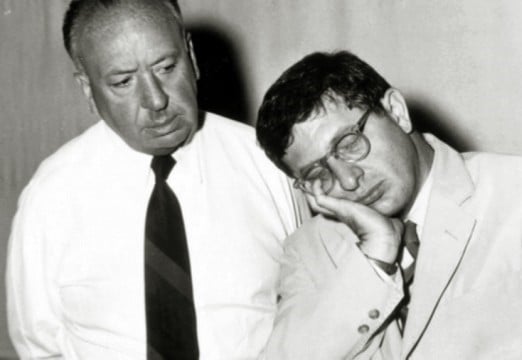
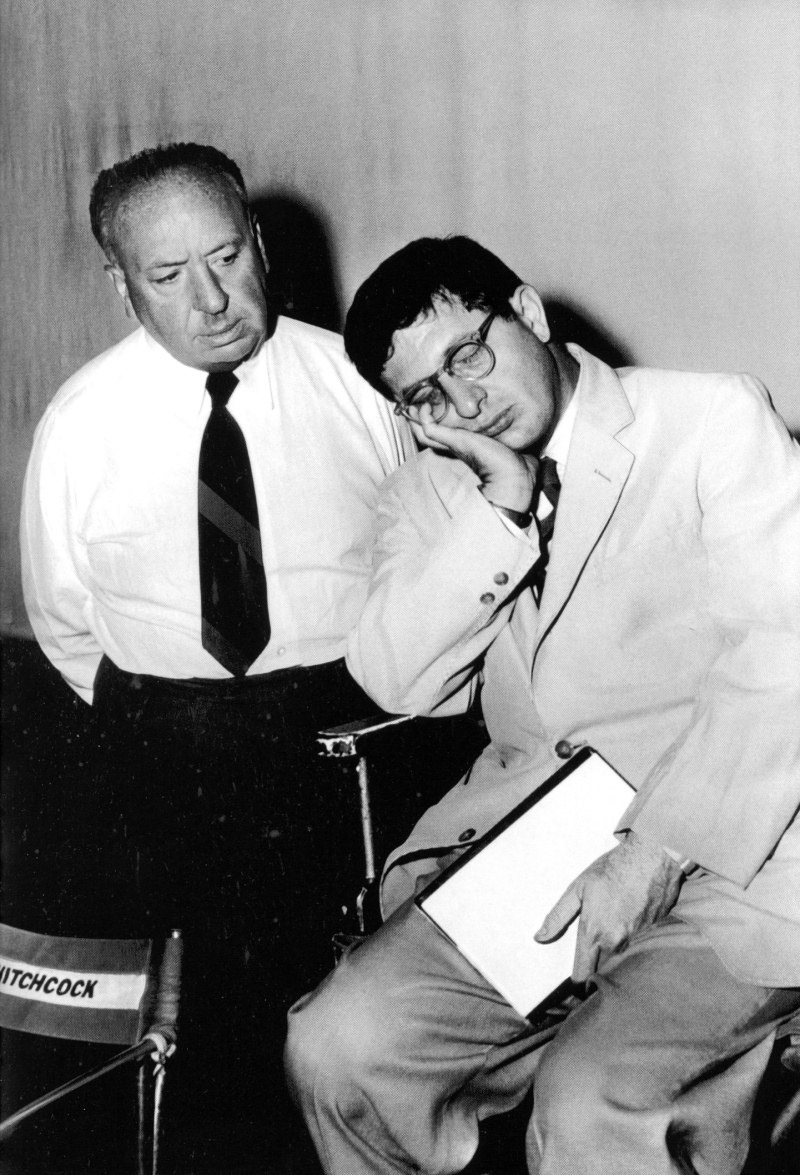
    Composer Bernard Herrmann will always be most closely associated with the films of Alfred Hitchcock. In particular, his music for the shower scene in “Psycho” has entered the popular consciousness as few other film scores have. Hitchcock and Herrmann collaborated on nine films in all. The first of these was a black comedy called “The Trouble with Harry” (1955), a droll farce about a corpse that materializes in a New England community and can’t seem to stay buried.

    Don Knotts and a haunted house – that’s the high concept behind “The Ghost and Mr. Chicken” (1966). How could it possibly miss? Knotts’ elastic-faced terror finds a goofy foil in Vic Mizzy’s score. Mizzy also wrote music for “The Addams Family.”

    Finally, in a kind of twist on “Topper,” Alec Baldwin and Geena Davis play a recently-deceased couple who try to scare off the inhabitants of their former home, in “Beetlejuice” (1988). In desperation, they enlist the services of a manic “bio-exorcist” (a loosy-goosy Michael Keaton) and things get seriously antic.

    The music is by Danny Elfman, as always a fan of Nino Rota, although he also pays homage to the Stravinsky of “The Soldier’s Tale” and frequently alludes to Raymond Scott. There’s even a touch of Bernard Herrmann in one of the tracks, as Elfman evokes the skeleton fight from “The Seventh Voyage of Sinbad.”

    I hope you’ll join me for a mishmash of horror and humor this week, on “Picture Perfect,” music for the movies, this Friday evening at 6:00 EDT, on WWFM – The Classical Network and wwfm.org.
  • Lost Worlds Epic Film Scores Picture Perfect

    Lost Worlds Epic Film Scores Picture Perfect

    This week on “Picture Perfect,” prepare to get “lost.” We’ll have an hour of music from fantasy films set in lost worlds.

    In “King Kong” (1933), filmmaker and entrepreneur Carl Denham hires a ship to an uncharted island, known only from a secret map in his possession. There the crew discovers the titular gorilla and other outsized and should-be-extinct creatures. Kong is abducted from his natural habitat – and you know the rest. The composer, Max Steiner, pulls out all the stops. “Kong” was one of the first films to demonstrate how truly powerful an orchestral soundtrack could be.

    Then we travel to the earth’s core, courtesy of Jules Verne, and “Journey to the Center of the Earth” (1959). James Mason is the professor who leads the expedition. The film sports one of Bernard Herrmann’s most outlandish soundscapes, the orchestra consisting of winds, brass and percussion, but also cathedral organ, four electric organs, and an obsolete Renaissance instrument called the serpent. Watch out for that giant chameleon!

    “One Million Years B.C.” (1966) is a guilty pleasure if ever there was one. Produced by Hammer, the studio that gave us all those repugnant yet somehow delicious Peter Cushing-Christopher Lee horror team-ups, the film features special effects by the legendary Ray Harryhausen and an equally legendary fur bikini, worn by Raquel Welch. The music is by Mario Nascimbene, who wrote one of my favorite scores for Kirk Douglas, for “The Vikings.” We’ll be listening to the film’s climactic volcano sequence.

    As he did with the Indiana Jones films, director Steven Spielberg turned to B-movie source material for his visual inspiration for “Jurassic Park” (1993), based on the novel by Michael Crichton. The herky-jerky dinosaur effects of yore are replaced by state of the art computer-generated effects, in the story of a safari park on a remote island gone wrong.

    Sure, we’ve come a long way from Raquel Welch getting carried off by a pteranodon, but admit it, we all still want to see people fight dinosaurs. Instead of fudging history, now we can feel superior by fudging science. “Jurassic Park” plays on the most recent scientific thinking, with DNA extracted from mosquitoes trapped in amber, cloning, and the theory that dinosaurs were not lizards, after all, but rather birds. The music is by long-time Spielberg-collaborator, John Williams.

    I hope you’ll join me for music for these “Lands That Time Forgot,” this Friday evening at 6:00 EDT, on WWFM – The Classical Network and wwm.org.


    Did anyone else see this story about the 25-foot statue of Jeff Goldblum erected in London this week to celebrate 25 years of “Jurassic Park?”

    https://www.usatoday.com/story/life/entertainthis/2018/07/18/25-foot-statue-jeff-goldblum-london-celebrates-jurassic-park/796609002/

Tag Cloud

Aaron Copland (92) Beethoven (95) Composer (114) Film Music (123) Film Score (143) Film Scores (255) Halloween (94) John Williams (187) KWAX (229) Leonard Bernstein (101) Marlboro Music Festival (125) Movie Music (138) Opera (202) Philadelphia Orchestra (89) Picture Perfect (174) Princeton Symphony Orchestra (106) Radio (87) Ralph Vaughan Williams (85) Ross Amico (244) Roy's Tie-Dye Sci-Fi Corner (290) The Classical Network (101) The Lost Chord (268) Vaughan Williams (103) WPRB (396) WWFM (881)

DON’T MISS A BEAT

Receive a weekly digest every Sunday at noon by signing up here


RECENT POSTS