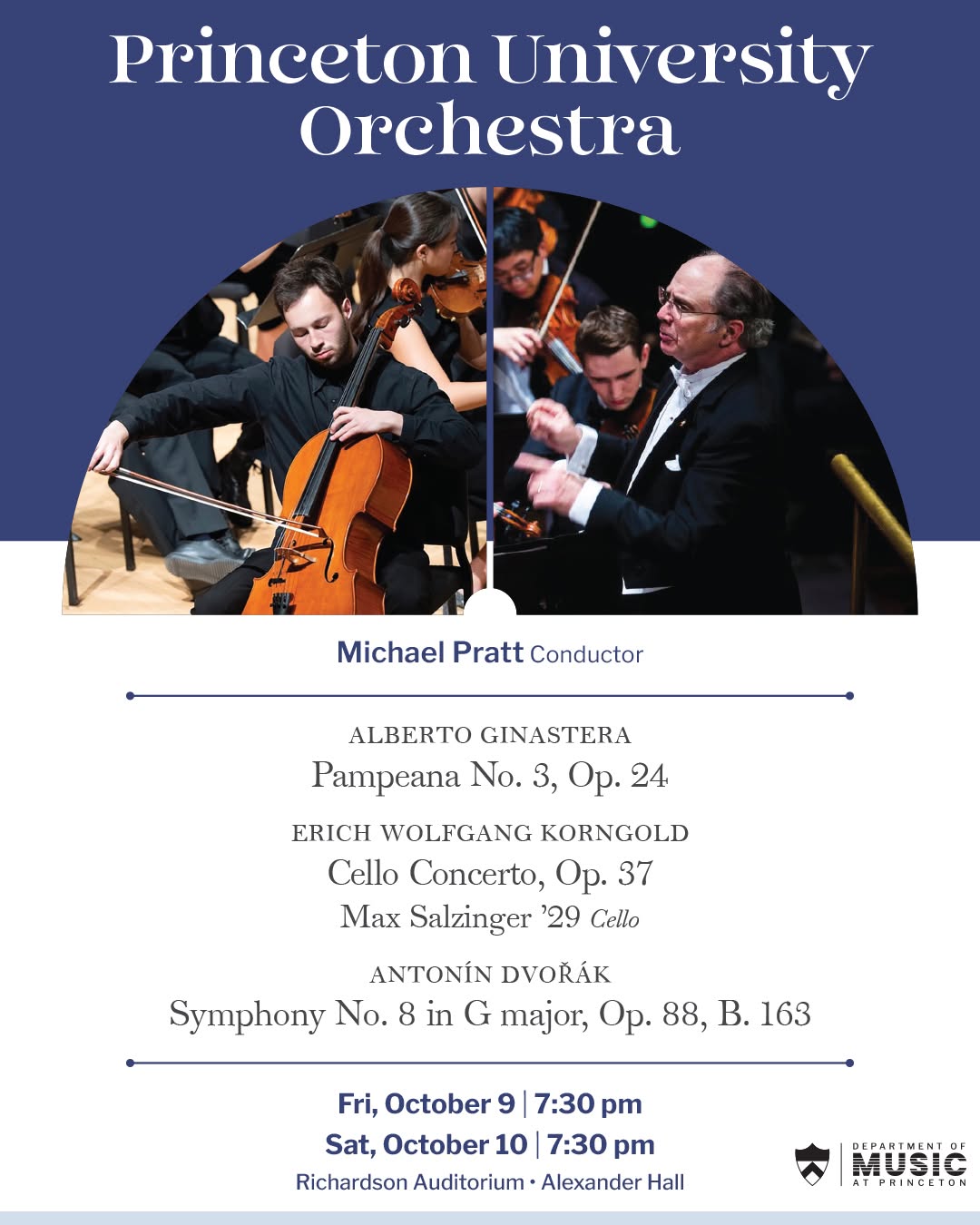
And suddenly, for me, the 2026-27 concert season gets underway. I know performing arts organizations have been busy for the past few weeks, but this weekend is the first that my dance card is on fire. How could I resist this program by the Princeton University Orchestra? Ginastera, Korngold, and my favorite Dvořák symphony!
Conductor Michael Pratt, the orchestra’s music director since 1977, is a genius at getting his students – few of whom are actual music majors (most of them are pursuing degrees in astrophysics, bioengineering, computer science, linguistics, sociology, philosophy, and other pointy-headed Princeton fields) – to play the most demanding repertoire. I’ve heard them perform “Ein Heldenleben,” the complete “Daphnis and Chloé,” several Mahler symphonies, and “The Dream of Gerontius,” among others. They’re always very good, and sometimes they even excel themselves. Furthermore, they play in Princeton’s intimate and historic Richardson Auditorium. Yowzers!
The cello soloist in the Korngold concerto is Max Salzinger (’29), winner of this year’s orchestra concerto competition. Korngold wrote the concerto for the 1946 Bette Davis-Claude Rains music-noir “Deception.” In the film, Paul Henreid (Casablanca’s Victor Laszlo) appears to play the solo part, but really he’s just making facial expressions, as in the closer shots, his hands are actually tied behind his back. Two professional cellists crouch behind him, one of their arms in either sleeve of a specially designed coat to give the actor’s pantomimed performance greater verisimilitude.
The cellist on the film’s soundtrack, the one that’s actually heard, is Eleanor Aller, the wife of Felix Slatkin (concertmaster of the 20th Century Fox studio orchestra and founder of the Hollywood String Quartet) and mother of conductor Leonard Slatkin. She was pregnant with her other son, Frederick Zlotkin, at the time. Zlotkin also grew up to be a professional cellist.
I’ve only ever heard the concerto performed live in concert once before. Naturally, I am very much looking forward to hearing it again, as Korngold is also one of my favorite composers.
Right here in my own backyard, too!
The Princeton University Orchestra program will be presented at Richardson Auditorium on both Friday and Saturday at 7:30 p.m.
For more information, visit:
https://music.princeton.edu/events/2026/princeton-university-orchestra-ginastera-korngold-dvořák
The other night? Why, Dalia Stasevska conducts the Philadelphia Orchestra in Sibelius’ “Pohjola’s Daughter” and Respighi’s “Pines of Rome,” with Gil Shaham the soloist in Saint-Saëns’ Violin Concerto No. 3, at Philadelphia’s Kimmel Center for the Performing Arts. I’m a lucky boy!
Category: Daily Dispatch
-
Korngold in Princeton
-
Exhumed Vampire and Mummy Fiction for Halloween
I’ve been interested in vintage horror and “weird fiction” for nearly half a century, so I thought I knew a thing or two about vampires. Over and over again, I’ve encountered historical surveys or introductions that repeat that the first vampire story in English was a fragment by Lord Byron. This was undertaken to fulfill his part in a wager he proposed, while lounging with his bored Bohemian cohort on Lake Geneva, during the soggy summer of 1816, a contest to concoct the scariest ghost story that also yielded Mary Shelley’s “Frankenstein.” Byron’s fragment was picked up and completed by his physician (also part of the party), John Polidori, who gave us the transparently Byronic Lord Ruthven in “The Vampyre” (1819) – at first believed to have been written by Byron himself.
Then there’s a long gap until the penny dreadful “Varney the Vampire” (published weekly, in serialized form, from 1845-1847); and after that, another quarter century until Sheridan LeFanu’s proto-lesbian vampire novella “Carmilla” (1872); and at the far end of the century, the ne plus ultra of vampire novels, Bram Stoker’s “Dracula” (1897).
As you can see, I had it down. Or so I thought.
Now here I am, hanging onto middle age by my fingernails, only to discover this rich vein of vampire fiction in France. I suppose I failed to take into account that the surveys I was reading were concerned with vampire tales IN ENGLISH. But has it not traditionally been the case, everything being so Anglocentric here in the U.S.? In fact, the books I’m about to consider didn’t even exist in translation until fairly recently.
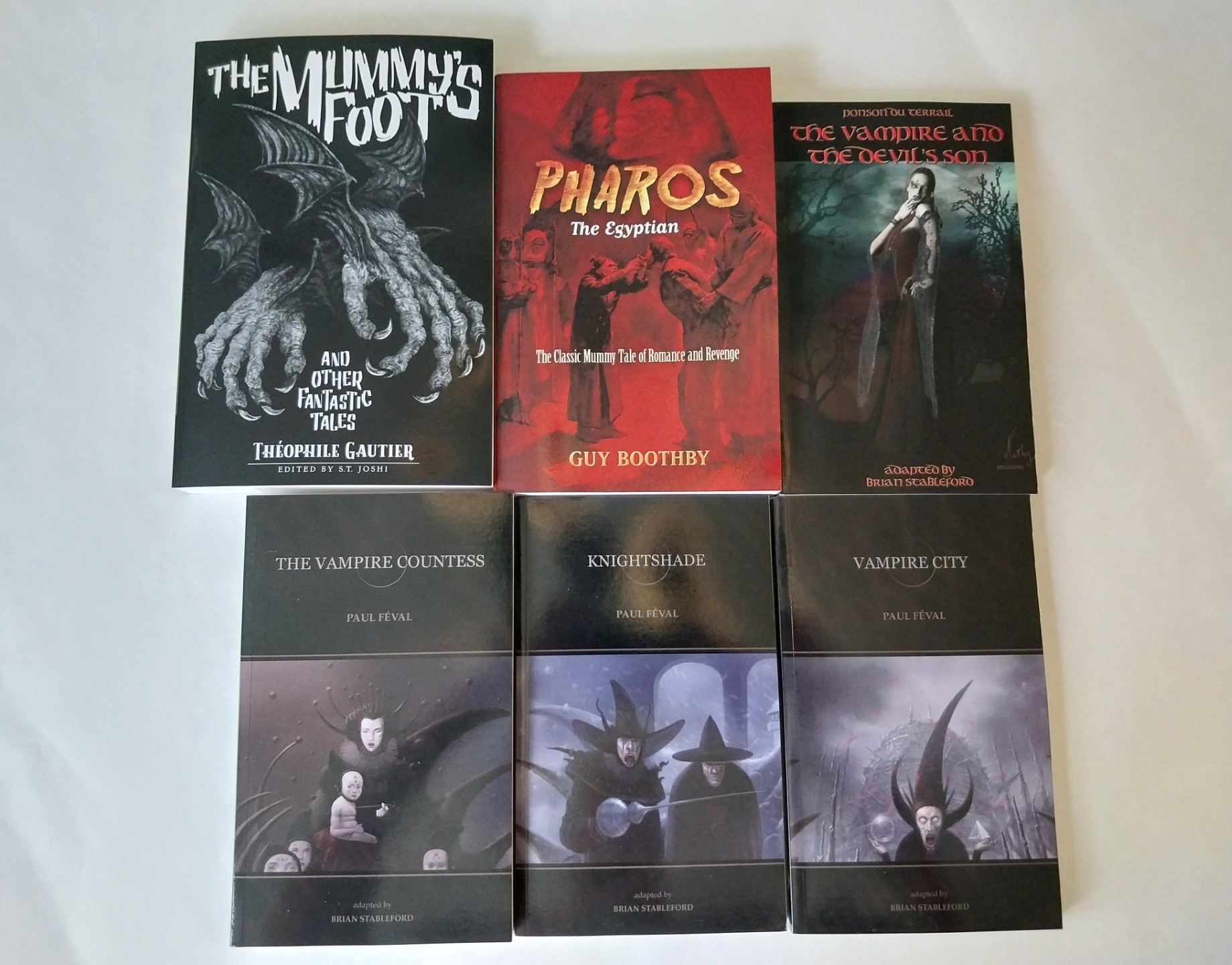
Imagine my surprise and delight to stumble across Paul Féval. Féval was known for his swashbuckling feuilletons (serialized adventure stories), most notably “Les Mystères de Londres” (itself cashing in on Eugène Sue’s “Les Mystères de Paris”), said to be a precursor of “The Count of Monte Cristo.” More to the point, he wrote three vampire novels, published after the same fashion, “Le Chevalier Ténèbre” (1860), “La Vampire” (1865), and “La Ville Vampire” (1874).
I’m going right to the top and starting with the third of his vampire feuilletons, “La Ville Vampire,” or “Vampire City.” From what I understand, this is the one in which the real-life Gothic novelist Ann Radcliffe faces off against the undead as a kind of proto-Buffy the Vampire Slayer.
Alas, Féval came to a bad end. First, he lost his incredible fortune – millions of dollars by today’s reckoning – in a financial scandal involving the Ottoman Empire. He staggered out of the ashes, hoping to reinvent himself by turning over a new leaf. He became the equivalent of a born-again Christian, gave up writing lurid novels, which he now regarded as sinful, and devoted himself to going back and touching up his earlier works in an attempt to smooth over all the objectionable bits. He also began writing novels on Christian themes.
When he was ruined a second time, by an embezzler, he suffered an attack of apoplexy that left him physically and creatively paralyzed. Two years later his wife died, which led to a second attack. He died in 1887 at the age of 70.
Another notable French contributor to the vampire genre was Pierre Alexis, Viscount of Ponson du Terrail (also, by the way, influenced by Radcliffe and Sue). Ponson du Terrail is said to be an important transitional figure in the evolution from old-fashioned Gothic novel to what we now recognize as the modern adventure story – especially in his “Rocambole” series, beginning with “L’Héritage Mystérieux, which features an heroic figure who rises above his apprenticeship to an evil genius to become a fearless champion of good.
The author certainly put his money where his mouth was. Following the surrender of Napoleon III to the Germans during the Franco-Prussian War, Ponson fled Paris to his estate near Orléans to engage in guerilla warfare against the enemy. In the end, he was forced to flee to Bordeaux after the Germans burned down his castle. He died in Bordeaux at 42, leaving his Rocambole saga incomplete.
I owe Brian Stableford and Black Coat Press a bottomless debt of thanks for exhuming a veritable catacomb of French vampire fiction. While I can’t yet vouch for Stableford’s talents as a translator, I am in awe of his drive and tenacity. When he realized so many of these novels were unavailable in English, he undertook to translate all of them himself. He published more than a hundred translations, on top of his hundred or so original novels and countless short stories. For the Black Coat publications, he also provides what promises to be, in light of the novels’ obscurity in the English-speaking world, a lot of helpful information in his introductions and afterwords.
In addition, I notice Stableford has translated and adapted (?) another, earlier Franco-vampire novel, “The Vampire Lord Ruthwen” (1820), spinning off from Polidori, also available from Black Coat Press. I’ll certainly keep it in mind, but I think I’m good with French vampire novels for this year.
https://www.blackcoatpress.com/catalog.html
In the process of boning up on French vampire fiction, I also learned of “La Morte Amoureuse” (1836) by Théophile Gautier, whose racy gender-bending swashbuckler, “Mademoiselle Maupin,” I happened to read in the past 15 years or so. So I picked up this collection, “The Mummy’s Foot and Other Fantastic Tales” – which looks like it’s basically a repackaging of “One of Cleopatra’s Nights and Other Fantastic Romances” (1882), with one or two substitutions of some of Gautier’s other weird fiction, translated by Lafcadio Hearn – now retitled, no doubt to appeal to a more luridly-inclined generation.
For classical music folk, Gautier cowrote the libretto for Adolphe Adam’s ballet “Giselle” and also rubbed shoulders with composers Georges Bizet, Giuseppe Verdi, and Hector Berlioz. Also, Charles Baudelaire dedicated his seminal volume of decadent poetry, “Les Fleurs de mal” (“The Flowers of Evil”) to him.
“The Mummy’s Foot” contains Gautier’s vampire story under its alternate title (after the vamp herself), “Clarimonde.” I just read it last night, and for anyone hankering for a 19th century vampire story on a level with “Carmilla,” it’s totally worth it. Is it a dream? An allegory? A manifestation of the narrator’s psychological state? Or did Clarimonde really exist and the story actually unfold as related? All I can say definitively is that it is one bizarre fever dream.
The book, a trade paperback edited by S.T. Joshi and published by Hippocampus Press, is very well produced, with a glossy cover, good paper, and a solid binding, none of which should be taken for granted in these days when so many independent “publishers” knock off inferior, on-demand reprints of public domain material in their basements. If you’re interested in this sort of fiction, definitely check out the titles in Hippocampus’ “Classics of Gothic Horror Collection.”
https://www.hippocampuspress.com/classics-of-gothic-horror
Of course the mummy story takes the cover, on the assumption that readers still know what mummies are and still associate them with supernatural goings-on. This prompted me to recollect Guy Boothby’s mummy potboiler “Pharos, the Egyptian” (1898), which is said to be closest in spirit to the Boris Karloff movie. It also features an over-the-top supervillain whose exotic cruelty and inexorable evil are said to have played on British imperial anxiety, in much the same way as “Dracula” and H.G. Wells’ “The War of the Worlds” (also 1898) did. There’s no way this fez-wearing stereotype is not going to be offensive to some modern readers, but you know I am going to lap it up, because I’m a grown-up, and I know right from wrong, and I understand historical context, and I know it’s just fantasy. I can’t wait to give it a whirl.
My copy was issued by Dover Publications, which has been making novels of this sort available more consistently than anyone else for more than 60 years, thanks to the editorial guidance of E.F. Bleiler. How I wish I could shake that man’s hand. (Bleiler died in 2010.) The company went bankrupt in 2020, but was purchased by Atlas Holdings, and the catalog remains available.
https://store.doverpublications.com/products/9780486803159?_pos=1&_sid=e34be0538&_ss=r
Who knows how many of these volumes of forgotten lore I’ll be able to wade through this month? Probably not many. There’s certainly plenty here to keep me entertained through November, and likely over the winter months, if not to be resurrected next year.
How about you? Reading anything to raise a shiver? As the days grow short, October, November, and December are prime ghost story season (if we’re to follow Dickens and M.R. James to Christmas). Hell, I’ll even throw January into the bargain. Why not?
Happy reading, everyone, and happy Halloween! -

Canticle to St. Francis
As an animal lover, I’ve always had a soft spot for St. Francis of Assisi. (Also, I was fortunate enough to visit his hometown before the devastating earthquakes of 1997.)
Today is Saint Francis’ feast day. This is a saint who was never too busy to chat with the birds or to befriend a wolf. He introduced the crèche to Christmas, complete with livestock. He even lobbied for a special law so that people would provide for the birds and the beasts. How could you not love this guy?
Regardless of one’s creed, no one, I should think, would take umbrage at the idea of love and respect for the natural world. Take a moment today to be kind to the animals. Hug your pet. Water the birds. Let a cricket out of the house. Bless all animals! Then enjoy some of the music below, only a fraction of the music inspired by St. Francis.———-
Franz Liszt’s “Saint Francis of Assisi Preaching to the Birds” (piano)
Liszt’s “Saint Francis of Assisi Preaching to the Birds” (orchestra)
Francis Poulenc’s “Quatre petites prières de saint François d’Assise”
Paul Hindemith’s “Nobilissima Visione” (suite, conducted by the composer)
Hindemith’s “Nobilissima Visione” (rarely-heard complete version)
Leo Sowerby’s “Canticle of the Sun” (1946 Pulitzer Prize winner)
Kenneth Fuchs’ “Canticle to the Sun” for French horn and orchestra
More about the 1997 quake that damaged Assisi’s St. Francis Basilica
https://www.italyonthisday.com/2017/09/st-francis-basilica-struck-by-earthquake.html -

All About Steve (Reich) on “The Lost Chord”
There’s no minimizing the fact that Steve Reich is 90 years old today.
Reich, of course, is best known as a pioneer of minimalism, his music marked by repetitive figures, slow harmonic rhythm, and canons. He’s also notable for his experiments with phase shifting, one or more repeated phrases playing slower or faster against others, gradually going “out of phase,” and creating new musical patterns.
His use of tape loops has also been influential. He’s made his mark especially on experimental music, contemporary electronic music, and rock. In fact, his experiments have been so widely respected and emulated that he’s been one of the most significant American composers of his generation.
I hope you’ll join me this week for “The Lost Chord,” as we celebrate Reich’s birthday by listening to two of his works.
First, we’ll hear his Pulitzer Prize winner from 2007, “Double Sextet,” commissioned by the ensemble eighth blackbird – despite its name (always in the lower case) consisting of six musicians, here playing against a slightly different prerecording of themselves. I defy you not to groove to the propulsive outer sections.
We’ll follow that with his settings of four Hebrew psalms, “Tehillim,” which sports a quite a distinctive palette: four treble voices, piccolo, flute, oboe, English horn, two clarinets, six percussionists (playing 4 small tuned tambourines without jingles, maracas, marimba, vibraphone and crotales, and clapping), two electronic organs, two violins, viola, cello, and bass. This is one work that proves you can be “minimal” but still engage the ear for half an hour.
Minimal music yields maximum rewards on “All About Steve,” celebrating Steve Reich at 90 on “The Lost Chord,” today on KWAX Classical Oregon!———-
Clip and save the start times for all three of my recorded shows:
PICTURE PERFECT, the movie music show – Friday at 8:00 PM EDT/5:00 PM PDT
SWEETNESS AND LIGHT, the light music program – Saturday at 11:00 AM EDT/8:00 AM PDT (***now with a repeat Sunday at 9:00 PM EDT/6:00 PM PDT***)
THE LOST CHORD, unusual and neglected rep – Saturday at 7:00 PM EDT/4:00 PM PDT
Stream them, wherever you are, at the link
-
Barley and the Grape on “Sweetness and Light”
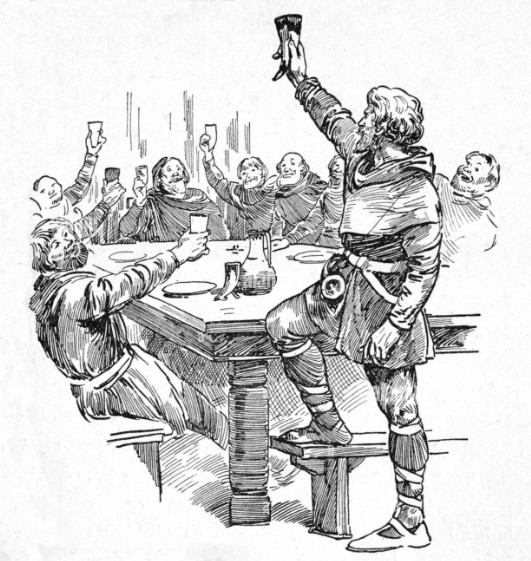
Raise your steins and goblets! “Sweetness and Light” can now be heard twice a week! If you miss the Saturday morning broadcast, pop on by on Sunday evening for a recap – or in the case of this week’s program, a nightcap. In this season of the harvest and Oktoberfest, we’ll roll out the barrels for a salute to BARLEY AND THE GRAPE.
When lyrics were added to the best-known polka of Czech composer Jaromir Vejvoda, it also became perhaps the most famous Czech song. Originally conceived as the “Modřanská Polka” – or “Polka of Modřany” – with words it took on a new life as “Škoda lásky” (“Unrequited Love”). It was also a hit in Germany as “Rosamunde.” World-wide popularity ensued, as soldiers adopted it as a drinking song during World War II and introduced it at home as the “Beer Barrel Polka.” We’ll Czech it out around the midpoint of the program.
The hour will also include the “Revelry Overture” by Montague Phillips and Leopold Godowsky’s “Symphonic Metamorphosis on ‘Wine, Women and Song’” after Johann Strauss II. We’ll hoist our kantharoi to celebrate the god of wine and carouse to ballet music from Jules Massenet’s opera “Bacchus” and the “Procession of Bacchus” from Léo Delibes’ ballet “Sylvia.”
We’ll also quaff to drinking songs by Reginald De Koven (“Brown October Ale” from the comic opera “Robin Hood”) and Henry Purcell (himself a casualty of one too many pub-crawls).
We’ve a powerful thirst for BARLEY AND THE GRAPE on “Sweetness and Light.” The taps are open, this Saturday morning at 11:00 EDT/8:00 PDT – NOW WITH A REPEAT, Sunday evening at 9:00 EDT/6:00 PDT – exclusively on KWAX Classical Oregon!
Stream it wherever you are at the link:
https://kwax.uoregon.edu/
Tag Cloud
Aaron Copland (94) Beethoven (95) Composer (114) Film Music (148) Film Score (143) Film Scores (255) Halloween (97) John Williams (196) KWAX (232) Leonard Bernstein (105) Marlboro Music Festival (125) Movie Music (163) Mozart (91) Opera (215) Philadelphia Orchestra (90) Picture Perfect (174) Princeton Symphony Orchestra (110) Radio (90) Ross Amico (244) Roy's Tie-Dye Sci-Fi Corner (290) The Classical Network (101) The Lost Chord (269) Vaughan Williams (107) WPRB (397) WWFM (881)