Tag: Franz Liszt

  • Happy Feast Day Saint Francis of Assisi

    Happy Feast Day Saint Francis of Assisi

    Today is the Feast Day of Saint Francis of Assisi.

    If saints are your thing, you‘d be hard pressed to find one more beloved than St. Francis – unless you’ve misplaced your car keys, in which case St. Anthony is your man. I count myself fortunate in that I was able to visit Francis’ hometown before the devastating earthquakes of 1997.

    Be sure to take a moment today to kiss your pet. Bless all animals! Then enjoy some of the music below.


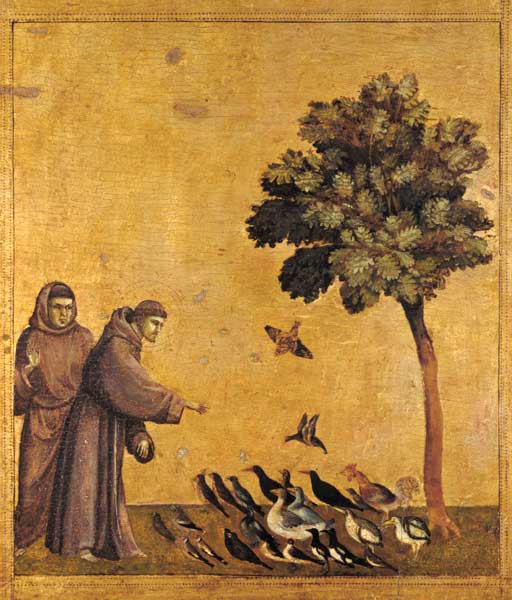
    Franz Liszt’s “Saint Francis of Assisi Preaching to the Birds” (piano)

    Liszt’s “Saint Francis of Assisi Preaching to the Birds” (orchestra)

    Francis Poulenc’s “Quatre petites prières de saint François d’Assise”

    Paul Hindemith’s “Nobilissima Visione” (suite, conducted by the composer)

    Hindemith’s “Nobilissima Visione” (rarely-heard complete version)

  • Alexandre Dumas Music on The Lost Chord

    Alexandre Dumas Music on The Lost Chord

    He is best known as the author of “The Three Musketeers” and “The Count of Monte Cristo.” However, Alexandre Dumas churned out historically-inspired prose on all manner of subjects, and he did so by the yard.

    This Sunday night on “The Lost Chord,” we present an hour of music inspired by his works, including rarely-heard incidental music, written for a revival of the play, “Caligula,” by Gabriel Fauré; ballet music from an opera, “Ascanio,” taken from a novel featuring Benvenuto Cellini, by Camille Saint-Saëns; and a poetic monologue, “Joan of Arc at the Stake,” by Franz Liszt. We’ll also hear the suite for symphonic band, “The Three Musketeers,” by George Wiliam Hespe.

    I hope you’ll join me for “The Lost Sword.” It’s all for one, and one for all, this Sunday night at 10:00 EDT, on WWFM – The Classical Network and wwfm.org.

  • Liszt the Saint Composer’s Sacred Side

    Liszt the Saint Composer’s Sacred Side

    While the adjective “diabolical” could be applied to Franz Liszt, both in terms of his prowess as a pianist and as a ladies’ man, its application might be justified, really, by only two aspects of his outsized personality.

    Liszt was an especially complex individual, marked by much nobility of character. He was a generous human being, a humanitarian, and an all-around nice guy. He was also quite devout. It was his intention to marry his long-time companion, the Princess Carolyne zu Sayn-Wittgenstein, on his 50th birthday, but his hopes were dashed, after the Church refused to grant her an annulment (she had been estranged from her husband long before she met the handsome touring virtuoso). He reacted by taking minor orders and living in a monastic cell in Rome, where he became known as the Abbé Liszt. (He had also recently lost two of his three children born to him by Marie d’Agoult.)

    Liszt’s religiosity was not something he wore lightly. From an early age, he felt certain he would be a musician or a priest. In the end, he became both.

    This Sunday night on “The Lost Chord,” we’ll sample from two of at least seven of Liszt’s works inspired by his fascination with the saints – “The Legend of St. Elisabeth” and “St. Stanislaus.” St. Elisabeth was the Hungarian princess much concerned with the welfare of the poor, and St. Stanislaus is the patron saint of Poland. These are the subjects of Liszt’s first and last oratorios.

    I hope you’ll join me for “Liszt of Saints,” this Sunday night at 10:00 EDT, on WWFM – The Classical Network and wwfm.org.

  • Liszt’s Diabolical Dances Temptation & Piano Fire

    Liszt’s Diabolical Dances Temptation & Piano Fire

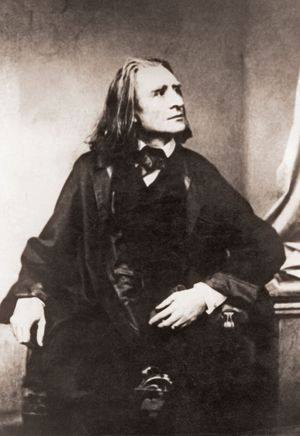
    Franz Liszt (1811-1886) was quite the complex personality. He was a devout Catholic his entire life, even taking minor orders and living in a monastery for a few years at middle age. However, as one of the performer-superstars of his youth, he was also frequently tempted by the pleasures of the flesh. And, as Oscar Wilde observed, “The only way to get rid of temptation is to yield to it.”

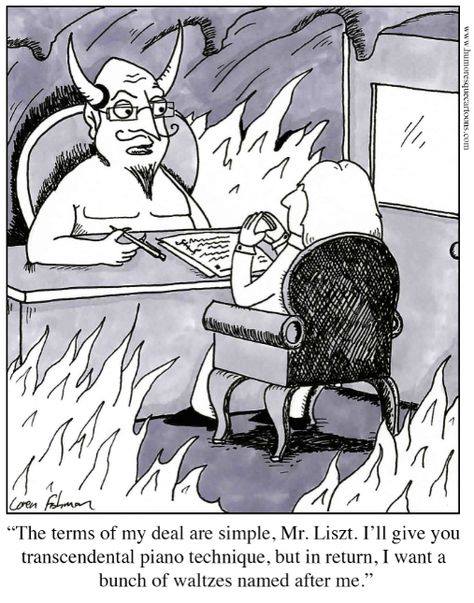
    Like many artists of the Romantic era, Liszt was consumed by the supernatural allure and philosophical wranglings of Goethe’s “Faust.” Perhaps something in the Faustian character appealed to him more than most. In his pursuit of loftier ideals, Liszt was certainly aware of his feet of clay. This Sunday night on “The Lost Chord,” we’ll examine the tension between striving artist and earthly pleasures through an hour of Liszt’s diabolical dances.

    We’ll sample from his “Mephisto Waltzes” (all except the first, which is so very well known); also, a “Mephisto Polka,” the “Czardas Macabre,” and a couple of operatic paraphrases, on “Robert le Diable” (treated as a “valse infernale”) and the waltz from Gounod’s “Faust.”

    Some of these are straight-ahead knuckle-busters, full of hair-raising keyboard acrobatics; others aim to gently unsettle, employing the interval of a tritone – known for centuries as “the devil in music” – or blurring into a kind of tonal ambiguity that foreshadows some of the experimental music of the 20th century.

    Liszt, a profound thinker and a grand provocateur, was always questing. That said, he seldom undersold the visceral thrill of a precipitous piano run or the simple pleasure of a good tune.

    Get ready to surrender to temptation with “A Fistful of Mephistos” – an hour diabolical dances by Franz Liszt, on his birthday – this Sunday night at 10:00 EDT, on WWFM – The Classical Network and wwfm.org.

  • Liszt vs Thalberg Epic Piano Duel in Paris

    Liszt vs Thalberg Epic Piano Duel in Paris

    Paris of the 1830s was teeming with superstar pianists, who drifted from recital to salon with the mystique and grace of cinematic gunslingers. On this date in 1837, the two most mythologized virtuosi of the day, Franz Liszt and Sigismond Thalberg, were brought together at the home of Princess Cristina Belgiojoso-Trivulzio, an Italian patriot living in exile, to prove once and for all who was the King of the Keys.

    The duel would prove to be a clash of styles and temperaments. In contrast to Liszt’s humble beginnings and acquired polish, Thalberg was an aristocrat by association, having been taking under the wing of a wealthy patroness very early on. A large part of his allure was in his unruffled appearance. He was handsome, educated, genteel. At the piano, he remained absolutely placid, sitting as still as possible while performing the most incredible, acrobatic feats. One of his much remarked upon, crowd-pleasing techniques was his ability to simulate three hands, which he was able to accomplish by picking out a melody with his thumbs and using the rest of his digits to ornament with brilliant arpeggios and arabesques. Matters of showmanship aside, his legato was of such beauty that even Liszt commented, “Thalberg is the only artist who can play the violin on the piano.”

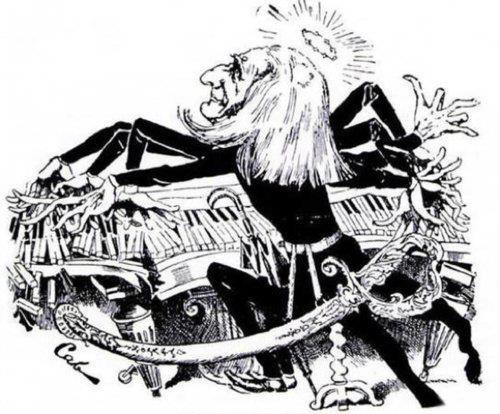
    Liszt, by contrast, was a fire-eater, who would literally destroy pianos on the stage of the Paris Opera before an audience of 3000. His playing had ladies clawing at one another to retrieve a glove or a cigar “carelessly” left behind after a concert.

    Partisans and newspaper critics long speculated on who was the greater pianist. The flame of animosity was fanned by rival journalists, as Hector Berlioz (who embraced Liszt) and critic and musicologist Francois-Joseph Fetis (who championed Thalberg) played out their most recent grudge match, polarizing music-lovers into two camps.

    As the debate grew in intensity, it seemed whenever one was in town, the other was on tour or vacationing. It all finally came to a head on the morning of March 31, 1837, at Belgiojoso-Trivulzio’s salon, in a war of the gargantuas engineered for charity. March definitely went out like a lion that year, as two titans of the keyboard faced off in the ultimate piano showdown.

    The verdict was diplomatic: Thalberg was proclaimed the finest pianist in the world; Liszt, the ONLY pianist.

    Popular tradition holds that Liszt mopped the floor with Thalberg, but apparently this wasn’t entirely the case. Nor was there any apparent animosity between the two men, who were cordial and even dined together several times after their legendary face-off. The two would collaborate, along with Chopin and three others, on one of Belgiojoso’s other schemes, the keyboard crazy quilt “Hexameron,” which Liszt titled, orchestrated, and toured with. Proceeds generated from both the duel and the “Hexameron” project went to the benefit of Italian refugees.

    An ironic epilogue to this story is that Thalberg’s final resting place, in Naples, was desecrated earlier this month, with his mummified corpse tossed callously into the corner of a vault. You can wade through a dizzying array of fonts and italics to learn more here:

    http://unravelingmusicalmyths.blogspot.com/2017/03/a-neapolitan-nightmare-virtuoso-pianist.html

Tag Cloud

Aaron Copland (92) Beethoven (95) Composer (114) Film Music (123) Film Score (143) Film Scores (255) Halloween (94) John Williams (187) KWAX (229) Leonard Bernstein (101) Marlboro Music Festival (125) Movie Music (138) Opera (202) Philadelphia Orchestra (89) Picture Perfect (174) Princeton Symphony Orchestra (106) Radio (87) Ralph Vaughan Williams (85) Ross Amico (244) Roy's Tie-Dye Sci-Fi Corner (290) The Classical Network (101) The Lost Chord (268) Vaughan Williams (103) WPRB (396) WWFM (881)

DON’T MISS A BEAT

Receive a weekly digest every Sunday at noon by signing up here


RECENT POSTS